

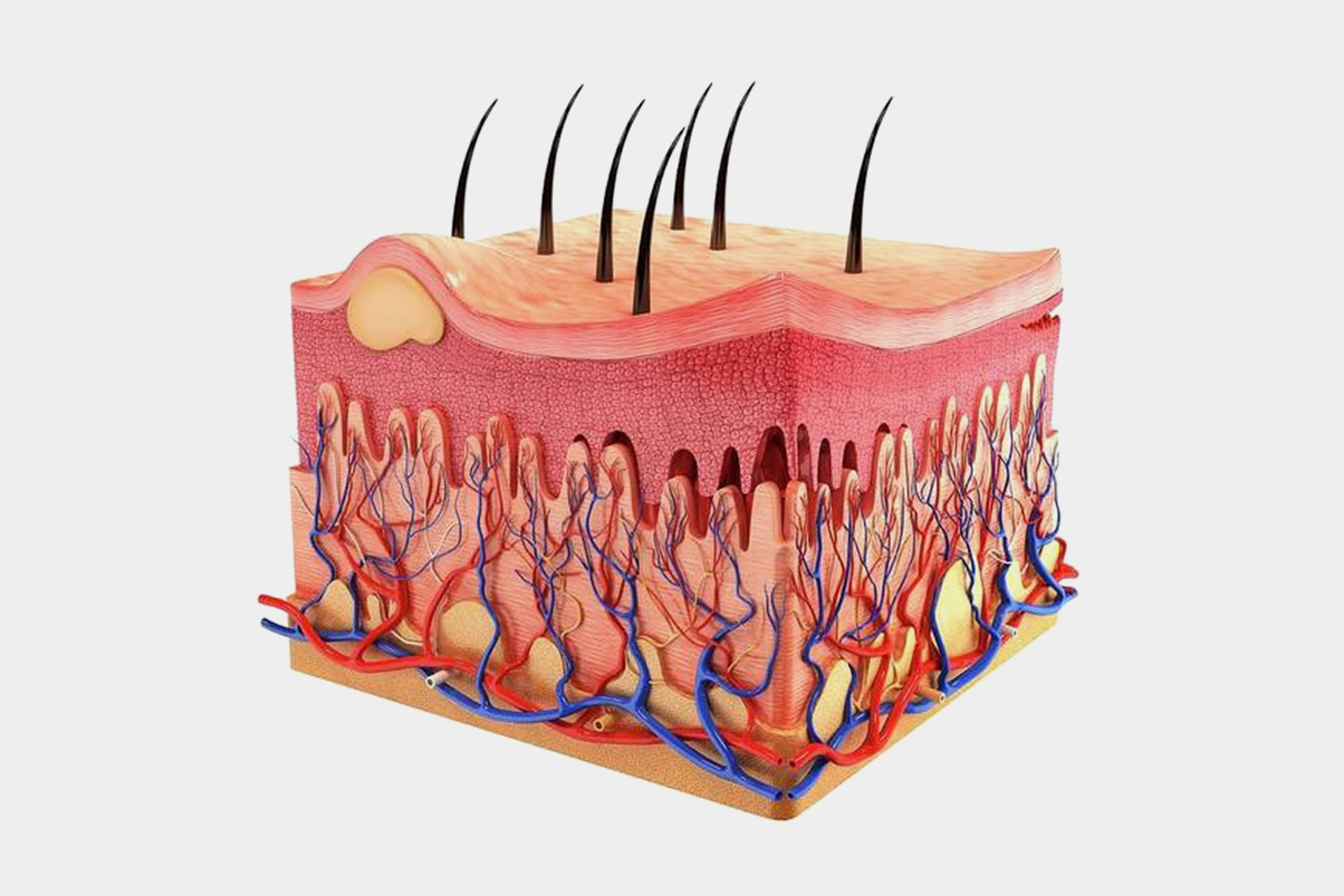
Researchers were able to print gel containing live cells with 3D printing technology and convert it into cultivated skin, and this technique may lead to new ways to treat extreme burns and wounds.
The study was conducted by researchers from the Disaster and Shock Medicine Center and the University of Linakoping in Sweden, and its results were published in the Advanced Healted Mateials Journal, and the Yurrick Alert website was written about.
The skin protects the body from the outside world, so helping the body restore the skin barrier after dangerous burns may be a matter of life or death.
It is often treated by large burns by planting a thin layer of the top of the skin, called the skin, this layer consists mainly of one type of cell, and the transplant of this part only leads to severe scars.
Under the skin there is a thicker and developed skin layer called the dermis. This layer contains blood vessels, nerves, hair follicles and other structures necessary for the function of the skin and its elasticity, but the dermis transplantation is also rarely a available option, because the process leaves a large wound.
A trick to solve the problem
The trick lies in the making of a new leather that does not turn into a scar tissue, but rather to a working dermis. “The dermis is so complicated that we cannot cultivate it in the laboratory, we do not even know its components, for this reason we, and many others believe that it is possible to plant its basic ingredients and then let the body produce the dermis by itself,” says Johan Jonker, a researcher at the Swedish Center for Disaster and Shock Medicine, and a professor of plastic surgery at the University of Lincoping, who led the study.
The connective tissue or fibrous cells are the most common types of cells in the dermis, and are easy to remove from the body and cultivate it in the laboratory. The connective tissue cells are also distinguished by their ability to develop into more specialized cells as needed.
The researchers provided a cell to grow on the granules of small porous gelatin, a leather collagen -like substance, but the liquid that contains these granules does not remain in place.
The researchers mixed gelatin granules with a gel consisting of another substance for the body to solve the problem, which is hyaluronic acid, and when mixing granules and gels they are connected to using what is known as clicking chemistry, and the resulting gel can be called “skin in an injection”.
“The gel is characterized by a feature of turning it into a liquid when it is subjected to light pressure. For example, you can use a syringe to apply it to the wound, and once applied it is due to its gelatinous shape. This also allows the printing of the 3D gel with the cells in it,” says Daniel Ili, Professor of Molecular Physics at Linchoping University, who led the study with Johann Jonker.
Erroma building
The results indicate the possibility of using this technique to develop the patient’s cells itself from a small skin biopsy, then prints three -dimensional in a taste and placed on the wound.
“We note that the cells remain alive, and it is clear that they produce various substances necessary to form a new dermis. In addition, the blood vessels are formed in the bait, which is important for the tissues to remain in the body,” says Johan Junker.
The blood vessels are essential for a variety of tissue -like engineering applications, and scientists can develop cells in 3D materials used to build orbits, i.e. mini -copies of the organs, but there is an obstacle facing these textile models; It lacks the blood vessels needed to transport oxygen and nutrients to cells, and this means that there is a maximum limit for the size of these structures before cell death in the center due to lack of oxygen and nutrients.
Researchers may be the closest step to solve the problem of blood vessels supply. In another research, researchers described a way to make threads of materials consisting of 98% water, known as water gels.
Daniel Ili says that the aquatic gel strands “become very flexible, allowing us to connect a contract on it, and can also be formed in the form of small tubes, we can pump fluids through them or make the blood vessels cell grow in it.”
These small tubes, or flow canals, as researchers call them new horizons for the development of blood vessels.