

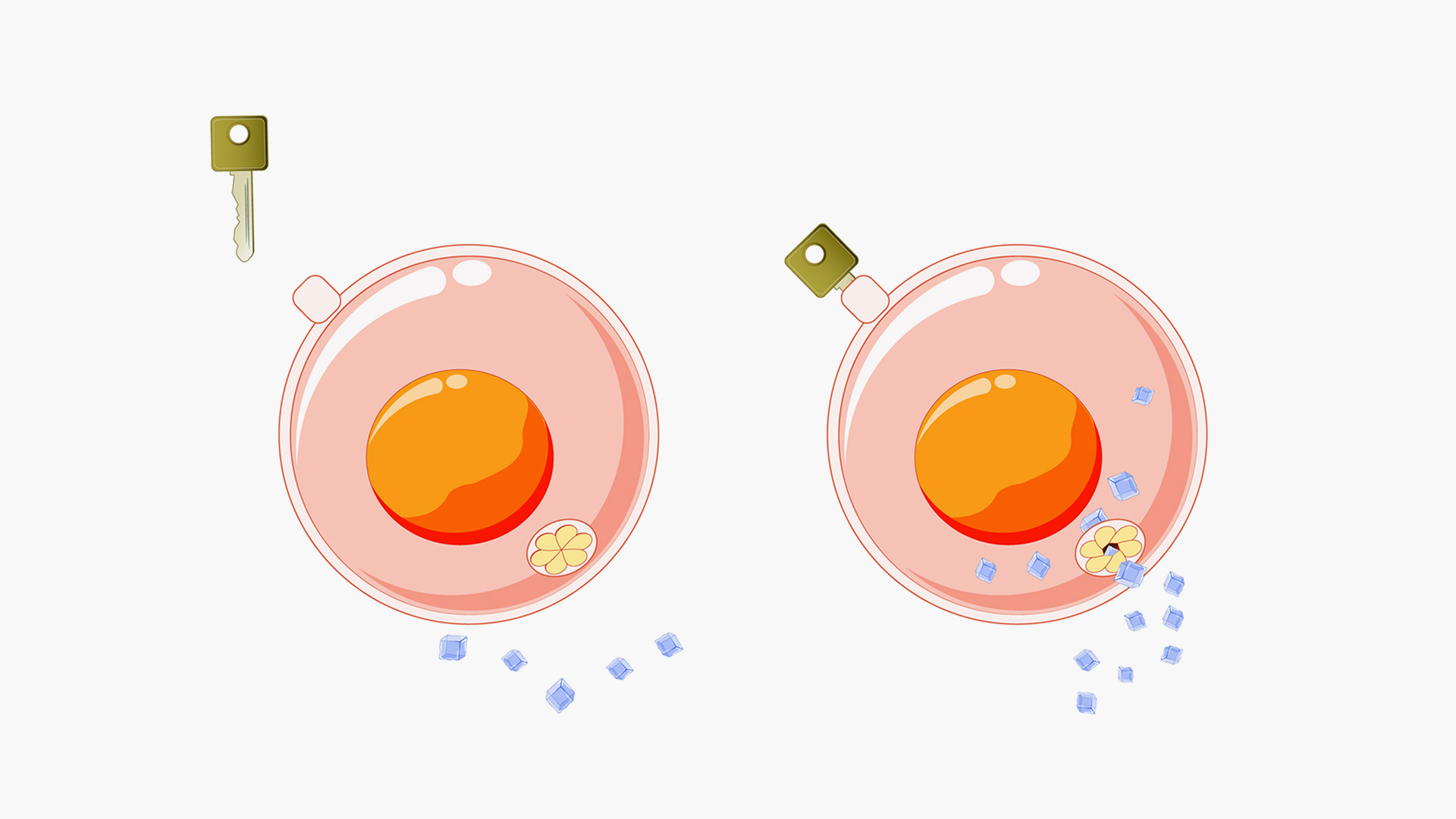
In December 1921, 14-year-old Leonard Thompson was on the verge of death.
The boy was diabetic and weighed just 65 pounds, and after a month in Toronto General Hospital his condition was not improving, so his doctors turned to an experimental treatment under development by Canadian researchers.
In January 1922, doctors carefully injected Thompson with pancreatic fluid extracted from cows. The scientific and medical understanding of diabetes was vague at the time, but it was progressing rapidly.
By injecting the boy, the team members hoped to confirm what they had already seen in the animals: something extracted from a healthy pancreas that regulates blood sugar, and scientists had a name for this mysterious thing: insulin.
As it turned out, the injection saved Thompson’s life, marking a turning point in treating a condition that had until then been a virtual death sentence, according to the American Chemical Society (ACS).
Diabetes is a chronic disease that disrupts the body’s blood sugar metabolism mechanism. High blood sugar usually indicates the pancreas secreting insulin.
But in one form of diabetes – type 1 – we now know that the pancreas produces little or no insulin, and in type 2 the pancreas may produce insulin but the body cannot use it effectively.
In both cases, glucose levels rise in the body, which ultimately leads to serious problems with the circulatory system, nervous system, and immune system, which can lead to blindness, kidney or heart failure, or stroke.
Despite the progress made since Thompson’s era, diabetes remains the ninth leading cause of death worldwide, with 1.5 million people dying from the disease in 2019.
The global burden of diabetes is increasing. There were 108 million people with diabetes in 1980, but that number rose to 422 million by 2014, according to the World Health Organization.
However, for those with access to insulin diabetes is now a largely manageable condition.
Pharmacology researchers continue to unravel the mystery of diabetes. They have learned to understand the nature of the disease, how to control it, and how to prepare and improve treatments. In doing so, they have saved millions of lives, and the story of success and sustainable improvement continues to this day.
What is the function of insulin dose?
The hormone insulin regulates blood glucose concentrations, which is the sugar the body produces when digesting food. Because the body metabolizes insulin, it must replenish its stock regularly, either through the pancreas or, in the case of diabetics, via injections.
In the pancreas and when injected into diabetic patients, insulin is in an inactive form called “insulin hexamer.” At the molecular level, insulin hexamer is a ball of 6 insulin molecules connected to each other.
Cells do not respond to insulin in such a large and consistent manner, but in the body the hexamerate of insulin is naturally broken down into its components, or monomers. For this reason, insulin analogues taken with meals are faster in action, as they reach the form of monomers faster.
Insulin monomers bind to protein receptors on the outside of cells, stimulating a structural change that spreads across the membrane. This cascading effect stimulates the cells to absorb more glucose, reducing the levels of glucose circulating in the bloodstream.
Early history
The recorded history of diabetes stretches back 3,500 years, to an Egyptian papyrus in which physician Hsi-Ra documented a case of “frequent urination.” We now know that when the kidneys cannot filter enough excess glucose from the blood, they release more sugary fluids into the urine.
Further knowledge was gained in 1675 when British physician Thomas Willis tasted his patients’ urine. If their urine tasted sweet, he diagnosed them with diabetes. One current test still checks the level of sugar in urine, but it no longer relies on tasting it.
Nearly 200 years later – specifically in 1869 – German medical student Paul Langerhans noticed that the pancreas contained “islets” of a distinct type of cell, although he did not know their function.
A few decades later, researchers showed that removing the pancreas from a dog caused diabetes, concluding that the pancreas produces a substance necessary for sugar metabolism.
In 1909, the term insulin was introduced. It is derived from the Latin word for islet, and insulin refers to the hypothetical substance produced by Langerhans’ pancreatic “islet” cells.
One of the first pieces of evidence supporting the insulin theory was that Langerhans cells were found to be destroyed in patients with type 1 diabetes.
Then in 1916, Romanian physiologist Nicholas Paulescu of the University of Bucharest showed that an extract of pancreatic cells lowered blood sugar in diabetic dogs.
Other researchers also worked with extracts, but attempts to extract insulin appeared to either destroy the active ingredient or contaminate the product with toxic impurities, preventing the potential use of this product.
Banting
These challenges inspired Canadian physician Frederick Banting to conduct his own experiments starting in 1921.
Working with Charles Best and James Collip under the guidance of University of Toronto physiology professor John James Rickard Macleod, Banting devised a process to extract an extract from pancreatic cells and purify it into insulin.
One of their most important achievements involved extraction using about 90% alcohol, which selectively dissolved the insulin so that it could be separated from certain impurities.
After successfully testing insulin injections in dogs and rabbits, the treatment became ready for human trials, starting with Leonard Thompson in January 1922.
The experiment lowered his blood sugar to near-normal levels and saved his life.
Members of the University of Toronto team improved their production process by first extracting pancreatic tissue in slightly acidified acetone, followed by alcohol extraction.
Doctors who heard about the wonder new drug were desperate for insulin to save their dying patients, but the university was unable to produce large quantities.
In May 1922, the pharmaceutical company Eli Lilly and Company began collaborating with the university to expand the production and marketing of insulin in the Americas. This effort was led by chemist George Walden of Lilly.
By July, the company shipped its first batches of Elitin insulin for clinical testing.
Almost overnight, the treatment of animal pancreatic extract transformed diabetes from a fatal condition.
Thompson lived to the age of 26, and other children from those early years of pioneering treatment lived longer.
Elizabeth Hughes, one of the first people Banting treated with insulin, died at the age of 73 after receiving approximately 42,000 insulin injections over 58 years.
In 1923 – the year after the clinical trial – Banting and MacLeod won the Nobel Prize for the discovery of insulin.
The effect of insulin was quite astonishing due to its amazing effect on diabetics. Those who watched the first diabetics who were starving and sometimes in a coma receive insulin and come back to life witnessed one of the true miracles of modern medicine.
Synthetic insulin
Mass production of animal-derived insulin began following successful clinical trials in Toronto and elsewhere in 1922, and in addition to Lilly, other entities began producing insulin, including the non-profit Nordisk Insulin Laboratory, which later became Novo Nordisk, and Sanofi’s predecessor, Hoechst AG.
The ability to produce a pure, reproducible product was of critical importance to pharmaceutical companies looking to expand their reach, and early experiments by doctors suggested that the purity of the extract affected patient outcomes, so chemists sought to develop new methods of purifying the “miracle drug.”
An important breakthrough has been made thanks to advances in a technique known as isoelectric deposition, which was discovered independently at Lilly and Washington University in St. Louis.
Pancreas extracts contain many different proteins, each with different molecular sizes, chemical properties, and electrostatic charges. Adjusting the pH of the solution containing the mixture changes the charge of those proteins, with different types of proteins responding at different pH.
At a certain pH, some proteins become neutral, causing them to precipitate out of the solution for easy isolation, while unwanted contaminants remain dissolved.
In 1923, Lilly began large-scale production of animal insulin based on this separation technology. This revolutionized the purity and stability of the final product, paving the way for mass production.
Over the following decades, researchers learned more about the still-mysterious extract. Insulin had long been considered a mixture of proteins, but starting in 1924, evidence emerged that insulin might be a single protein, and scientists from Johns Hopkins University proved this hypothesis in 1935.
Then, between 1951 and 1955, the English biochemist Frederick Sanger determined the amino acid sequence of this single protein. These discoveries influenced the world’s view of insulin and, perhaps most importantly, prompted scientists to imagine how to purify insulin and even manufacture it themselves.
Insulin update
Viewing insulin as a single chemical entity rather than a heterogeneous extract proved key to radically improving its potential as a drug, and scientists were able to apply the rules of chemistry to better purify the insulin molecule.
Pharmaceutical companies began achieving 80-90% purity by the 1970s using techniques such as chromatography.
More importantly, it also had the tools needed to determine the exact structure of insulin molecules.
For example, researchers discovered that insulin consists of two long chains of amino acids (polypeptide chains) called “A” and “B,” linked by “bridges” containing sulfur.
But not all insulin is equal. Human insulin differs from cow insulin, which in turn differs from pig insulin, and each contains largely equivalent chains of amino acid building blocks with some changes that set them apart.
Until the 1980s, doctors treated diabetes in humans using insulin extracted from animals, especially pigs and cows.
But in the wake of the emerging biotechnology revolution, that too began to change, as manufacturers sought to avoid the allergenic potential of these animal products, and DNA editing experts at Genentech collaborated with Lilly to develop a new process that uses microbes to produce insulin.
Imagine any microbial cell as a kind of protein factory: each cell naturally makes proteins based on instructions written in its DNA.
Pharmaceutical chemists knew the protein they wanted, down to the individual amino acid building block, and their new tools made it possible to sew customized genetic instructions into the blueprints of microbes’ DNA.
The collaborators used this “recombinant DNA” process to produce human insulin from bacteria with 98% purity, and in 1982 the Food and Drug Administration approved the resulting drug Humulin.
Humulin’s success made a strong case for genetic engineering’s new role in pharmaceutical chemistry: chemists now had almost complete control over the amino acid sequences of their products and could achieve higher degrees of purity.
This opened the door for scientists looking to modify and fine-tune a still-imperfect drug.
Analog receiver
A protein’s function depends on its chemical structure, and the size, charge, and type of motifs attached to each amino acid affect key protein properties that affect pharmaceutical properties: how cells process the drug, how stable the molecule is, and how effective it is.
So, armed with the additional personalization tools of genetic engineering, drug researchers began inventing insulin “analogs,” which are variations of the natural insulin protein intended to enhance performance.
In this case, enhancing performance is not just about increasing effectiveness. It is also a way to overcome the problem of dosage. If a person’s insulin dose is too low, he will not get enough benefit. If his dose is too high, excess insulin risks removing too much glucose from the blood and causing dangerous hypoglycemia. The therapeutic dose “window” for normal insulin is uncomfortably narrow.
To overcome dosage problems, scientists have fine-tuned the structure of insulin by tinkering with the individual amino acids of the protein. This is done by changing the order of some amino acids or adding or deleting others, like changing the beads in a necklace.
Changing the order leads to changing the properties of insulin. For example, Lispro – an analogue produced by Lilly – breaks down from large complexes to small subunits more quickly than regular insulin, which means that it becomes available to cells in a faster form and availability, which is beneficial for meal time dosing, and reduces the possibility of hypoglycemia resulting from residual insulin. Novo insulin aspart is based on Nordisk is on a similar principle.
A different approach involves changing some amino acids to produce more stable, long-lasting analogues for the basic once-daily use of insulin.
Novo Nordisk created insulin degludec with this approach, while Aventis, which became part of Sanofi, used it to produce insulin glargine.
The subtle changes in degludec and glargine make the molecules less soluble, so they dissolve into the bloodstream slowly without causing rapid spikes in insulin levels.
The overall goal is to increase insulin in the blood when it is needed, and reduce it when it is not needed.
Researchers from pharmaceutical companies and startups are now thinking beyond molecular structure and genetic engineering, and some have looked to technologies such as microneedles to solve the dosage problem.
Insulin is produced in different forms to meet the diverse needs of diabetics. Fast-acting formulations make insulin available to cells faster, while long-acting formulations release insulin more slowly, allowing them to control glucose levels for a longer period.