

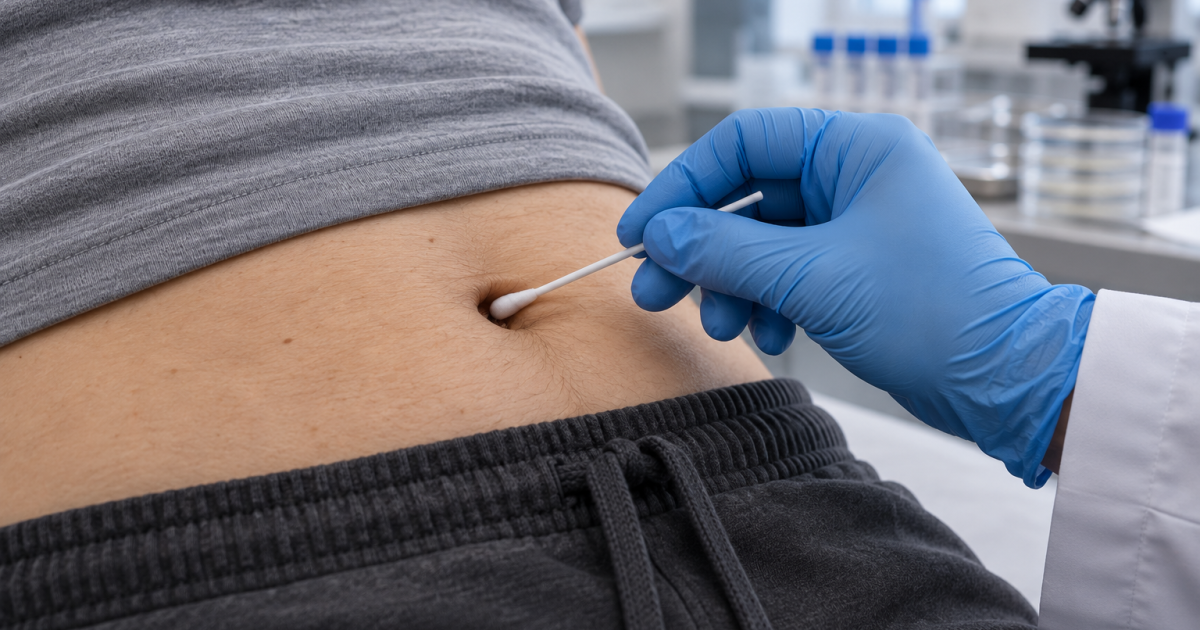
The belly button may be more than just a cavity in which remains of skin and sweat accumulate, as a recent German study indicates that the volatile chemical compounds that can be collected from it may carry fingerprints associated with diseases such as Parkinson’s and mild cognitive impairment, in a result that may pave the way in the future for the development of non-surgical examination methods.
But the researchers stress that the results are still preliminary, and do not mean that the smell of the navel can currently be used to diagnose any disease, as the study was limited to a very limited number of participants, and was conducted in controlled laboratory conditions.
Why do scientists care about body odor?
The human body constantly releases a mixture of volatile organic compounds, which are small molecules that can be released through sweat, skin oils, breath, urine, and saliva as a result of normal metabolic processes.
The composition of these compounds may change under the influence of several factors, including food, medications, and health conditions, which has prompted scientists to study the possibility of utilizing the body’s chemical fingerprints to monitor some diseases.
In the study, the researchers chose 3 areas of the body that are relatively less exposed to soap, perfumes, and personal care products:
- The front part of the nasal cavity.
- Belly button.
- The concave area of the auricle.
These areas provide an easy source for collecting volatile compounds associated with body odor, especially since the navel may contain sebum, skin cells, microbes, and various secretions.
How was the study conducted?
Researchers – including sensor scientist Thorsten Graunke from the Fraunhofer Institute for Integrated Circuits in Germany – conducted a study that included 24 people, who were divided into 4 equal groups:
- 6 with Parkinson’s disease.
- 6 suffer from mild cognitive impairment.
- 6 infected with Covid-19.
- 6 healthy people for comparison.
The researchers collected sterile swabs from the nose, navel, and ear, wiping each area for about 10 seconds, and then the samples were frozen before being analyzed.
The team used a technique known as laser-based photoacoustic absorption spectroscopy, which relies on passing air around the swab to release volatile compounds from it, and then exposing it to laser radiation in the infrared range.
When compounds absorb certain wavelengths, a thermal change results that generates small pressure waves that can be measured, ultimately forming a “spectral fingerprint” of the sample.
The researchers then used a statistical analysis, known as principal components analysis (PCA), to see if patterns in the samples differed depending on health status.
What did the results reveal?
Analyzes showed different patterns between the four groups, but the degree of discrimination varied depending on the sampling location.
In navel samples specifically, the clearest difference was between healthy people and those with mild cognitive impairment, while samples from Parkinson’s and Covid-19 patients were in moderate areas, with a partial overlap between them.
This is an important point, because the study did not prove the existence of a single chemical compound specific to each disease, but rather observed differences in the overall spectral fingerprint of the compounds emitted from the samples.
The researchers also tested three additional samples from people with Parkinson’s, collected about two weeks after the original measurements, and found that they fell within roughly the same pattern that appeared in the first group of Parkinson’s patients. This provides a preliminary indication that the pattern may be repeated, but is not sufficient to prove its diagnostic accuracy.
One of the striking results is that the researchers found that using the full range of infrared radiation may not be necessary.
After testing different combinations of wavelengths, they found that a set of only 5 wavelengths achieved group separation close to that achieved by the broader spectral range.
The researchers believe that this result may open the way in the future for manufacturing smaller and simpler devices to analyze these chemical fingerprints, instead of relying on large and complex laboratory equipment. But it is still in the proof-of-concept stage, and a clinical diagnostic tool based on these results has not yet been developed.
Are the results sufficient for diagnosis?
Despite the striking results, the study faces important limitations that currently prevent it from being converted into a disease diagnostic test.
Each group included only 6 people, which is a very small number, which does not allow determining the sensitivity, accuracy, or ability of the test to reliably distinguish between patients and healthy people.
The researchers also found an association between age and the observed spectral patterns, while Parkinson’s and cognitive impairment are more common in older people, so it was not possible in this small sample to completely separate the effect of age from the effect of the disease.
The measurements were also carried out under controlled laboratory conditions, while in everyday life results may be affected by factors such as personal hygiene, perfumes, soaps, environmental pollutants and individual differences.
Most importantly, the researchers did not develop or test a clinical diagnostic model that could accurately determine the illness of an unknown person. Rather, they investigated in an exploratory manner the extent to which the chemical patterns of the groups separated from each other.
Ultimately, the study provides preliminary evidence that volatile compounds from navel, nose, and ear swabs may carry chemical signatures that differ between healthy people and those with Parkinson’s, mild cognitive impairment, and COVID-19.
But the results do not mean that “smelling the navel” can detect these diseases, nor that examination has become a means of early diagnosis.
The next step is to test the technology on hundreds or thousands of people, with groups close in age and conditions more similar to daily life, to see if the fingerprints discovered are stable and accurate enough to one day be transformed into a practical medical examination.