

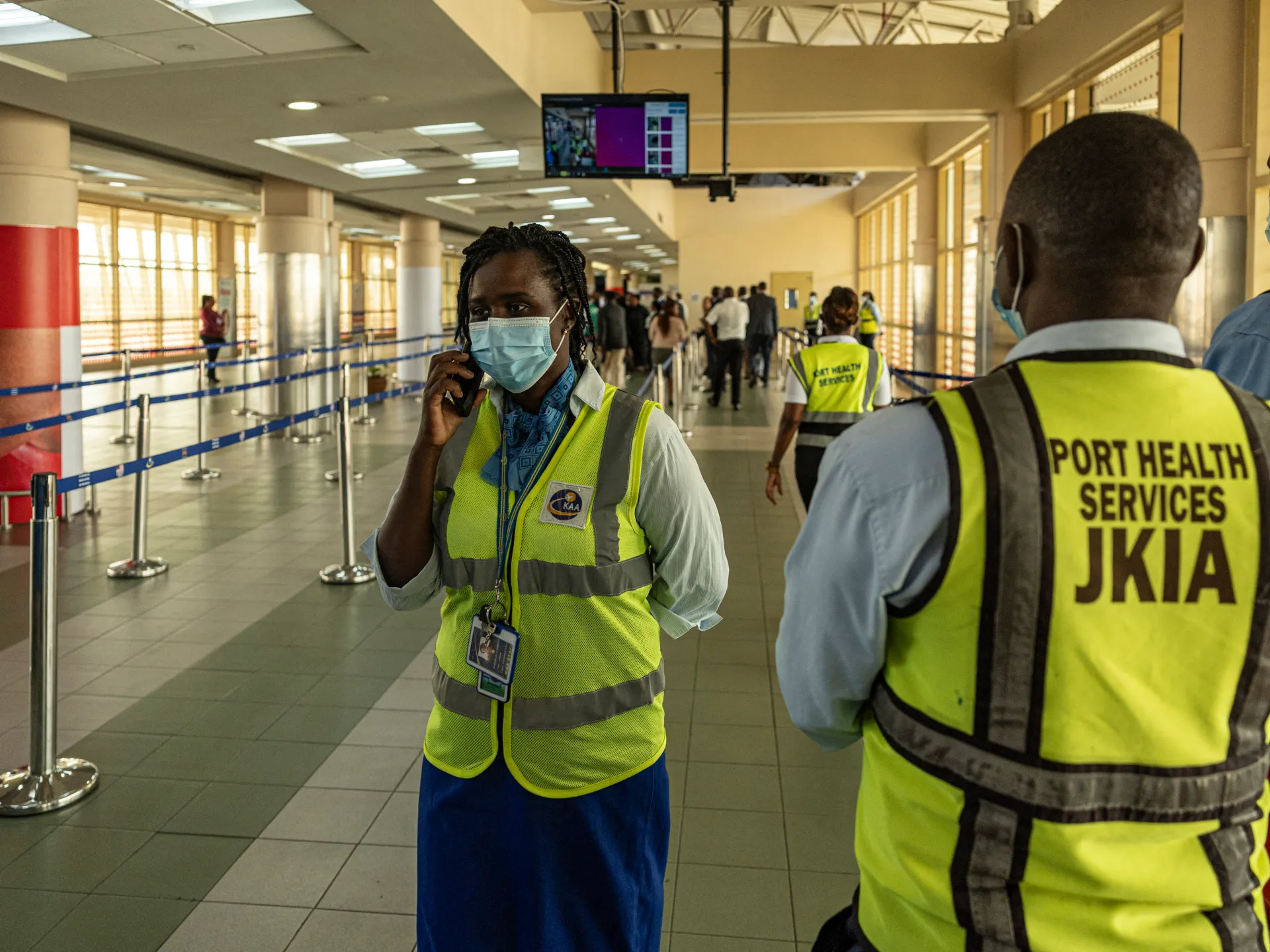
The first death from the Ebola virus in Kenya raised fears about the expansion of the outbreak that started from the Democratic Republic of the Congo, after a patient coming from it via Uganda passed health screening points at two airports before his infection was discovered in Nairobi.
The death is attributed to the “Bundebugyo” strain, which is a strain of the Ebola virus that was first detected in Uganda in 2007, according to the World Health Organization, and there is no vaccine available for it, unlike the “Zaire” strain, which caused an outbreak in West Africa between 2014 and 2016 and for which there are vaccines.
Kenyan Minister of Health Aden Duale said that the infected person is a Kenyan citizen, whose identity was not revealed, who fell ill about a month ago in the Democratic Republic of the Congo, where he lived for 7 years, and received treatment there. On October 2, he moved by land from the city of Beni to Kampala, then took a plane to Nairobi, arriving the next day.
One of his relatives and a friend took him to a hospital in Nairobi, where he was isolated and his test result came back positive. Then he died last Monday and was buried on Tuesday, according to the Ebola protocol approved in Kenya.
As of last Thursday, the Kenyan health authorities had identified 57 potential contacts, including members of his family and health workers, and were also separately tracking 23 passengers and 4 flight crew members, according to the World Health Organization.
Loophole in the examination
Travelers to, from, or through Uganda and Kenya undergo multiple temperature checks and fill out at least two digital forms about possible exposure to the virus in the Democratic Republic of Congo, but the patient evaded these measures.
The Ugandan Ministry of Health said that the man’s temperature was normal when he was examined at Entebbe Airport in Uganda before his departure, while the Kenyan authorities say that he may have taken medications to hide his symptoms when he was examined later at Nairobi Airport, which is still under investigation.
A senior Ugandan health official, in statements to Reuters, said that officials are trying to review the digital form that the patient supposedly filled out at Entebbe airport, and are reviewing surveillance recordings to determine the identity of the driver who drove him to the airport.
As for Ugandan government spokesman Allen Kasuga, he wrote on the X platform: “Get Uganda out of this debate. We do not have Ebola here.” Uganda had treated 20 people who came from the Democratic Republic of the Congo before declaring it free of the virus last July.
Wolfgang Preiser, professor of medical virology and head of the department at Stellenbosch University in South Africa, believes that the tracking system appears to be as effective as it was in Uganda, citing the speed of diagnosis in Kenya.
Conflicts and displacement
The outbreak began in Ituri Province, northeast of the Democratic Republic of the Congo, and was officially announced by the authorities in May. It then spread to 7 provinces in the north and east of the country, recording at least 4,148 deaths out of 8,300 reported cases.
The response is hampered by weak infrastructure, the remoteness of the affected areas, conflict with armed groups near the borders with South Sudan, Uganda and Rwanda, as well as strikes by unpaid health workers, misinformation, and cultural practices such as family funerals with open coffins.
Last Monday, Doctors Without Borders warned of a “worrying rise” in infections in North Kivu province bordering Uganda, where about 40% of new infections are currently recorded. Stephanie Hoffman, coordinator of the organization’s Ebola treatment center in Butembo, likened it to “fighting a wildfire.”
About two million people live in and around Butembo, where there are four Ebola treatment centers, two of which opened recently, and patients are often transferred between them, raising the risk of infection.
Preiser said that the huge numbers and speed of spread are beyond the capacity of many systems, expecting cases to continue to appear in other Congolese provinces and neighboring countries until the numbers begin to decline.
For its part, the World Health Organization said last Tuesday that Kenya is enhancing epidemiological monitoring with more targeted screening at high-risk ports of entry, and that the organization is working with the Kenyan authorities to trace contacts and examine travelers. It explained that it had delivered about a thousand Ebola detection tests and a thousand sets of personal protective equipment to high-risk Kenyan counties.
For his part, Jean Bisimwa Nachega, professor of infectious diseases at Stellenbosch University, said that the virus does not respect national borders, and that strengthening border testing alone is not enough, calling for strengthening the entire public health response, including training front-line workers, rapid laboratory diagnosis, isolation, and contact tracing.