

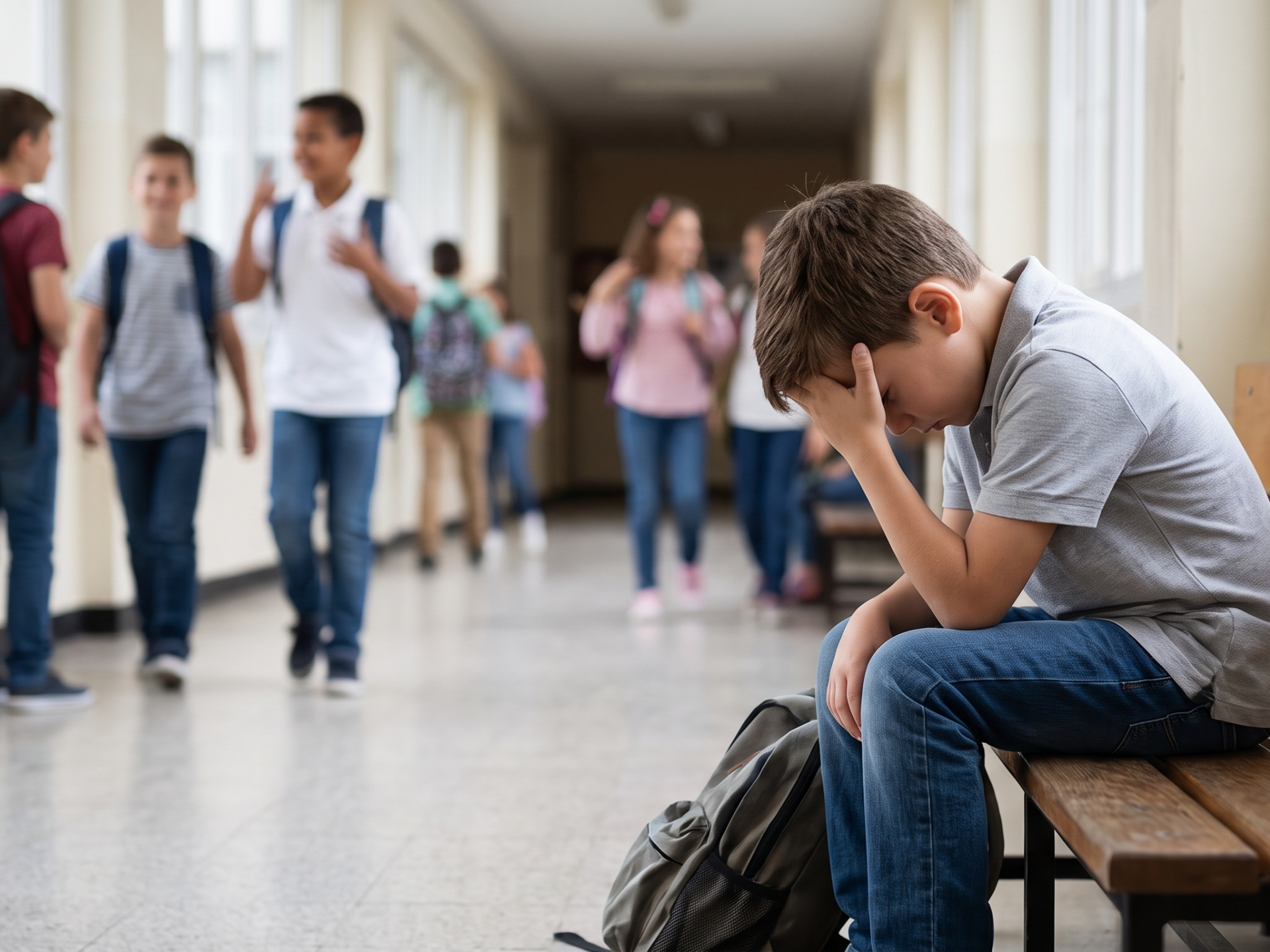
How many times when browsing the news have you come across headlines such as: “People in the state of Georgia, USA, organized demonstrations that gathered hundreds of parents, to demand accountability from the administrative staff of a secondary education institution, after a 12-year-old student committed suicide as a result of being bullied.” Or: “A French teenager ended his life by hanging after being exposed to a systematic campaign of cyberbullying.”
The list is undoubtedly long, and the pages of newspapers and news websites are regularly filled with it.
Some may think that these are just hateful behaviors that express the disintegration of values in the West and the collapse of its moral system, but that is not the case! Arab countries are not devoid of similar incidents.
School and cyberbullying have direct effects such as psychological suffering, social isolation, loss of self-esteem, sleep disorders, anxiety and depression.
These repeated incidents spread throughout the world indicate that what was long viewed as merely passing and normal disagreements between students has now become a major public health problem, in terms of its spread and the seriousness of the consequences that result from it.
Hence, a pivotal problem arises: In light of the increasing spread of school bullying and its expansion in the digital space, how can we work on early detection of psychological and social effects and establish mechanisms for preventing and taking care of them, whether at the school or family level or at the level of qualifying the students themselves?
What do psychological studies say about the bully?
The basic psychological mechanisms that make a bully can be summarized in 3 concepts:
- A child learns aggressive behavior from others by watching them, especially if he sees that they are making gains because of him.
- Behavioral reinforcement: When bullying gives the perpetrator power, status, or control, the behavior may be repeated because it has become a means to achieving a specific goal.
- Moral detachment: The bully justifies his actions, or downplays their importance and seriousness: (“I was just kidding, I didn’t mean to…”), which helps him continue hurting others.
Is every child bully exposed to bullying or violence?
This is a common idea, but it is inaccurate. Some bullies may be former victims, while others grow up in a seemingly stable family.
It is not possible to determine the cause of behavior alone, but the child’s circumstances, the way he deals with authority and peers, and the extent of his awareness of the harm he causes must be analysed.
But the most important point is evident in the following: Understanding the mechanisms of bullying does not mean at all justifying this shameful behavior, as the bully needs clear limits and an appropriate punishment, in addition to attending emotional control courses, teaching empathy (for example, lessons are given in this regard in Denmark, and they have been compulsory in educational institutions since 1993), and how to build healthy relationships.
A child learns aggressive behavior from others by watching them, especially if he sees that they are making gains because of him
Is there accurate data on the prevalence of bullying?
Many studies have been conducted in this regard, including an important study whose results were published in September 2026, which included more than 138,000 teenagers from different countries (Asia, America, and Europe). It found varying rates, with high rates of school and electronic bullying recorded, reaching more than 50%, especially in Eastern European countries.
Also, according to data and reports issued by UNESCO, the North African region records the second highest school bullying rate in the world, with an average rate of 42.7%.
As for the Middle East region, it ranks third globally with a rate of 41.1%, with percentages ranging by country between 17.5% and 59.5%.
The UNESCO study highlighted differences that determine the type of bullying, as boys in the Arab environment are more vulnerable to physical bullying and physical violence, while girls are more exposed to psychological and social bullying (spreading rumors or exclusion), in addition to electronic bullying via social media platforms.
What are the risk factors that make teens vulnerable to bullying?
There are several factors, which can be classified into three basic areas:
1- Individual factors:
- Differences include physical and cultural differences (physical appearance, weight, race, a different accent, a style of dress seen as out of the ordinary), the presence of a physical or mental disability, a learning disability, ADHD, or speech disorders.
- Subjective characteristics: excessive shyness, introversion, low self-esteem, social phobia.
- Success and excellence: Possessing talents or achieving remarkable success and excellence may make a teenager a target of some of his peers.
2- Family and educational factors: Using an inappropriate educational method, either by excessive use of authority, physical punishment, or verbal violence; Or, on the contrary, excessive protection that prevents the child from developing his independence and building equal social relationships.
Let us not forget the impact of lack of family support, as the absence of parents, their weak participation in the child’s life, weak communication within the family, or the presence of conflicts may make the child isolated when bullying occurs.
3- Factors related to the school environment: Among them, we mention the transitional stage between primary and preparatory education, then the weakness of the spirit of solidarity among peers, with the presence of conflicts within the classroom.
The educational staff within the institution also has an important role, as the lack of supervision and support by professors and administration sometimes worsens the situation.
It is the family’s duty to keep digital evidence such as text messages, videos, and offensive electronic accounts so that it is a file that constitutes a compelling argument before the institution and the judiciary alike.
4- Finally, bullying can result from institutional stigma: When the integration of some students is weak or excessive highlighting and differentiation of some school support programs such as specialized sections or adapted exams.
School and cyberbullying have direct effects such as psychological suffering, social isolation, loss of self-esteem, sleep disorders, anxiety and depression.
This may lead to more serious consequences, such as refusal to go to school, school dropout, self-harm, and suicidal thoughts, which in some tragic cases lead to suicide.
Cyberbullying is characterized by its long-term effects, as the continuation of posts and content on the Internet causes the psychological trauma to continue even after the attacks stop.
What are the effective mechanisms to deal with this phenomenon?
All recent studies have highlighted that confronting the phenomenon of bullying and confronting its destructive effects requires work on several different fronts, and that concerted efforts alone yield good results, between school interventions, and other family and individual interventions.
1- School interventions:
- Establish a permanent anti-bullying policy and not be satisfied with a temporary and temporary campaign.
- Train professors and staff to recognize the signs of bullying.
- Intervention at the whole grade level.
- Preparing adolescents to become positive interveners (Upstanders) instead of passive bystanders, by not participating in laughter, not re-posting offensive content, not liking it, providing support to the victim in a confidential manner, and informing an adult through institutional mechanisms that ensure the safety and confidentiality of the matter.
- Work with witnesses and train them to intervene and report by providing a simple and confidential system for reporting cases of bullying.
- Ensure follow-up for several weeks or months after the intervention to ensure that improvement continues and that bullying does not return.
2- At the family level:
An ongoing dialogue must be maintained with the teenager, by constantly asking about what he is experiencing at school, monitoring the use of mobile phones, regulating access to social media, and the number of hours he spends daily in cyberspace. Blaming the victim or minimizing his or her suffering should also be avoided.
It is the family’s duty to keep digital evidence such as text messages, videos, and offensive electronic accounts so that it is a file that constitutes a compelling argument before the institution and the judiciary alike.
The cooperation of the family and the institution remains necessary in all cases.
3- At the child or adolescent level:
Psychological effects such as anxiety, depression and suicidal thoughts must be diagnosed and treated, with a special approach tailored to each case.
Prevention is not limited only to reducing the use of mobile phones and electronic applications, but rather requires that we teach our children how to use this technology in a safe, safe and organized manner.
Are there preventive measures against school and electronic bullying?
Yes, we can intervene before damage occurs, through several mechanisms:
1- Ways to prevent school bullying:
- Establish clear rules through strict policies that reject bullying and specify clear and appropriate consequences for anyone who practices it.
- Monitor places where bullying occurs frequently, such as playgrounds, hallways, and bathrooms.
- Rapid intervention and immediate separation of concerned parties.
- Promote empathy among students by organizing classroom activities and discussions that encourage mutual respect and appreciation of differences among students.
2- As for the means of protection against cyberbullying, they include technical and educational steps:
Technical procedures: Among them is the necessity of activating parental control applications (Family Link) to set screen time, monitor content, and filter websites.
Children’s digital and video game accounts must also be set to private, with the geographical location feature disabled.
Educational procedures: Teach children the concept of digital impact, meaning that everything published on the Internet leaves a trace, so you must think carefully before publishing.
Children must also be educated not to accept friendships or open messages from unknown accounts or strangers. It is necessary to go immediately to the parents when feeling distressed or threatened.
It is essential to build a safe family environment, while creating a permanent and open dialogue, to ensure that children do not fear punishment or having their devices removed if they are exposed to bullying.
Finally, monitoring sudden behavioral changes (anxiety, isolation, etc.) remains one of the most important indicators that lead to an early diagnosis.
We must not forget the role of public policies in the field of digital citizenship education, starting from the preparatory level, in order to urge teenagers to activate the ban on any offensive content, not to re-publish or like it, and to keep incriminating evidence.
Prevention is not limited only to reducing the use of mobile phones and electronic applications, but rather requires that we teach our children how to use this technology in a safe, safe and organized manner.
The world is currently experiencing an unparalleled digital revolution, with the frightening advance of artificial intelligence and the use of screens of all kinds. In parallel with this situation, we cannot help but notice the growing moral crisis among children and adolescents, as their exposure to violence in a continuous manner through video games and their constant consumption of models marketed by applications that depict success in a stereotypical way (forms and materials first), generate a narrow-minded view of their role in life and their ambitions.
However, it is impossible to stop digital development, and therefore we must find solutions that focus on building well the individual from childhood, and focusing on educational foundations that reinforce universal values and develop the critical sense of young people, so that our children can protect themselves and move steadily towards a better future.
The opinions expressed in the article do not necessarily reflect the editorial position of Al Jazeera Network.