

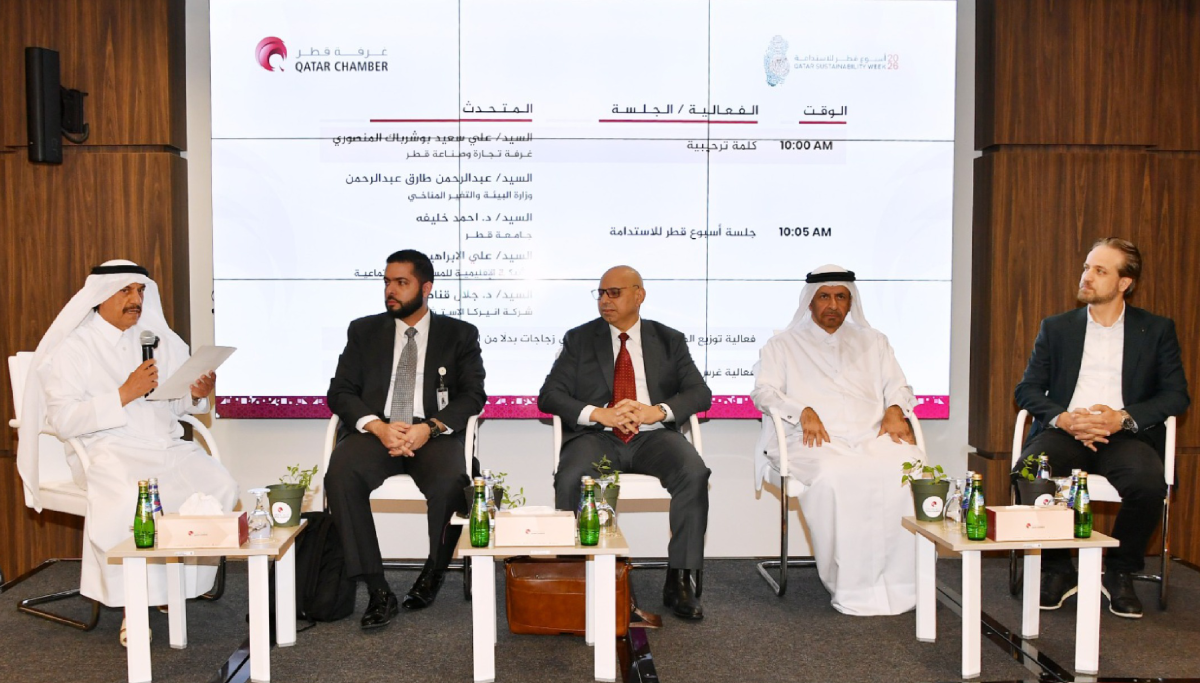
Qatar Chamber emphasized that sustainability is an essential pillar for building a more diversified and efficient economy, and achieving a balance between economic growth, preserving natural resources and the rights of future generations, in line with the goals of the Qatar National Vision 2030.
This came in a speech by Mr. Ali Busherbak Al-Mansouri, Acting Director General of the Qatar Chamber, during a symposium on sustainability, planting seedlings and replacing plastic containers with glass, within the activities of Qatar Sustainability Week.
He explained that the Qatar Chamber pays great attention to sustainability as an integral part of its social and institutional responsibility, due to its certainty that the role of institutions is not limited to achieving economic returns, but rather contributes to the development of society, preserving the environment, and promoting responsible business practices. He stressed that the private sector is an essential partner in achieving sustainability, and that adopting responsible practices, rationalizing the use of resources, investing in human resources development, and enhancing governance are all factors that contribute to building a sustainable economy and a more prosperous society.
Al Mansouri pointed out the Chamber’s keenness to spread the culture of social responsibility and sustainability by organizing conferences, seminars, training and qualification programmes, introducing relevant international standards, and encouraging companies to adopt the principles of environment, society and governance, and integrating them into their institutional strategies and practices.
Mr. Abdul Rahman Tariq Abdul Rahman, representative of the Ministry of Environment and Climate Change, Dr. Ahmed Khalifa, representative of the College of Administration and Economics at Qatar University, Dr. Ali Al-Ibrahim, representative of the Regional Network for Social Responsibility, and Dr. Jalal Qannas, professor of economics at the College of Administration and Economics at Qatar University, spoke at the symposium.
Mr. Abdul Rahman Tariq Abdul Rahman spoke about the role of the Ministry of Environment and Climate Change in Qatar Sustainability Week, and about the role that the Ministry plays in promoting sustainability as an essential matter in life, as well as educating citizens and residents on how to properly use natural resources, reduce their consumption, and limit pollution.
He pointed out that the Ministry is conducting studies and research related to sustainability, measuring the extent of application of sustainability standards and the extent of their continuity, and publishing knowledge and educational packages on the environment.
For his part, Dr. Ahmed Khalifa spoke about economic technology to reduce carbon emissions, pointing out that Qatar University is implementing five axes to enhance sustainability; The first is the sustainability of the university campus and measuring the extent of air pollution inside it and the efficiency of water and electricity use.
The second axis relates to the classrooms and the programs offered within them related to environmental protection and safety, along with the development of economic programs in the field of sustainability. The third axis relates to the university’s research centers and their relationship to sustainability. The fourth axis relates to the university’s role in innovation. The fifth axis is the role of the business community in supporting Qatar University’s initiatives.
Dr. Ali Al-Ibrahim spoke about the role of organizations in achieving development and sustainability goals, pointing out that the Regional Network for Social Responsibility is an international, non-profit, professional institution that was established in 2007 and operates in 24 countries. It aims to raise the level of awareness about the social responsibility of companies and institutions, and work to strengthen it in companies, institutions, and the governmental, private, and private sectors.
He pointed out that the regional network is working to keep pace with the 2030 Sustainable Development Goals approved by the United Nations in 2015, pointing to many initiatives undertaken by the network in support of sustainability, including the International Ambassadors Program for Social Responsibility and the United Nations Commissioner’s Program to promote the United Nations 2030 Sustainable Development Goals.
Dr. Jalal Qannas presented a working paper entitled “From National Policies to Business Competitiveness: The Economic Value of Sustainability in the State of Qatar,” in which he talked about sustainability and how to build an economy that has a role in long-term growth, pointing out that sustainability is a comprehensive concept that is not limited to the environmental field, but rather includes various fields and sectors.