

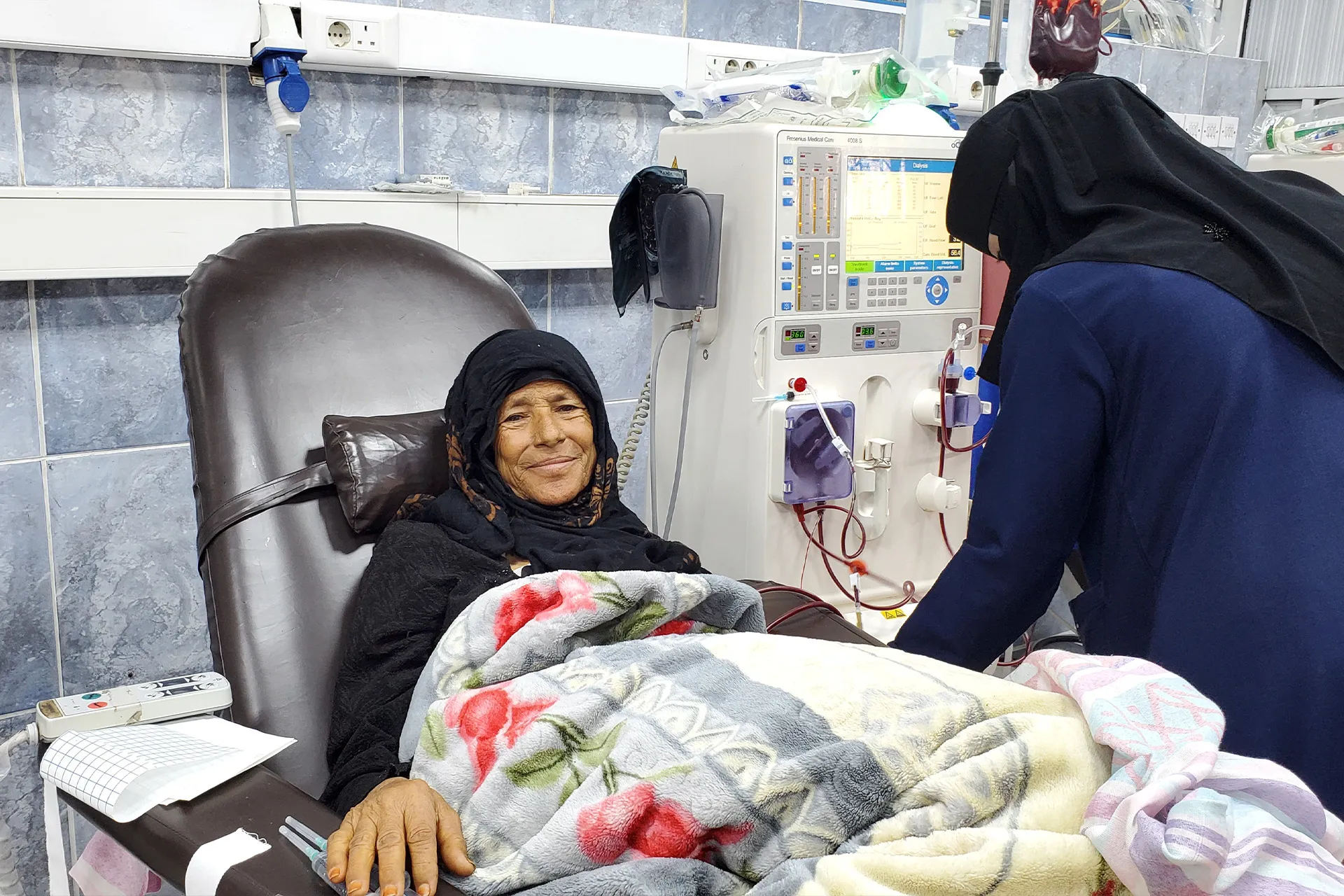
Taiz- Zubaida Faed, a fifty-year-old woman suffering from kidney failure, is forced to walk on her feet to reach the kidney center at Al-Thawra General Hospital in the city of Taiz, after the war and siege crisis burdened her with exorbitant transportation costs, in order to continue the dialysis sessions she needs twice a week. Getting to the hospital on foot represents an overwhelming challenge for a body exhausted by aging and disease, but it is the way of being forced to an appointment that it cannot do without.
On one of the beds inside the dialysis center at Al-Thawra Hospital, Zubaida looks tired with a pale face, while the dialysis machine connects to one of her veins. She told Al Jazeera Net that she began the washing sessions about a year ago, and before the recent escalation, she returned to her area in Shamir (west of Taiz) every two months to stay for only 3 days before returning to the city.
However, the closure of roads and the deterioration of conditions made return impossible, and the difficulty of movement doubled. Zubaida adds, “I used to arrive half an hour before home. I live in the nearby neighborhood at a good distance. I walk on my own two feet until I get here. There is an oil crisis and the passenger fare is 500 riyals.”
Her suffering reveals part of the crisis facing patients with chronic conditions in Taiz. Access to the hospital, which is supposed to be a step towards treatment, has become – for some of them – an additional burden added to the costs of medicines and health care supplies, especially since the dependence of kidney failure patients on indispensable periodic sessions means that the inability to reach dialysis centers may result in a serious deterioration in their health condition.
Suffering is repeated
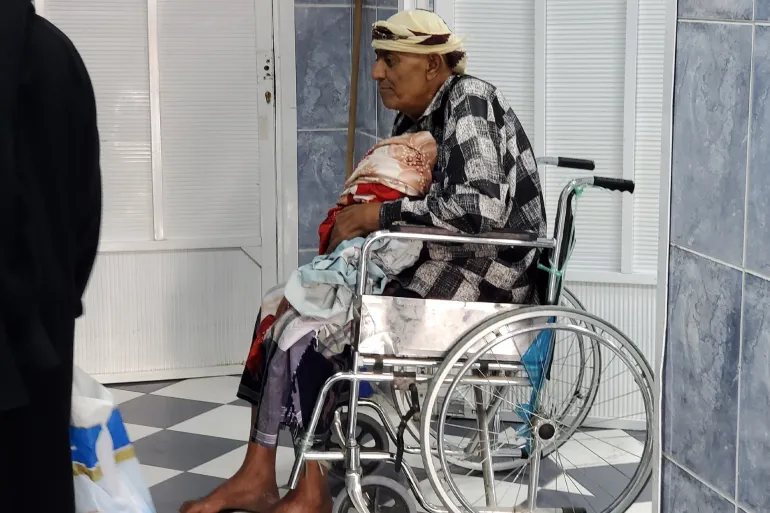
On an adjacent bed inside the dialysis center at Al-Thawra General Hospital in Taiz, Muhammad Saif Al-Sami spends hours receiving the treatment he needs to survive. Since he suffered from kidney failure 3 years ago, regular washing has become an indispensable part of his life, but the war, road closures, and the oil derivatives crisis made his trip to the hospital more difficult, and turned obtaining treatment into a daily battle.
Al-Sami’i comes from the Sam’i District in the countryside of Taiz Governorate, and he relied on the roads linking his area to the city for transportation and receiving treatment. However, according to his account, recent military developments and road closures prevented him from returning to his home, while the fuel crisis increased the difficulty of his movement within the city.
The citizen says that he is now unable to return to his home – in the Taiz countryside – as he used to do before, and that the closure of the eastern crossing, which he used to take through the Al-Hawban area, has increased his suffering. Al-Sami’i’s suffering is not limited to being far from his family, as he is forced to use a motorcycle to reach the hospital from his residence in the Al-Jumhuriyya neighborhood, in light of the absence of usual means of transportation and the high costs of transportation.
He added to Al Jazeera Net that the trip costs him about two thousand Yemeni riyals (about $8.47) one way and the same amount, which is an amount that burdens him daily, especially with the frequency of washing sessions weekly. He also complains of a lack of some supplies and medications, most notably Heparin, the medicine for kidney failure, which he says costs about 4,500 Yemeni riyals (about $19). In addition to the lack of solutions, which threatens the continuity of treatment for a patient who needs regular washing sessions, in addition to the burden of living, at a time when needs are increasing and the options available to patients are narrowing.
Hundreds of patients are at risk of interruption of medications
Youssef Al-Zakri, director of the dialysis center at Al-Thawra General Hospital in Taiz, warns of the repercussions of the siege and road closures on kidney failure patients, explaining that about 50 patients were unable to reach the center due to their homes being outside the city or in areas of clashes, while some of them were forced to live near it for fear of missing dialysis sessions.
Al-Zakri told Al Jazeera Net that the center provides its services to about 420 patients with kidney failure, through 31 devices that operate around the clock, and receives about 120 patients daily. He warns that the lack of fuel and high transportation costs threaten the continuation of service, stressing that stopping the center will endanger the lives of patients, in light of the limited capacity of the washing center at Al-Jumhuri Hospital – which receives about 320 patients – to accommodate additional cases, according to his account.
He added that the closure of the eastern port hindered the arrival of dialysis solutions and medical supplies coming from Aden and Sanaa, noting the arrival of a shipment of medicines from the Ministry of Health in Aden, with the expectation of the arrival of a second shipment. It calls for facilitating the passage of medical supplies and fuel, and neutralizing the needs of patients with kidney failure and chronic diseases from the conflict, to ensure the continuation of dialysis sessions and to protect the lives of patients.
For her part, Shaima Muhammad, a nurse at the Kidney Center at Al-Thawra Hospital, says that patients face major obstacles in moving around and securing transportation fees, in addition to a severe shortage of necessary medical supplies such as the drug “heparin” and materials for dialysis machines.
Speaking to Al Jazeera Net, Shaima warns of the seriousness of this situation, as the patient’s interruption of dialysis sessions leads to the accumulation of toxins and fluids in the body, which seriously threatens the patient’s life and increases the number of deaths, amid continuing to receive recorded cases despite the severity of the siege and the current situation.
Disastrous indicators
Abdul Rahman Al-Sabri, Director of Al-Thawra General Hospital in Taiz, says that the health sector in the city faces great challenges as a result of the siege imposed on it, the near absence of humanitarian organizations, the shortage of diesel, and the lack of alternative energy sources, in addition to the scarcity of resources and operational expenses, which has led to a faltering medical services provided to patients with heart and kidney failure whose care requires the continued operation of health equipment and facilities.
Al-Sabri explained to Al-Jazeera Net that the number of kidney failure patients registered in the hospital is about 420, while about 1,500 patients visit the chronic diseases unit to undergo examinations and receive treatment, noting that the number of people with heart disease and high blood pressure at the governorate level is estimated at about 15,000 patients who need monthly medications.
He warns that the available fuel stock is only enough for 5 days, while the medicines are not enough for more than a month, pointing out that the solutions for dialysis sessions and medicines for blood pressure and diabetes, especially insulin, have run out, which prompts patients to buy medicines from the markets at their own expense.
He added that the first shipment of dialysis solutions arrived at the hospital recently, which is the first since the roads were closed, stressing the continued need to provide fuel, medicines, and basic medical supplies.
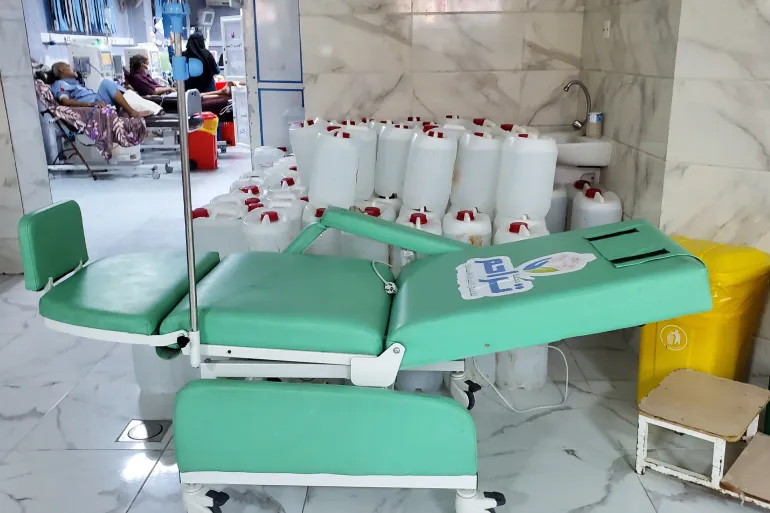
The statistics – which Al-Jazeera Net obtained from the governorate’s media, for the dialysis departments in Al-Thawra Hospital and Al-Jumhuri Hospital – show that there is tremendous pressure and increasing need, as the total number of recorded cases reaches 1,110 cases distributed among only 43 beds throughout the departments.
At the level of the Al-Thawra Hospital Authority, the department serves 25 beds with approximately 610 cases, recording an average of 122 washing sessions per day, with a total of 3,660 sessions per month.
In the Republican Hospital, the department receives 500 cases in only 18 beds, with an average of 88 sessions per day, bringing the monthly sessions to 2,640 sessions.
Thus, the total number of sessions required at the hospital level is 210 washing sessions per day, equivalent to 6,300 sessions per month, which reflects the great challenge compared to the available capabilities and limited numbers of beds.