

Ancestral Heritage is a page concerned with the customs, traditions and life of the people of Qatar in the past, in an attempt to introduce the reader to the Qatari heritage in its various aspects, from traditional foods and the way they are cooked to terms and words that distinguish the Qatari citizen, and explaining their meanings according to current terminology. The page attempts to explore the depths of the Qatari heritage in its many aspects and forms, and the light will also be shed on a personality who distinguished himself in one of the areas of life. We welcome your participation, and we invite anyone who has pictures, stories and anecdotes that talk about Qatar’s heritage to email us. [email protected]
From Qatar: Al Adina
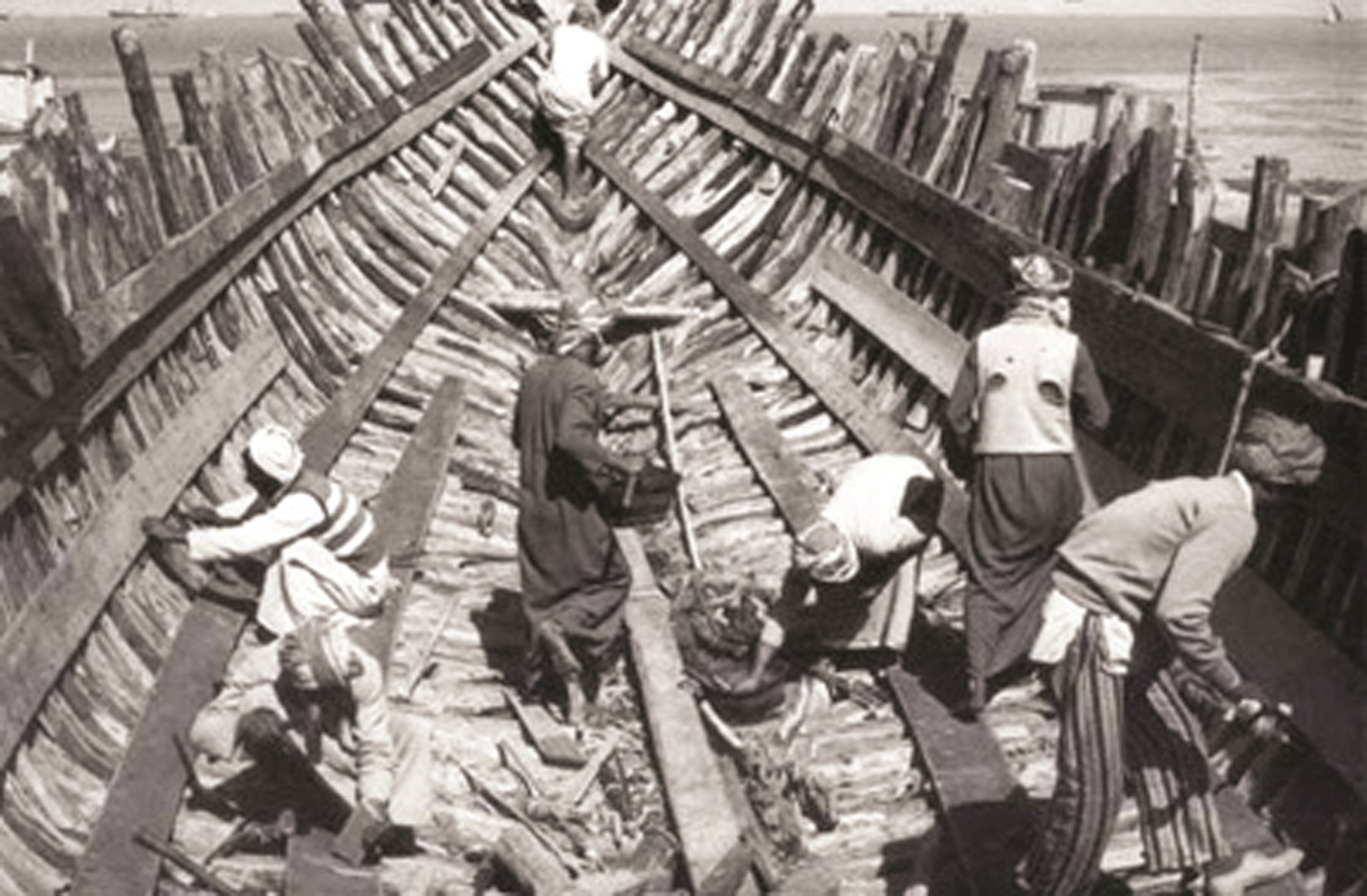
These verses were said by Mr. Saad bin Mansour Al-Kaabi in the ship called (Al-Adina):
Like the adenium, I did not board a ship
She came from Umm al-Shaif during the Messianic era
She is mute and not fat
How would it be if she wanted to pray and paint her?
He didn’t think he would catch her or his arm
Laboum Bin Hindi and Sunbouk Rushdan
Saad Mansour stood looking with his eyes
He said, “Rejoice, this has reached us.”
I preached against the mustache and noted his adornment
Danger crashes inside stallion residents
And in the morning at the balck they rowed
In Samisma with the group and the Brotherhood
– Words: Umm Al Sheif: a well-known hare located opposite Ras Laffan, Sal: oil extracted from certain types of fish and used as paint for ships, Laffan: a head located on the eastern coast of the State of Qatar, Al Balat: the natural harbour.
From Yemen: popular proverbs
– He is not taahish unless he has a nahish
– Whoever is not home should speak balsan
– Adina Yunusna, the blind man, opened his eyes and made us sad
– My son’s son is for me and my daughter’s son is for the people
– Do not say righteousness except through righteousness
– If it had milk in it, it would have been healthy
– Blood loves suffocation
– Your old friend
– The uncle is uncle and the hostility is empty
– The person with the need is concerned with the request
– When his response came back as it was
– The nature is like necrosis
– The thief’s ear is ringing
– They said to the liar, “Swear.” He said, “Relief has come to you.”
– A built-up house is better than a ruined village
– I will sacrifice the one who made me cry, but I will sacrifice the one who made me laugh and the people laughing at me
– A house with enemies and no house alone
– He doesn’t know my belly or my belly’s son
– Nothing scratched my hair except my braid, and nothing helped me except my son
– Swimming and reading are for me and my sister, Anisa Taqmbar. – Taqmbar means sitting
-Eyes in skulls
– If we cared about the birds, we would not smoke
– Whoever listens to the chicken will be brought into the thrush
– I love the broth and I missed the goat
– She only suffers from a defect
– He who has a physical nature that does not fill it
– Far from death, not Hadhramaut
– He wants to correct her blindness
– A house with enemies or a house that is empty
– We let him enter with his donkey
– My son is from me and I am what I am from him
– Among her mothers, even if she is a scab
– We said, “A bull.” He said, “Milk him.”
– The girl smelled the stone like her mother
Traditional Gulf forms of breastfeeding
There are some traditional forms of breastfeeding methods in the past, especially when the mother is not able to breastfeed for any reason, and these forms include:
– Use dates wrapped in gauze as breastfeeding.
– Using small sea snails as breastfeeding for the child, whereby a little milk is placed in them and the narrow front of the shell is placed in the child’s mouth to breastfeed from.
– Making a feeding bottle or pacifier from the skin of a lizard’s tail, pouring milk into it and offering it to the child.
– Al-Sarkuk: Al-Sarkuk is a small jug with a small front in which milk is placed, boiled, and given to the child from the bottle.
– Open-sided breastfeeding: Nearly more than forty years ago, a glass bottle with open sides was made and the child is breastfed from one of these two sides. They say: There is a necessity for there to be two openings for the child to breastfeed on one side and for air to come out on the other side. Thus, breastfeeding resembles the mother’s breast, as the child is breastfed from one breast and leaves the other to replenish the air.
However, if the child is breastfed with sheep’s milk, this milk must be prepared. It is boiled and then it is mixed with a mishkhala, that is: they strain it with a strainer or filter it through a white cloth. When sugar is added to it, they put it in a mixer or churn and the mixing is done using a metal spoon. A little water may be added to it, and after mixing the milk, the breastfeeding is placed, it is cooled, and it is given to the child.
From Iraq: Sun Al-Dhib…and the bell
What women fear most for their children is the evil eye and evil spirits. To avoid this, the Iraqi mother used several means to protect her son, and one of these means is (the wolf’s tooth), which is a small piece in the shape of a (tooth), the wide part of which is made of ivory bone, and the rest is made of gold and is hung on the child’s neck by a small chain. The wolf has a prominent place in popular beliefs, as we often hear mothers’ responses when one of their children falls to the ground, as they say: (Put him in… the wolf) according to the prevailing belief that When the bad genie hears what the mother says, especially the name (the wolf), he runs away and does not approach the child falling on the ground for fear of the wolf, which is known for its malice and treachery.
As for the word (Ismala), it is from the basmala, which means (In the name of God, the Most Gracious, the Most Merciful).
Bell: It is a special ornament for males. It is a small bell made of two pieces. The lower piece is cut in the middle, and in the upper part there is a loop through which two strings, usually made of black silk, are tied. It is tied around the child’s stomach so that he does not harm him due to his delicate body, and the bell remains dangling.
From Kuwait: It is a belief in the event that a woman’s husband dies
A woman whose husband dies must prepare to enter into the “iddah,” which means that she is legally obligated to conceal herself in her home for a period of four months and ten days. She has no right to leave it or see men in addition to her grief over him. One of the prevailing beliefs at that time was that her watching the moon would invalidate her waiting period. She would refrain from seeing the young neighbors’ children who came to her house to play with her children except those who were tall (less than the length of a sword). When she suspected one of them, she had to test him to ensure the extent of his awareness, so she came forward. (Mishkhala) tells him the command: Go and fill this with water. If the child tells the truth and goes, she will know that he does not break the waiting period for her. But if he answers her that how can he bring her water in a vessel full of holes (like a miskhala), then she realizes that the presence of this child in her house violates her waiting period, and he must be prevented from entering for the entire months of the waiting period and bathing when this happens.
There are many myths about this matter, as she should not touch ashes or salt or look in the mirror.
As for the last night of her waiting period, she must be taken to the sea blindfolded for fear that she will see a man on the road and die. After bathing in sea water, she has the right to remove the blindfold and see whoever she wants. On her way to her home, she must enter a mosque through its first door and exit through its other door. This concludes her “iddah,” which is full of taboos.