


Consumption of high amounts of some sweeteners used in sugar-free soft drinks (diet) and similar products was associated with a faster decline in memory and mental abilities, according to a study that followed about 13,000 adults over 8 years.
The study, published in the American Academy of Neurology’s journal Neurology, found that the speed of cognitive decline among those who consumed the most sweeteners was 62% faster than those who consumed the least amounts.
The amount consumed by some participants was equivalent to approximately what is found in one can of “diet” soft drinks per day, but the researchers stressed that the results monitor a statistical relationship, and do not prove that sweeteners were the direct cause of the decline in mental abilities.
Follow up 8 years
The researchers relied on data from 12,772 participants in the “Brazilian Longitudinal Study of Adult Health,” a large study that included government employees from different regions in Brazil.
The average age of the participants was about 52 years, and they were followed up during three stages that extended from 2008 to 2019.
At the beginning of the study, participants provided detailed information about the foods and drinks they used to consume during the previous year, and the researchers used this data to estimate the amount of low- or no-calorie sweeteners they get daily.
The study included 7 sweeteners: aspartame, saccharin, acesulfame potassium, erythritol, xylitol, sorbitol, and tagatose.
These materials do not all belong to the same category; Aspartame, saccharin, and acesulfame potassium are very sweet sweeteners, while erythritol, xylitol, and sorbitol are classified as sugar alcohols.
Tests of memory and thinking
Participants took cognitive tests at the beginning of the study and during follow-up, measuring memory, verbal fluency, information processing speed, word retrieval, and general reasoning ability.
The researchers divided the participants into 3 groups according to their average daily consumption of sweeteners. The average consumption was about 20 milligrams per day for the lowest group, 66 milligrams for the average group, and 191 milligrams for the highest consumption group.
After taking into account factors that may affect mental abilities, such as age, gender, level of education, income, physical activity, smoking, blood pressure, heart disease, and diabetes, those with higher consumption recorded a faster decline in the results of general cognition tests.
What does 62% mean?
The result does not mean that the participants lost 62% of their memory or thinking abilities. But it means that the rate of decline in cognitive test results was faster in the group that consumed the highest amount of sweeteners compared to the group that consumed the least amount of sweeteners.
The researchers estimated that the difference between the two groups was equivalent to about 1.6 additional years of cognitive aging during the 8-year follow-up period.
As for the moderate consumption group, the rate of cognitive decline was about 35% faster compared to the lowest consumption group.
The paper did not study whether the participants had dementia or Alzheimer’s disease, and its results do not mean that those who consume “diet” drinks will develop these diseases.
6 sweeteners associated with decline
The researchers found an association between consumption of 6 of the sweeteners included in the study and a faster decline in some memory and thinking functions. The list included aspartame, saccharin, acesulfame potassium, erythritol, sorbitol, and xylitol.
On the other hand, researchers did not find a clear link between tagatose and cognitive decline, but this does not prove that it has a health advantage or that it is absolutely safe. It only means that the study did not detect a clear statistical relationship in the sample it followed.
The study also did not include a number of other widely used sweeteners, such as sucralose and stevia, so the results cannot be generalized to them.
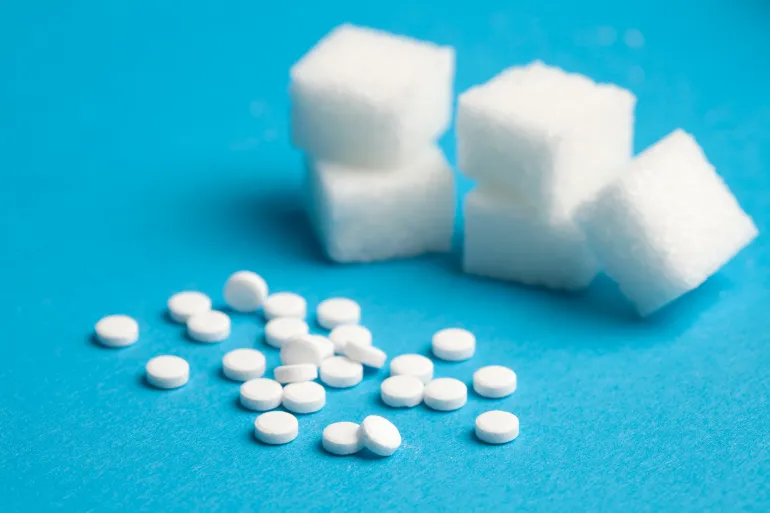
The effect is clearer before the age of 60
The association appeared more clearly in participants under the age of 60, especially in tests of verbal fluency and general thinking ability. The researchers did not observe the same strong relationship among older participants.
The association was also more pronounced among people with diabetes, which is a striking result because this group may rely more on sugar-free foods and drinks to help control glucose levels.
But the researchers indicated that there may be other factors that explain part of the results, such as underlying health condition, food quality, and frequent consumption of ultra-processed foods.
Are gut bacteria affected?
Interest in the effect of sweeteners on the brain coincides with other research studying their relationship with gut bacteria, which play important roles in metabolic and immune processes and communication between the digestive system and the brain.
In a separate laboratory study conducted by researchers from the University of Cambridge, the effect of 39 types of sweeteners on 25 strains of gut bacteria was tested.
The researchers found that a large number of the tested sweeteners affected the growth of at least one type of bacteria, and some effects changed when the sweeteners were combined with other substances, such as caffeine, flavorings, and some medications.
But these results were conducted in the laboratory, and do not prove that the same effect occurs inside the human intestine, or that it leads to a decline in memory and mental abilities.
Are sweeteners the reason?
The Brazilian study is observational, not a randomized clinical trial; That is, the researchers did not ask one group to consume sweeteners and prevented another group from eating them, and then compared the results.
Instead, they tracked the participants’ eating habits and then studied the relationship between them and changes in tests of memory and thinking. This type of study can monitor correlations, but it cannot conclusively prove cause and effect.
Diet assessment also relied on participants’ ability to remember what they were eating, a method that may be affected by forgetfulness or inaccurate estimation.
Sweetener consumption was assessed primarily at the beginning of the study, although dietary habits and product formulations may change over the following years.
The sample was limited to government employees in Brazil, which may limit the generalizability of the results to all populations and countries.
Are sweeteners safe?
The US Food and Drug Administration says sweeteners approved for use in foods do not raise safety concerns when consumed within permissible limits and conditions.
The Joint Expert Committee of the World Health Organization and the Food and Agriculture Organization also kept the daily acceptable limit for aspartame at 40 milligrams per kilogram of body weight.
But having a toxicologically safe daily limit does not necessarily mean that long-term reliance on sweeteners provides health benefits or helps prevent chronic disease.
In 2023, the World Health Organization recommended against the use of non-sugar sweeteners as a long-term means of weight control or non-communicable disease risk reduction.
The organization explained that the review of evidence did not show a proven and sustainable benefit in reducing body fat in adults or children, with health indicators that require further research.
Should I go back to sugar?
The results do not mean that sugar is the best alternative, or that people with diabetes should suddenly replace sugar with sweeteners. Eating large amounts of sugar is associated with weight gain, tooth decay, and a higher risk of metabolic disorders. It may also cause difficulties in controlling glucose levels in diabetics.
Instead, the study indicates that the phrase “diet” or “sugar-free” should not be treated as sufficient evidence that the product is healthy.
Reliance on very sweet drinks, whether sweetened with sugar or its substitutes, can be gradually reduced, and switched to water, unsweetened drinks, and whole foods as much as possible.
Diabetics should discuss any significant change in their diet with their doctor or dietitian, because the decision is influenced by medications, weight, blood sugar control, and the entire diet.
So, the study published in September 2025 adds new evidence to the scientific debate about the long-term effects of low- or no-calorie sweeteners.
Higher consumption of some of these substances has been linked to a faster decline in memory and thinking, especially in adults under 60 and those with diabetes.
But the results do not prove that one can of diet soft drinks causes brain damage, nor do they mean that participants lost 62% of their mental abilities.
The more accurate message is not to go back to sugar, but rather to reduce reliance on ultra-sweet products and ultra-processed foods, until clinical trials and long-term studies provide more conclusive answers.