

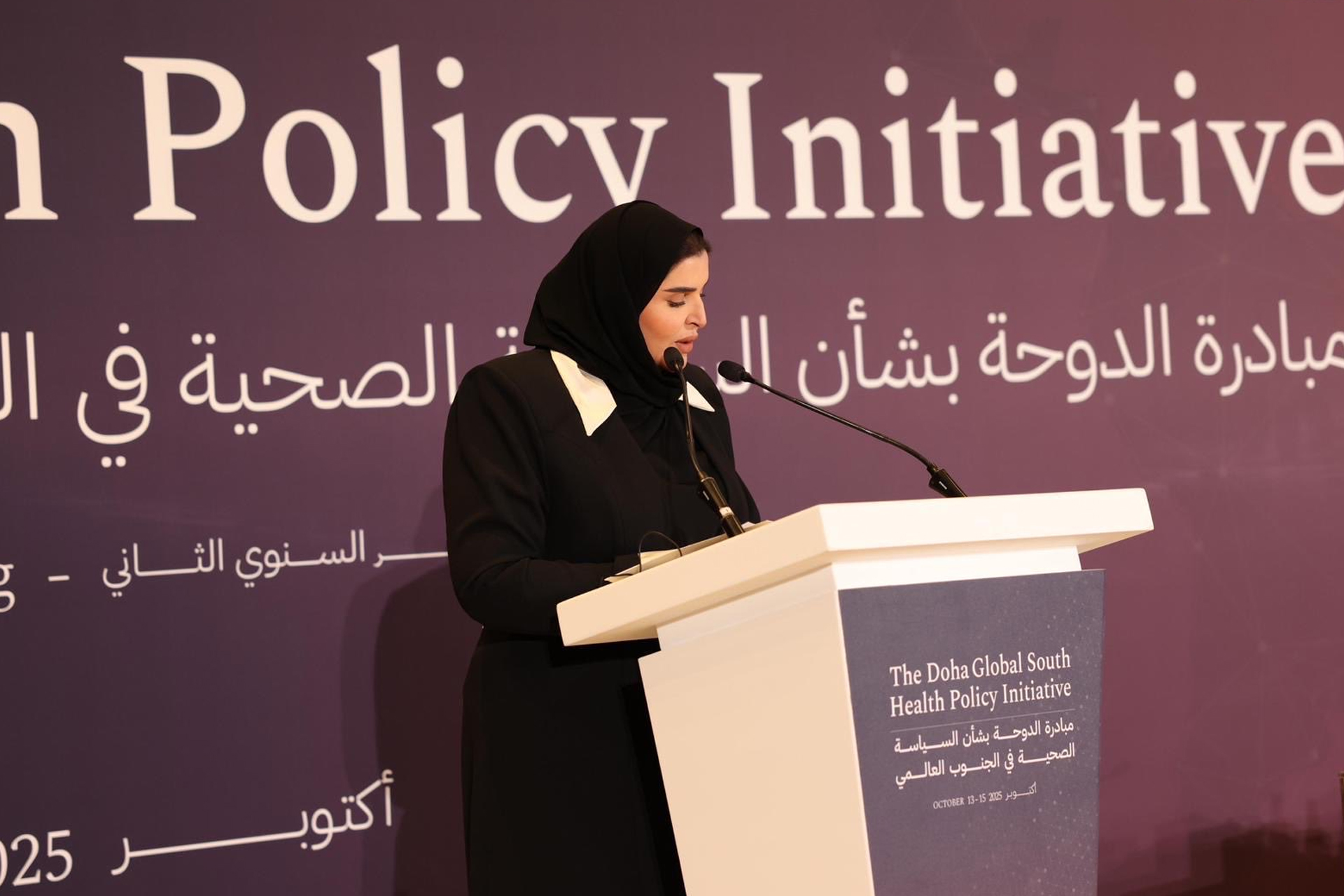
Qatar’s Minister of State for International Cooperation, Dr. Maryam bint Ali bin Nasser Al-Misned, participated in the second annual meeting of the Doha Initiative on Health Policy in the Global South 2025, which was held in Doha.
Her Excellency explained, in a speech, that this meeting is not only to review what has been achieved, but to continue a humanitarian journey that began with a vision that believes that health is not a privilege, but a right for every human being, wherever they are, pointing out that this initiative holds special importance for the State of Qatar, because it embodies its vision of cooperation, innovation, and collective responsibility in promoting global health.
The Minister stated that the State of Qatar supported the launch of this initiative, based on its firm belief that the countries of the Global South should not remain recipients of policies, but rather partners in their formulation, active in devising their solutions, and having a heard voice in the global dialogue about the future of health.
Her Excellency indicated that the disparity in access to health care remains one of the most prominent challenges in our world today, especially for women, girls and the most vulnerable groups, noting that in many countries, clinics are still far away, medicines are scarce, facilities are limited, health workers face burdens that exceed their capacity, and efforts are often directed towards treatment after the disease occurs, rather than prevention and early detection.
Her Excellency the Minister of State for International Cooperation explained that building effective health systems begins with prevention, education, the environment, and the human being himself, pointing out that health is not just a service provided, but a dignity that is preserved, a basic human right, and an indispensable pillar for achieving sustainable development.
Priority is health
She added, “We in Qatar believe that any local health crisis does not remain local, but rather its effects extend to everyone. Therefore, prioritizing health and addressing the social and environmental factors that affect it is the way to build more resilient, prosperous and just societies.” Her Excellency the Minister of State for International Cooperation said that the first meeting of the initiative frankly presented the challenges facing the implementation of health policies, from weak institutional capabilities and a shortage of cadres, to limited funding and infrastructure in rural and remote areas, noting that the recommendations of the 2024 report stressed the importance of sustainable investment in capacity building, enhancing coordination, and developing reliable data to make evidence-based decisions.
She added, “Qatar was guided by these recommendations last year, whether in its national policies or in its international efforts, to prove that a well-thought-out vision is capable of transforming into a tangible impact when will is combined with action.”
Her Excellency touched on the National Health Strategy 2024-2030, which was launched by Sheikh Mohammed bin Abdul Rahman bin Jassim Al Thani, Prime Minister and Minister of Foreign Affairs, to be an ambitious road map towards an integrated health system that puts people at the heart of its priorities, noting that the strategy focuses on prevention before treatment, integration of services between the public and private sectors, and fair and comprehensive access for all segments of society, from children and the elderly to people with disabilities.
The Minister continued, “Innovation, research and development constitute the focus of this strategy, because it is not limited to providing services, but rather seeks to build qualified national cadres capable of leading the future of health in Qatar.”
Her Excellency said that Qatar was, and still is, at the forefront of countries that consider health to be the basis for peace and human security, explaining that during the past decade, the Qatar Fund for Development provided more than one billion dollars in aid in the field of health care, from which more than fifty countries in the world benefited.
She added that Qatar has invested more than $690 million in building and developing hospitals and health centers, and providing them with ambulances and medical equipment in more than ten developing countries. In 2024, the Qatar Fund for Development and the World Health Organization launched a joint initiative worth four million dollars to strengthen primary health care systems and emergency response capabilities in developing countries.
Supporting maternal and child health services
Her Excellency continued: “In Afghanistan, Qatar extended its hand to support maternal and child health services in the most deprived areas. In Pakistan, it funded mobile clinics that provided services to more than five hundred and thirty thousand people affected by the floods. In Yemen, it cooperated with UNICEF to improve water and sanitation services. In Jordan, it contributed to the operation of the Zaatari refugee camp clinic, which provides health care to more than one person. Thirty thousand displaced people.”
Her Excellency indicated that the Qatar Fund for Development supported UNICEF with a contribution of eight million dollars, on the sidelines of the 2025 United Nations Economic and Social Council Forum, to ensure children in the world’s access to health, water, sanitation and hygiene services.
Her Excellency stressed that these combined efforts do not only express financial support, but rather a humanitarian vision that believes that building a strong health system is an investment in human dignity, and a firm Qatari belief that health justice is the cornerstone of achieving peace and sustainable development.
Her Excellency noted that the renewed health challenges cannot be faced by any country alone, explaining that they require sincere cooperation, continuous coordination, and joint accountability that makes us all responsible for the future of health in our world.
In concluding her speech, Her Excellency the Minister of State for International Cooperation affirmed that the State of Qatar continues to support initiatives that bring together governments, international organizations, civil society and experts, to unify efforts towards achieving the 2030 sustainable development goals.