When a country the size of Qatar hosts the World Cup, talk is not only about stadiums and organization, but rather about an exceptional experience that redefined the concept of the “combined World Cup,” as the tournament in the 2022 edition turned into a unique event during which fans and teams can move with unprecedented ease between stadiums and cities.
Today, as the start of the 2026 World Cup in the United States, Canada and Mexico approaches, the numbers are speaking again, but this time about the huge difference between the two versions, whether in distances, transportation, or even the nature of the fan experience.
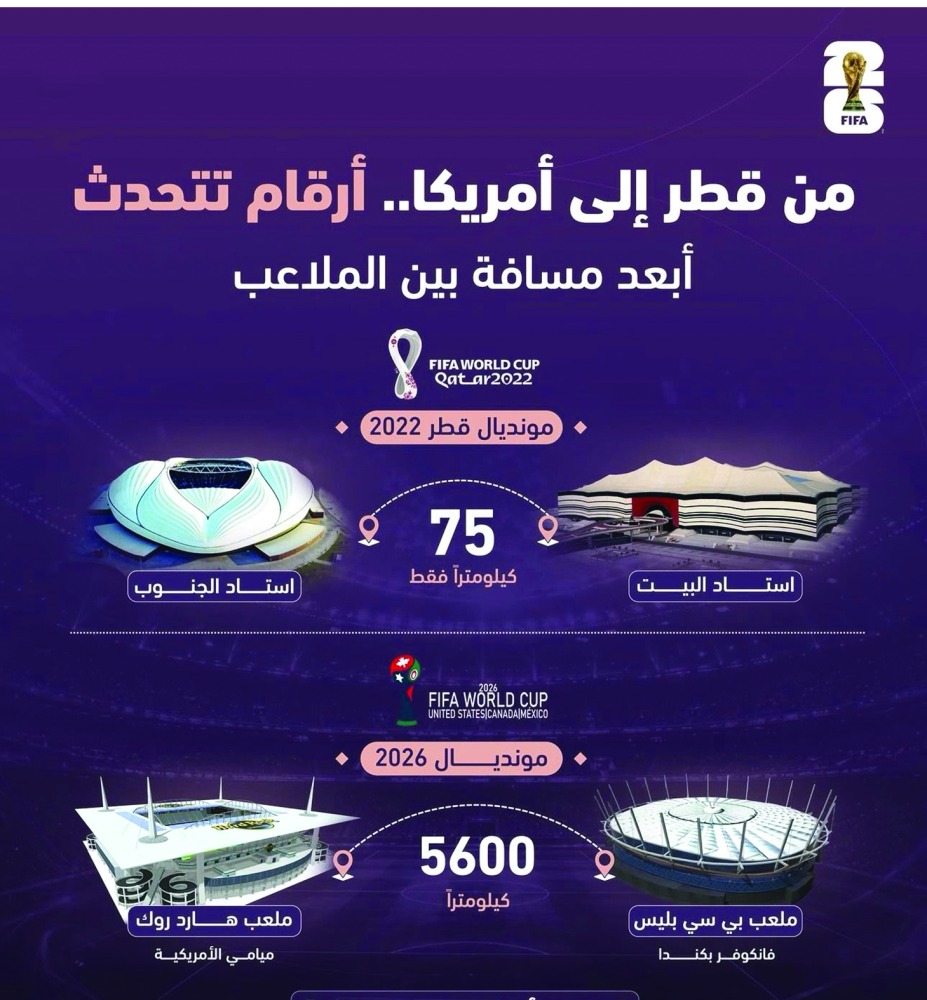
In Qatar, the farthest distance between two stadiums in the tournament was only 75 kilometers, between Al Janoub Stadium and Al Bayt Stadium, a distance that could be covered in approximately an hour by bus or car, which gave fans the opportunity to attend more than one match in one day, and also facilitated the task of the teams and the media in moving around and following up.
As for the 2026 World Cup, the picture looks completely different, as the farthest distance between the “BC Place” stadium in the Canadian city of Vancouver and the “Hard Rock” stadium in the American city of Miami is about 5,600 kilometers, which is a huge difference that reflects the expansion of the tournament and the multiplicity of host countries.
The numbers reveal that the difference between the two versions exceeds 74 times. While the bus was sufficient to travel between the stadiums of the World Cup in Qatar, long flights will become an essential part of the diaries of the teams and fans in the 2026 edition.
The close distances in Qatar were not just a logistical advantage, but rather gave the tournament an exceptional character, as the fans experienced the entire atmosphere of the World Cup within a limited geographical area, with easy access to stadiums, fan zones and accommodation, which many considered one of the most prominent secrets of the success of the World Cup in Qatar 2022.
This also helped the players and technical staff reduce fatigue resulting from travel, and focus more on the technical and recovery aspects, at a time when the 2026 World Cup teams will face great challenges related to long travel, time differences, and constant movement between cities and countries.
Despite the huge potential possessed by the countries hosting the 2026 World Cup, the digital comparison reaffirms the uniqueness of the Qatari version, which presented a different model for the World Cup, combining modernity, ease of movement, and the closeness of the stadiums in an experience that is still present in the memory of football fans around the world. The Qatar 2022 World Cup remains an exceptional case in the history of the tournament, after the numbers proved that the “shorter distance” created an experience that may be closest to the hearts of the fans.