

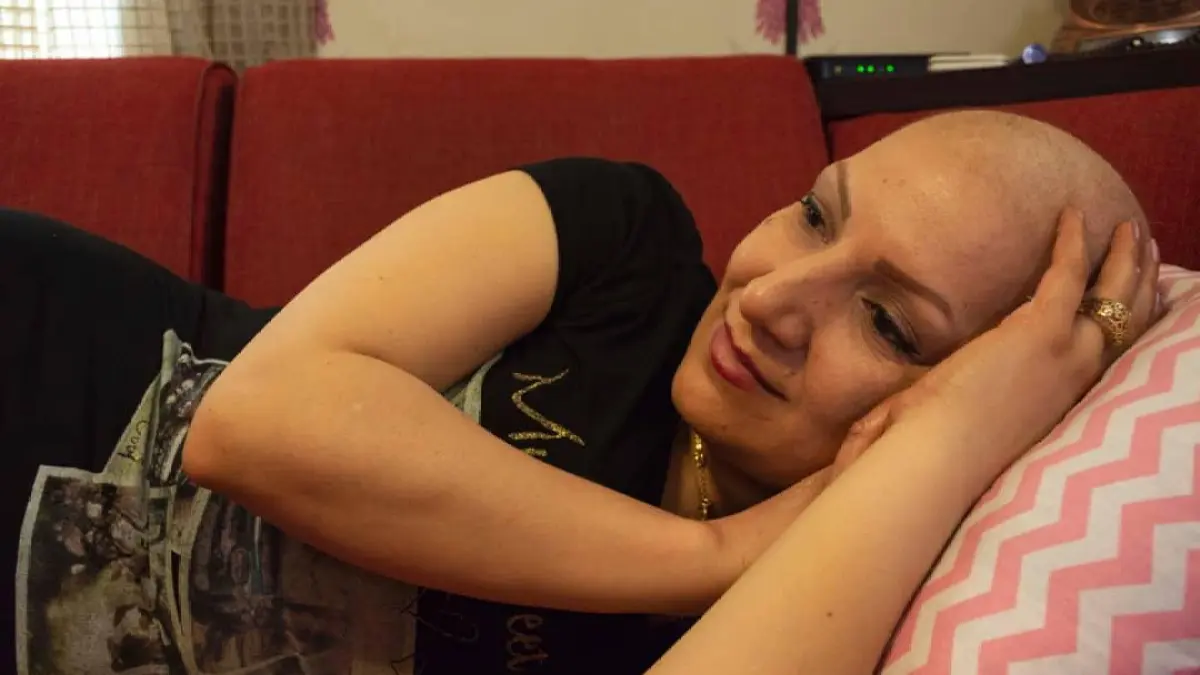
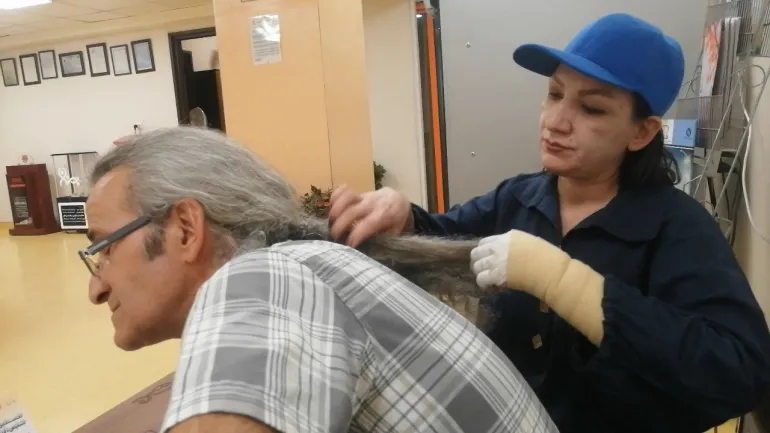
Tehran- In a small apartment in the center of the Iranian capital, Tehran, fifty-year-old Linda Brinji stands in front of the mirror and looks at her smooth head after all her hair fell out as a result of receiving chemotherapy doses. She did not grieve over its loss, but instead turned to her husband, Mohsen, so she grabbed a comb and began combing his hair. She said: “If the disease takes away my hair, I will take revenge on it by taking care of my companion’s hair.”
This scene was only a very short chapter of a long story that began about 21 years ago, when Linda was 32 years old, an Arabic language teacher, and married for one year, but she still carried in her body the memory of 8 cancer cases, as well as a number of battles with treatment, and then returns to life.
Linda narrates her suffering with breast cancer to Al Jazeera Net, recalling the small lump she felt in her left breast in 2005, but she did not pay attention to it until her weight began to decrease for no reason. She and those around her thought it was due to excessive activity, and when she finally went to the doctor, the lump had grown and the disease had spread to nearby tissues.
Hard shock
She went on to narrate: “The shock of the diagnosis was severe, but I returned home and started dancing and moving my hair strands in the air. Some people thought that I had lost my mind, so I told them that with the start of the treatment journey I would not be able to do many things, so they left me alone so that I could dance as much as possible instead of crying.”
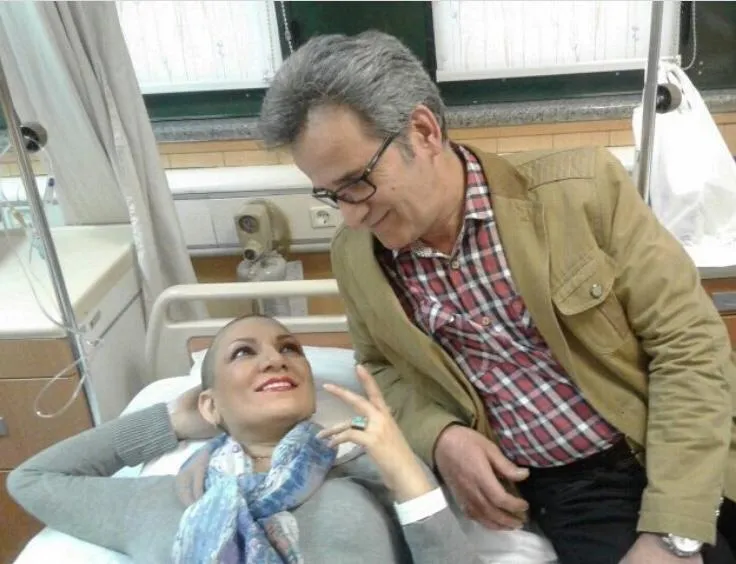
But the worst thing was what Linda once heard from a doctor that she would only live a few days, but she refused to write her end in anyone’s mouth, saying: “I am no longer willing to allow a number or an expectation to decide my fate,” so she decided to fight the battle of will despite the painful blows that were being dealt to her body with every chemical dose she received.
Four years after the first recovery, the disease returned again, aiming its arrows at the lymph nodes. She underwent surgery and radiation treatment again, but she had learned early detection and returned to life quickly. The matter happened again 3 years later when the cancer spread to the lung, and here the doctor lost hope and was frank: “We no longer have anything to do, and we cannot rely too much on the treatment,” but she did not give up, and what happened she described as “beyond the calculations of science.”
Then she was silent for a while before continuing: “I could have died after receiving the first dose of treatment, but I lived for 20 years after that, and I consider all these years a gift and a valuable opportunity that might not have been there.” After the lung, the disease spread to her second breast and other organs 5 times, until she knew from the change in her body odor that the disease had returned before the doctors confirmed it, stressing that breast cancer is hereditary in her family, and that major shocks – whether deep sadness or tremendous joy – affect its course.
The treatment battle
But the battle was not only with cancer cells, but with access to medicine. She remembers the first days of her injury, when some types of imported medicines sometimes disappeared from Tehran pharmacies, so patients’ families were forced to search for them in other cities or provinces, or import them from abroad, until, by 2013, Iranian companies began importing raw materials and manufacturing them locally, so the medicine became permanently available.
However, following the tightening of sanctions two years ago, medicines began to be absent from pharmacies, according to Brinji, who confirmed that following the recent imposition of the sea and air blockade and the cutting off of supplies of raw materials, securing medicine has become very difficult, adding that “the problem is not only the lack of availability of the medicine, but rather its failure to arrive at the appropriate time.” What is worse is that the door to individual imports from abroad has been closed for months due to the blockade.
Pointing out that prices have multiplied several times, and that the cost of examinations and radiological imaging has risen more than five-fold in just two years, Linda describes the reality of patients under siege in her country these days in one sentence: “An unequal struggle between the bodies of innocent people and cancer cells.”
Most common
Linda’s story is only a small window into a broader scene in Iran. Breast cancer in this country is not an individual story, but rather a large health and social file in which infection numbers intersect with early detection programs, and in which the suffering of infected women is intertwined with sanctions, blockades, and high treatment costs.
For his part, former spokesman for the Iranian Ministry of Health, Kianush Jahanpour, provides an overview of the reality of the disease, the national programs, and the challenges facing the health system in his country, considering breast cancer to be one of the most common types of this disease, and stressing that the Ministry of Health has been implementing for nearly two decades a national plan for early detection at all levels of the health care network in rural areas and cities.
Speaking to Al Jazeera Net, Jahanpour reveals that the coverage rate recorded in electronic records is about 25%, but he adds that the real coverage is higher than that. Because many people conduct early detection tests in the private sector outside the government system, stressing the launch of periodic educational and diagnostic campaigns, in addition to self-care awareness campaigns and the continuous preparation of diagnostic and treatment centers at all levels.
He points out that breast cancer in Iran appears about a full decade before the global average age, adding that national data show a continuous increase in the number of cases discovered over the past years, an increase reflected by multiple factors, some of which are linked to increased awareness and early detection, and others are linked to health and social transformations, lifestyle, pollution, and other factors.
Sanctions and blockades
Jahanpour explains that the National Early Detection Program targets women from 30 to 69 years of age, and that the first level of it is free, while the affected person bears part of the cost in the next stages of treatment. He also reveals that about 19,000 Iranian women are infected with breast cancer annually, which is equivalent to one infection approximately every 28 minutes.
Jahanpour continued that with the tightening of sanctions in recent years, especially following the recent imposition of the naval blockade, his country is facing great pressure in importing raw materials for treatment and supplies for nuclear medicine and radiotherapy, not to mention the huge increase in cost. Expenses related to access to therapeutic and diagnostic equipment have doubled, making obtaining diagnostic and treatment techniques an expensive matter that threatens the family economy, the continuation of the treatment course, and the health of the rest of its members.
Based on the challenges mentioned by Jahanpour, Linda explains that after her illness she turned into an awareness activist. She began sharing her experiences on social media platforms under the hashtag “Cancer is Treatable,” providing advice to Iranian women about the disease, especially breast cancer, directing infected patients to doctors, and communicating with charitable organizations to collect financial aid for patients with limited income.
Linda looks to the sky and says: “We must not forget that life is a gift, but what worries me today is not death, but rather that an injured person loses her hope of recovery for no reason other than that the medicine did not arrive on time,” which is a bitter testimony to those patients who struggle both with pain and the difficulty of receiving treatment under siege.