

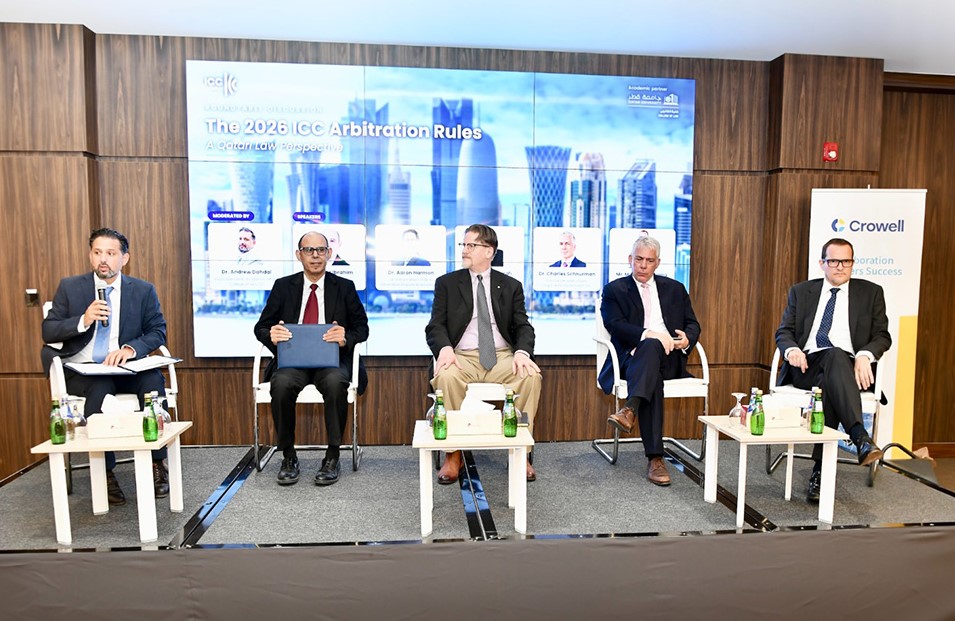
The International Chamber of Commerce Qatar (ICC Qatar), in cooperation with the College of Law at Qatar University, organized a symposium entitled: “The 2026 International Chamber of Commerce Arbitration Rules from the Perspective of Qatari Law,” with the participation of an elite group of academics and experts in the field of arbitration.
The symposium discussed the International Chamber of Commerce’s Arbitration Rules, which were revised in June 2026, and the practical implications of these amendments for companies, legal practitioners and beneficiaries of arbitration services in Qatar, with a focus on enhancing the efficiency, flexibility and transparency of procedures, and their compatibility with Qatari arbitration law.
The symposium focused its discussions on the most prominent amendments to international arbitration rules and their implications on the legal environment and business sector in Qatar.
It also addressed the practical repercussions of the amendments introduced to the arbitration rules in June 2026, and the most prominent changes compared to the 2021 rules, including canceling the document defining the tasks of the arbitration panel, holding an initial case management meeting, procedures for early settlement of claims, developing expedited arbitration procedures, in addition to emergency arbitration, temporary measures, disclosure requirements, the independence of arbitrators, and the digitization of arbitration procedures.
Her Excellency Sheikha Tamader Al Thani, Secretary-General of the International Chamber of Commerce Qatar, said that studying the extent of compatibility of the new arbitration rules with the Qatari arbitration law is essential to providing clear guidance to companies and legal practitioners, noting that cooperation with the College of Law at Qatar University aims to transform legal studies related to the amendments into practical insights that support the practice of arbitration in Qatar.
During the symposium, Dr. Nader Ibrahim, Professor of Commercial Law, discussed the adoption of electronic correspondence as a primary means of communication, stressing its role in enhancing the efficiency, flexibility and sustainability of arbitration procedures.
Dr. Aaron Harmon, Sir William Blair Chair in Alternative Dispute Resolution, said that replacing the arbitral tribunal’s duties document with improved case management procedures would contribute to simplifying and accelerating arbitration procedures, while enabling arbitral tribunals to identify and organize the issues in dispute at an early stage in the course of the case.
In turn, Dr. Charles Schnorman, clinical lecturer of law in the Legal Skills Department, described the introduction of Article 30 related to early dismissal as an important development, as it allows arbitral tribunals to exclude claims, defenses or issues that clearly lack a good basis at an early stage, while ensuring due process is observed.
Mr. Matthew Williams, legal advisor at Crowell & Moring Law Firm, emphasized that the choice of arbitration procedures should be based on the complexity of the dispute and the willingness of the parties, and not only on its value or the speed of its resolution.
He added that the 2026 amendments enhanced the importance of emergency measures procedures, while continuing the pivotal role of local courts in obtaining temporary measures.
For her part, Dr. Sarah Hamad Al-Qarah, Assistant Professor of the Law Department and Head of the Legal Skills Department, said that cooperation between academia and legal practitioners is essential for developing arbitration practices and supporting their continued development in the State of Qatar.
The symposium comes within the framework of the International Chamber of Commerce Qatar’s commitment to enhancing awareness of developments in the field of international arbitration, supporting the legal community and the business sector, and consolidating Qatar’s position as a regional center for dispute resolution.