


Headphones have become a part of daily life, whether listening to music, making calls, or watching videos and games, and with their diversity between headphones that are placed inside the ear, those that cover them, and bone conduction headphones, a question arises: Is there a type that is less harmful to hearing?
The answer is not related to the shape of the hearing aid alone, as the risk of noise-related hearing loss is primarily determined by the volume level, duration of listening, and frequency of exposure. The louder the sound, the more dangerous it is to the ear.
Large speakers may give an advantage
Ear, nose and throat consultant Dr. Ahmed Al-Hajj says that there is no headphone that can be described as completely safe, or as the safest in all circumstances, explaining that headphones that cover the ear may be a good option, especially if they are well insulated or equipped with an active noise cancellation feature.
He added – in an interview with Al Jazeera Net – that this preference is not due to the earphone being farther from the eardrum, but rather to its ability to reduce ambient noise, which reduces the user’s need to raise the volume.
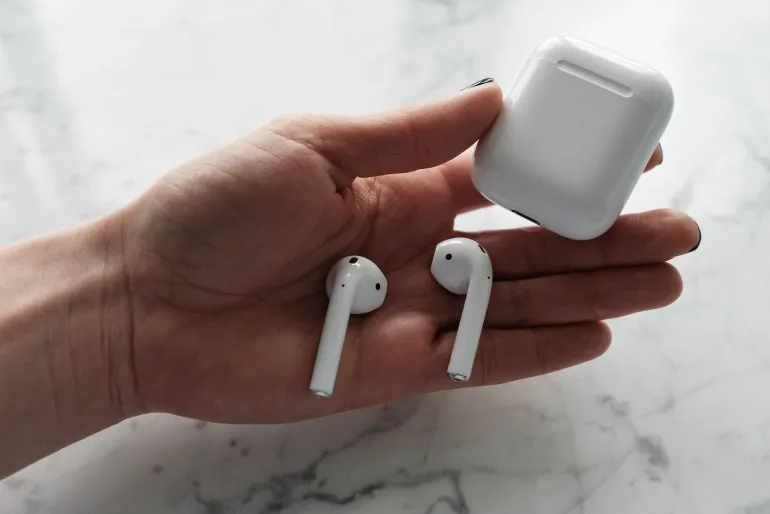
As for earbuds, they are not dangerous simply because they are near the eardrum, and their use can be relatively safe if the volume level is low.
The World Health Organization recommends using good, suitable headphones equipped with noise cancellation, which help avoid raising the volume in noisy places. Houston Methodist Hospital also confirms that noise canceling headphones may help protect hearing indirectly, because they reduce the need to increase the volume to overcome the noise of the surrounding environment.
Are in-ear headphones more dangerous?
Dr. Al-Hajj confirms that the belief that the proximity of the earphone to the eardrum automatically makes it more dangerous is an “inaccurate simplification,” as the damage resulting from noise depends mainly on the intensity of the sound, the duration of exposure, and its frequency. Therefore, an in-ear earphone used at a low volume may be safer than a large earphone used at a very high volume.
Ear, Nose and Throat Consultant Dr. Musa Zayed says that prolonged use of headphones that are placed inside the ear may lead to friction and skin infections. It may also hinder the natural exit of earwax and push it inside, which increases the possibility of its accumulation.
Zayed added that wax accumulation may lead to a feeling of clogged ears or poor hearing, and therefore prolonged use of in-ear headphones should be avoided and attention should be paid to their cleanliness, especially for people who are most susceptible to wax accumulation.
American University Hospitals indicates that prolonged use of in-ear headphones may trap moisture and create an environment that helps bacteria grow, so it advises taking breaks, cleaning the headphones regularly, and not sharing them with others.

Is bone conduction safer?
Bone conduction headphones may seem safer because they do not enter the ear canal, but rather transmit sound vibrations through the bones of the skull to the inner ear.
But Al-Hajj warns against considering them immune to harm, explaining that the hair cells in the inner ear remain vulnerable to being affected if the sound level is high enough, and therefore the different method of sound transmission does not eliminate the risk of hearing loss resulting from excessive exposure to sound.
These headphones are characterized by keeping the ear canal open, which may be useful for those who need to hear ambient sounds during some activities, but a report published by NDTV indicates that the volume level and duration of use are essential factors when evaluating the safety of listening, whatever the headphone technology.
The volume level is more important than the type of speaker
The World Health Organization sets a level of 80 decibels for adults for up to 40 hours per week as the reference level for safe listening, but the duration decreases quickly as the volume level increases, reaching 90 decibels for up to 4 hours per week, and at 100 decibels for only about 20 minutes.
The organization also recommends – when using personal devices – keeping the volume level at less than 60% of the device’s maximum, in addition to reducing the time a person spends listening to loud sounds and taking regular breaks.
Dr. Al-Hajj points out that the “60/60” rule, meaning listening at about 60% of the volume level for a period not exceeding 60 minutes before taking a break, can be treated as a practical rule that helps encourage safer listening habits, and is not a precise medical limit that applies to all devices and people.
Signs that should not be ignored
Hearing damage caused by noise may occur gradually and painlessly, so a person may not notice it at first. Dr. Al-Hajj says, “The most prominent warning signs are the appearance of tinnitus after listening, or the feeling that sounds have become muffled, or difficulty understanding speech in noisy places or on the phone, or the need to raise the volume of devices more than usual.”
He added that the repeated appearance of these symptoms requires reducing exposure to sound and conducting a hearing evaluation if they persist.
In conclusion, it is not possible to choose the least harmful speaker based on its appearance alone. Over-the-ear headphones with good isolation or noise cancellation may give a practical advantage because they help you hear clearly at a lower level, but the most important factor remains the dose of sound that reaches the ear.
Lowering the volume, reducing the duration of use, taking breaks, and taking care of the cleanliness of the headphones are all more important factors for protecting hearing than simply choosing between an in-ear, an above-the-ear, or a bone-conduction headphone.