

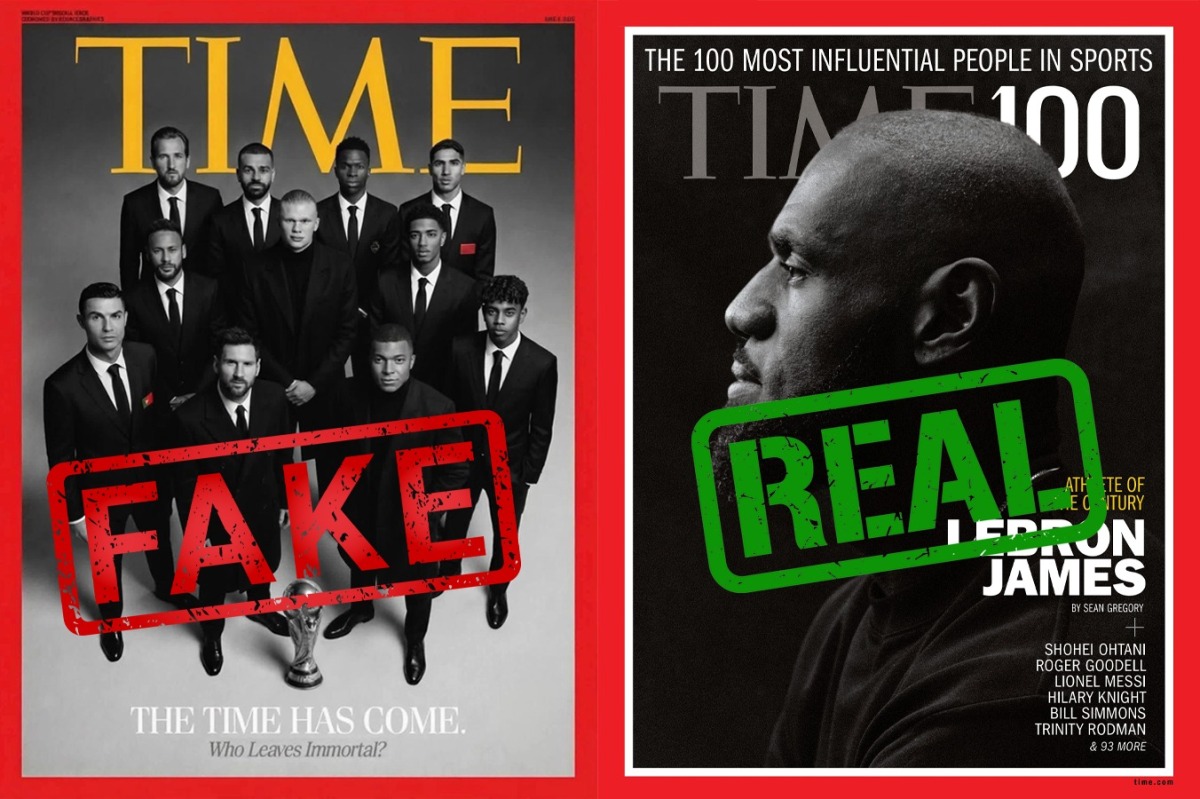
A circulated image simulating the cover of the famous American magazine “Time” sparked widespread interaction on social media platforms, as the image included a number of the most prominent football stars expected to attend the 2026 World Cup, in a dramatic scene bearing the striking title “THE TIME HAS COME- Who Leaves Immortal?” Or “The moment has come… who will leave forever?”
The truth is that the cover was designed with artificial intelligence, and this was evident through some changes in the features of the players and the inaccuracy of the cover that Time used in its publications. What confirmed this was Time magazine’s release of its latest issue yesterday, Tuesday, celebrating the list of “The 100 Most Influential People in Sports for the Year 2026,” and the international basketball star LeBron James topped the cover, celebrating his achievements and his exceptional career.
The “fake” cover, which spread “virally” on social media, shows a group of the game’s stars in a group photo in black and white, with elegant formal looks and classic suits, surrounding the gold World Cup, in a visual attempt to summarize the extent of the emotional and historical stakes surrounding the next edition of the World Cup, which will be held in the United States, Canada and Mexico with the participation of 48 teams for the first time in the history of the tournament.
It seems that whoever designed the cover used emotional dimensions that touch football fans and fans of these legends, as the unreal “Time” cover included huge names from different generations, including Messi, Cristiano Ronaldo, Mbappe, Haaland, Bellingham, Neymar, Harry Kane, Hakimi, Vinicius Jr., Lamine Yamal and Mohamed Salah, in a combination of legends who made the history of the game, stars living the peak of their careers, and young talents preparing to inherit the stardom of the world football stage.
This spread was not just a passing interaction with an attractive picture or a magazine cover, but rather seemed closer to a reflection of the global state of anticipation surrounding the 2026 World Cup, as a tournament that may bear a symbolic farewell for an entire generation of football legends.
For many, this edition may be the last global appearance of the duo “Messi and Cristiano” on the World Cup stage, after more than two decades of historical competition that shaped the conscience of an entire generation of game fans.
Messi, who won the World Cup in Qatar 2022, enters the scene this time as a defending champion, and on a land he knows well after he moved to Inter Miami, while Ronaldo’s potential participation with the Portugal national team is seen as almost the last chance he has to achieve the dream that has remained far from him throughout his international career.
It was also noteworthy that Mohamed Salah was present among this constellation of stars, in clear recognition of his status as one of the most prominent players of his generation in the world.
Salah is competing in this tournament after his departure from Liverpool, with whom he won local and European titles during his career, and he carries on his shoulders great aspirations from both Egyptian and Arab fans in a long-awaited World Cup, especially since Egypt missed the last World Cup in Qatar 2022.
On the other hand, the presence of names such as Mbappe, Bellingham, Vinicius and Haaland gives the picture another dimension, as the matter does not stop at the farewell of the generation of Messi and Ronaldo, but rather extends to the struggle of a new generation seeking to impose its dominance in world football.
Mbappe, who led France to the 2018 title and the 2022 final, enters the next tournament loaded with huge expectations, while Bellingham and Vinicius represent examples of two stars who are experiencing a great rise at the club and national team levels.
As for the choice of Lamine Yamal, the youngest face in the design, it carried a clear symbolic meaning, as his presence alongside Messi and Ronaldo seemed like a notification of the passing of the torch from one generation to another.
The young Spanish player, who caught attention at an early age, stands in the same photo with names that made modern football legends, indicating that the 2026 World Cup may be at the same time the end of an era and the beginning of another.
Despite the wide interaction with the design, it is not an official cover issued by “Time” magazine, but rather a popular visual work that mimics the magazine’s identity and the style of its famous covers.
Time had published an official cover for the 2026 World Cup featuring American star Christian Pulisic under the title “Captain America,” in reference to his expected role with the United States national team during the tournament, which will be held partly on American soil.
What is noteworthy is that the unofficial version circulating found a greater resonance among football fans, because it presented what seemed like “the image that the audience was waiting for,” an image that does not limit itself to representing a host country or one star, but rather brings together the entire World Cup scene in one frame: the dream, farewell, inheritance, and the struggle for immortality.
Perhaps the secret of the spread of this “virtual” cover is due to its connection with the football passion of the fans, especially since the World Cup is not only seen as a sporting event, but rather as a major platform for creating legends. There are players who enter the tournament in search of the title only, and other players who seek to confirm their football legacy, fully aware that the opportunity only comes once.
In this sense, the question written on the design was not “Who will leave immortal?”
Just a propaganda phrase, but rather a question that sums up the essence of every edition of the World Cup: Who can turn the tournament into an eternal moment in the game’s memory? Who will emerge from it having written the final chapter in his legend?
As the tournament approaches, it seems that the 2026 World Cup will not just be a larger version in terms of the number of teams, stadiums, and fans, but rather it may become one of the most crowded World Cups with human and sporting stories, between legends bidding farewell, stars chasing glory, and new talents trying to begin their story from the largest football stage in the world.