

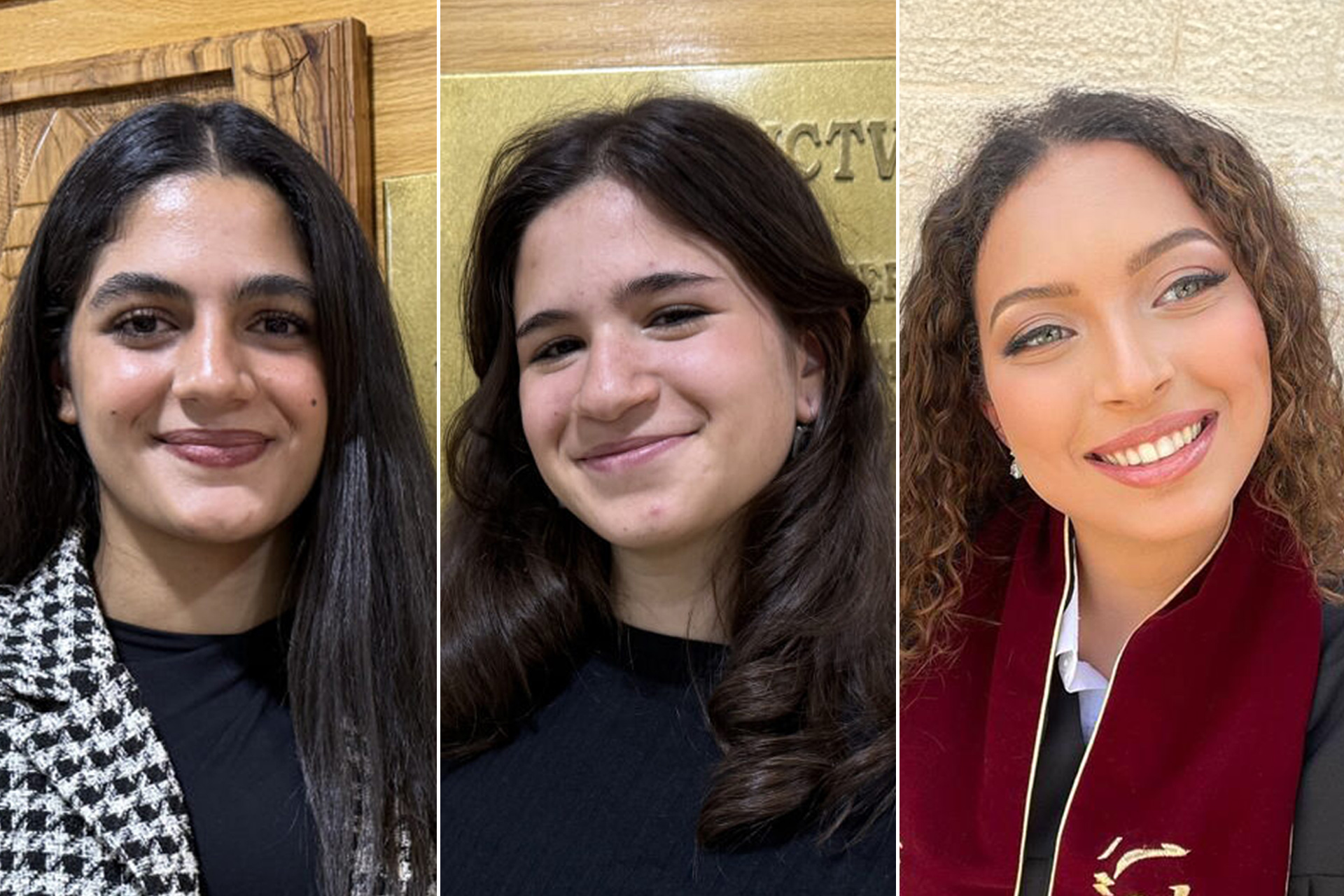
Three Jerusalemite girls achieved a scientific achievement by participating in publishing specialized research papers in the field of nerves and the brain, an achievement celebrated by the occupied city of Jerusalem, where the girls explained their experience to the public in an exceptional research symposium held the day before yesterday, Saturday, at the historic Notre Dame Hotel.
Remas Sayed, Tia Abu Sneineh, and Jana Qutb are the first three girls in the Middle East to participate in preparing scientific research and succeed in publishing it in an international academic journal while they are still students, which is Frontiers for Young Minds.
Fremas Sayed and Tia Abu Sneineh participated in the research paper titled “How can lavender oil help protect your brain?” In this study, the work team found that lavender oil can help AMPA receptors, which are ionic receptors that allow electrical charges to pass between nerve cells, to remain open for a little longer, without causing any damage. This may help protect the brain and treat its disorders in the future.
As for Jana Kotb, she participated in the research paper titled “A vitamin-like substance that protects the connections between brain cells.” During the study, lipoic acid was added to cells that contain AMP receptors, and it was noted that it kept the receptors open for a slightly longer period, which may prevent damage to brain cells.
The team reached the conclusion that this acid may be useful in treating brain diseases by helping receptors work at the correct level to maintain its integrity.
The two research papers were supervised by the founder and director of the Palestinian Neuroscience Center (Neuropal), a private research and educational center, Dr. Muhammad Qanibi.
Determine the university path
In the presence of a diplomat and a group of doctors with several specializations, the two students, Jana Qutb and Tia Abu Sneineh, were honored, as well as the graduate Remas Sayed, who completed high school months ago and went on to receive her university education in France in the field of neuroscience.
Remas graduated from the Rosary Sisters Secondary School in Jerusalem, and the two students, Jana and Tia, are still receiving their education in the same school. They are the first three female school students in the Middle East to publish scientific research in the field of neuroscience in the international scientific journal “Frontiers for Young Minds,” which is concerned with presenting scientific research based on the latest results and discoveries in various fields, while facilitating it for children and young people, which makes science close and understandable to these two groups.
Over the course of an hour and a half, the Jerusalemite girls answered a set of questions related to their research, their career in scientific research, and their future prospects.
Al Jazeera Net asked Rimas Sayyed about her own career, and she said that she started through the “TOBE” program at the Palestinian Neuroscience Center, and later became part of its leadership team, as she “had the honor of guiding younger students and supervising their theoretical and practical work in the laboratory.”
In her last year of school, i.e. in high school, Remas said that scientific research gave her tools that she did not know she possessed, such as discipline, critical thinking, and perseverance, and thanks to that, she confirms that she was able to obtain second place at the level of the Jerusalem Governorate in the scientific branch.
She adds that these tools are now helping her to form a mindset that faces challenges in her university career, in addition to the courage to speak and the curiosity to explore, noting that she proposed an idea for a scientific blog in one of the university’s courses entitled “The Earth is the First Pharmacy,” and she is leading this project, which falls within the same field in which the scientific research in which she participated was published.
A life-changing experience
“The Palestinian Neuroscience Center made me realize the extent of the impact of scientific research on me. It taught me to think like a scientist, understand what professors expect, and view science as discovery, not just indoctrination and memorization,” the young woman from Jerusalem added.
As for Tia Abu Sneineh, who participated in the scientific research itself, she said that she found herself part of a rare scientific process in her homeland, and that her role was effective in collecting information, analyzing the results, and participating in formulating the scientific research, which allowed the use of advanced medical and scientific tools and learning about laboratory research methods up close.
She added that this experience added a lot to her, as it contributed to changing the course of her life and her way of thinking, whether in terms of academic progress in scientific subjects, or socially in terms of her self-confidence, and finally in shaping the features of her university career, which she decided to pursue in the field of medical sciences.
As for the student Jana Qutb, who participated in the research paper “A vitamin-like substance protects the connections between brain cells,” she indicated that this experience helped her develop her skills in collecting and analyzing data and drawing conclusions. She said that she felt “pride, accomplishment, and ability to achieve goals despite all the challenges we are experiencing.”
Trust in Palestinian minds
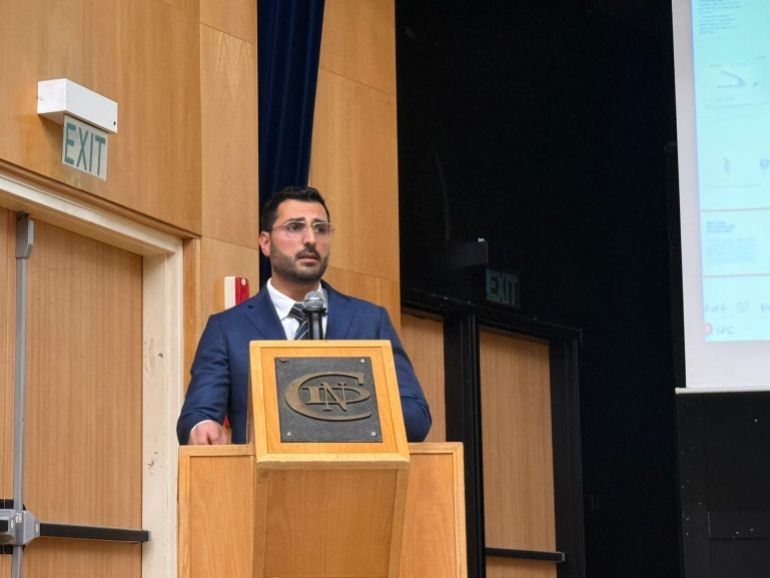
Muhammad Qanibi, who listened carefully to his students’ answers, answered when asked how he felt when he saw these students armed with the principles of scientific research and setting off from this city by saying that he felt joy and pride, and that this achievement “deepens my belief in the capabilities of our Palestinian students and minds, and confirms that our students are capable of competing and excelling in various scientific fields, and that they possess the real potential to achieve impressive scientific achievements at the regional and international levels.”
Regarding the extent to which this experience contributed to supporting female students for the university stage, starting with their admission to universities, through assisting them in the field of scientific research, Qunaibi stressed that the presence of a published research by a student at the school stage is considered a major achievement, and reflects that he is an ambitious, diligent and distinguished person.
He added, “This achievement gives the students an advantage in university admission files, as it shows the student’s commitment and ability to achieve big goals even at a young age. From a psychological standpoint, this experience gives the students high self-confidence, because they overcame great challenges and accomplished what initially seemed impossible.”
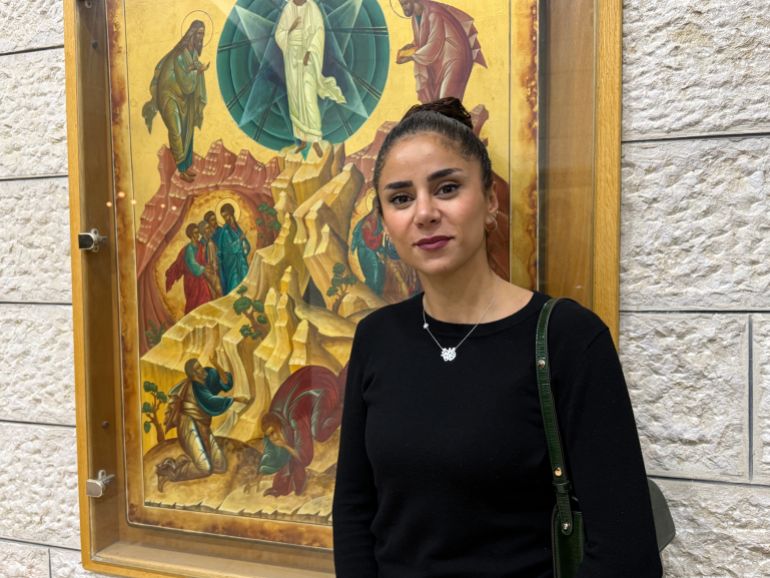
For her part, dentist Rawan Al-Rifai was keen to attend this research symposium, and says that she felt proud of the existence of a Palestinian center that develops children’s capabilities in the field of scientific research, and helps them determine their inclinations and future academic path.
What was striking for Dr. Al-Rifai was the high confidence with which the three girls spoke, the depth of their knowledge, and their involvement in scientific experiments that were not available to children in previous generations.