

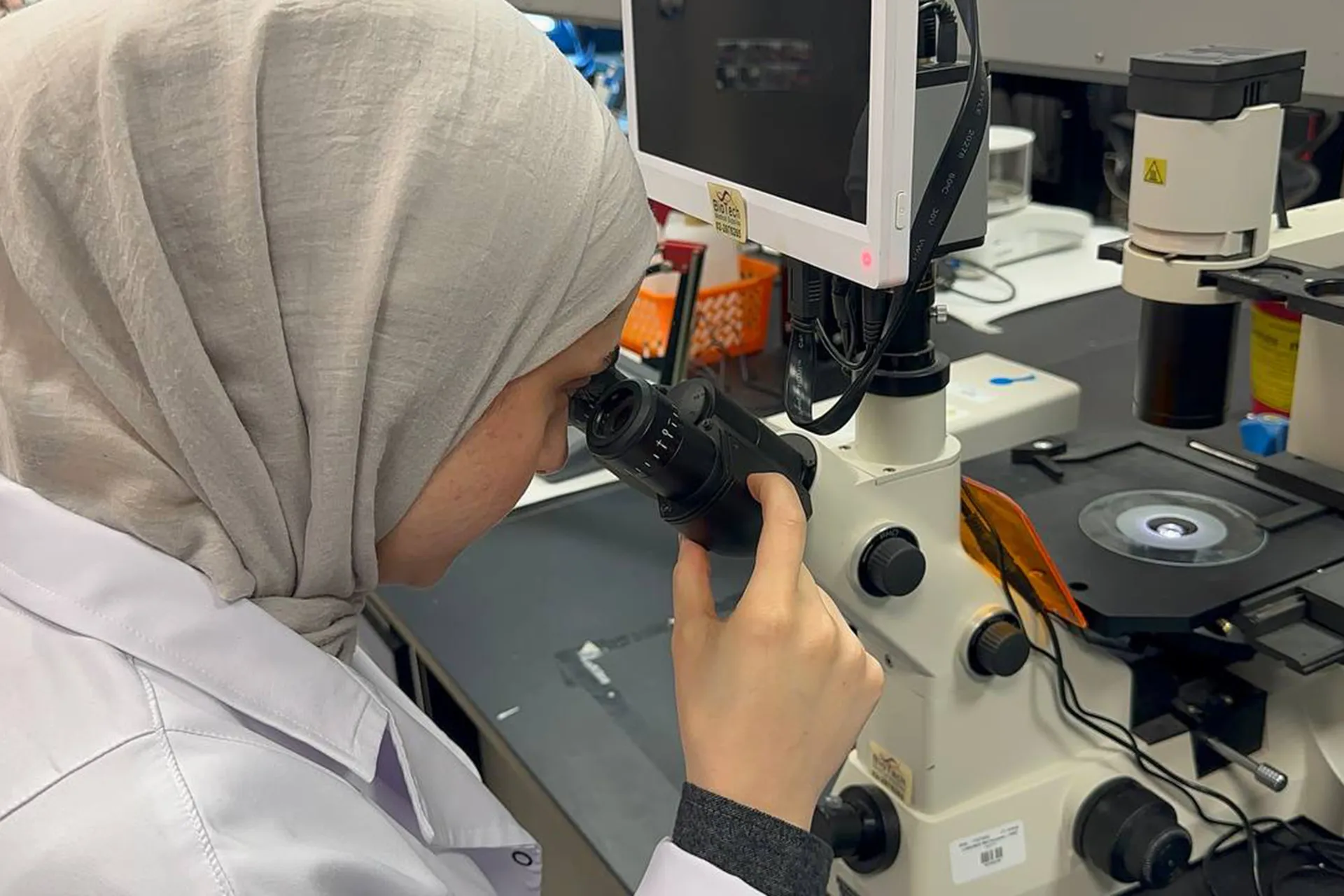
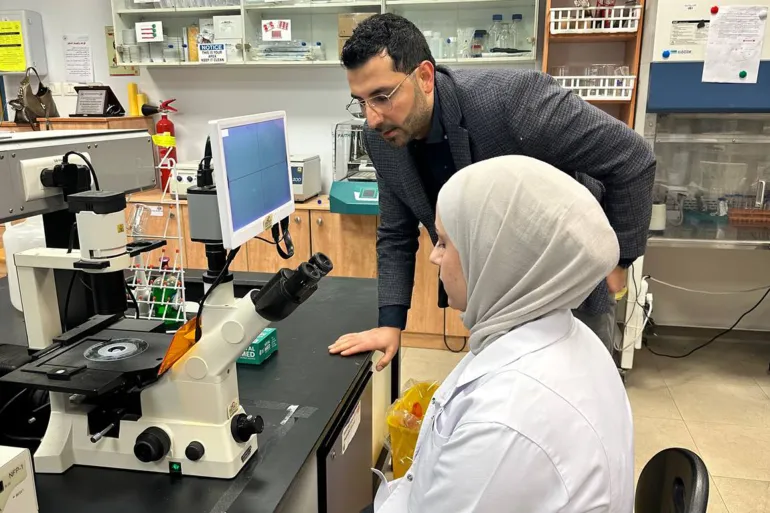
Inside the neurological laboratory at An-Najah National University in the northern West Bank, student at the Faculty of Human Medicine, Susana Badir, was finishing reviewing the results of her latest research with her supervising doctor, before moving to the examination hall to take her scheduled exam.
Six years ago, Susana became accustomed to the neurological laboratory being part of her university day, where she took her first steps towards scientific research and the study of neural receptors in the brain.
Susana explains to Al Jazeera Net the nature of the research activities she used to carry out, saying: “We study nerve receptors in the brain called AMPA, where we mainly study their motor activity and their influence on some chemical and natural compounds, and based on the results we obtain, we complete these studies to determine their influence on other compounds, and so on.”
International experiences
Susana lives with her family of nine members in the city of Tulkarm in the northern West Bank, and spends her days studying and scientific research at the university, and counseling meetings and electronic conferences after her return home.
She says that she took a summer vacation twice during her six years of study, and on one of them she was able to travel with a group of medical students from Palestine to UH Hospital in Cleveland, Ohio, in the United States.
She explained to Al Jazeera Net her three-week scholarship experience, saying: “It was a research training in the Department of Radiation Cancer Treatment, and most of our focus was on Health Informatics and Learning Health Systems in Radiation Oncology, with full-time work within the department.”
She added: “It was a very fruitful experience for me, because during my studies I did not train in oncology departments in hospitals here, especially since there is no radiation therapy in West Bank hospitals. In addition, we got to know Arab and foreign students and exchanged experiences and information with them.”
Susana chose to specialize in human medicine after excelling in high school with a grade of 99.1. Despite the difficulty of the specialization and its need for a great deal of time and effort, she was able to join the scientific research team that was established eight years ago in the College of Medicine, from her first years of study, and to date, to date, she has completed approximately 25 studies into nerve cells and their effect on some diseases, especially epilepsy.
Advanced research
The latest research presented by Susana, published last March, was titled: “Auxiliary TARP Subunits Define AMPA Receptor Pharmacology and Function,” which dealt with an advanced study to understand how new chemical compounds affect the activity of AMPA receptors responsible for transmitting nerve signals in the brain.
The study focused on testing eight chemical compounds using precise electrophysiological techniques at the cellular level, with the aim of analyzing their effect on nervous activity, especially in conditions associated with nervous hyperactivity such as epilepsy.
The results showed that these compounds act as regulatory inhibitors of receptors, contributing to reducing the intensity of nerve signals and accelerating the closure of ion channels, which opens promising horizons for developing future drug treatments.
Susana says: “I was very afraid of entering the world of scientific research, especially since I am still a first-year student. Research requires a lot of time and focus, as do my studies, but I learned how to balance them, and I do not deny that my commitment to research projects helped me organize my studies greatly.”
Susana participated in multidisciplinary research, including the use of artificial intelligence techniques in early detection of myocardial infarction using electrocardiography (ECG), an indication of the diversity of her scientific interests and her ability to combine modern specializations.
From laboratory idea to completion
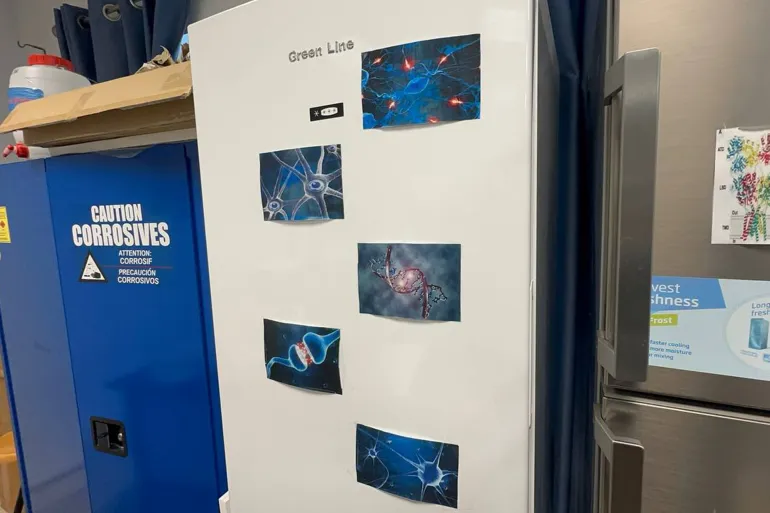
An-Najah National University includes approximately 25,000 male and female students, and offers 11 academic programs. The Neurological Center is considered the first medical research laboratory at the level of universities in the West Bank, as it was established with an initial idea from Dr. Muhammad Al-Qunaibi, a neurochemistry specialist and lecturer at the university.
The idea of establishing a research laboratory that includes students in medical colleges from the beginning of their studies did not receive much support from the circle around Dr. Al-Qunaibi at the university, but today, eight years after its launch, it has resonated in medical colleges across the West Bank.
Dr. Al-Qunaibi explains to Al-Jazeera Net how the laboratory transformed from an idea into a center that receives an international award for published research: “Before the research laboratory, I had never visited the city of Nablus, but today I travel long distances, with great motivation, and I am coming from the city of Jerusalem, to start my day with the students.”
He added: “I started in 2018, and Susana was the first student to join the laboratory. She joined the laboratory to study scientific research methods in 2020. She grew with him during these years, and today she has been able to publish approximately 25 scientific papers. More important than publishing is the echo that these researches create. When we find within one year that a joint scientific research of mine and Susana received 3,000 downloads, this confirms the importance of the research and the results it reached.”
Dr. Al-Qunaibi believes that what is more important than the center’s development and success is instilling the value and importance of scientific research in students from the first year of their university studies, because of the impact this has on their future, whether in specialization or job opportunities, and also in opportunities for professional exchange and gaining experience with other countries.
50 scientific research
He says: “I started with Susana, and today there are five students here who learned the basics of scientific research, and Susana was able to transfer her expertise and experience to them smoothly, which helped them learn quickly, and today we are working with them on their own research.”
Each scientific research takes about a year and a half to come to light, but the students of the Neurological Center work in parallel on more than one research during one year, which has helped in disseminating this amount of scientific research globally through the neurological laboratory at the university, which has reached 50 research to date.
He confirms that the distinction of the Neurological Center at An-Najah University comes through its specialization in studying a single nerve cell, and extracting the biophysical properties of this cell and the nature of its activity with each neurochemistry, which means limiting the data emerging from this study.
He says: “During the next five years, we at An-Najah University, in general, and the Neurological Center, are looking forward to reaching a clinical study, which does not exist in a large number of Arab countries at all, whereby we will then be able to study the results not only on the brains of experimental mice, but also move to a broader field, which is to study them clinically. Of course, clinical laboratories need a very high cost and equipment that we do not have, but we are confident that the Neurological Center will one day reach that.”
Dr. Al-Qunaibi mentions that the construction of the neurological center and its research laboratory faced major challenges, represented by allowing the entry of some equipment from abroad and preventing others from being used by the occupation, in addition to the security situation that directly affects the nature of study at the university, which turns on many days to e-learning due to closures, incursions, and war conditions, while scientific research students need to be present in the laboratory for long hours to complete and study their experiments.
He also pointed out the high cost of equipment, devices and some materials used in the studies.