

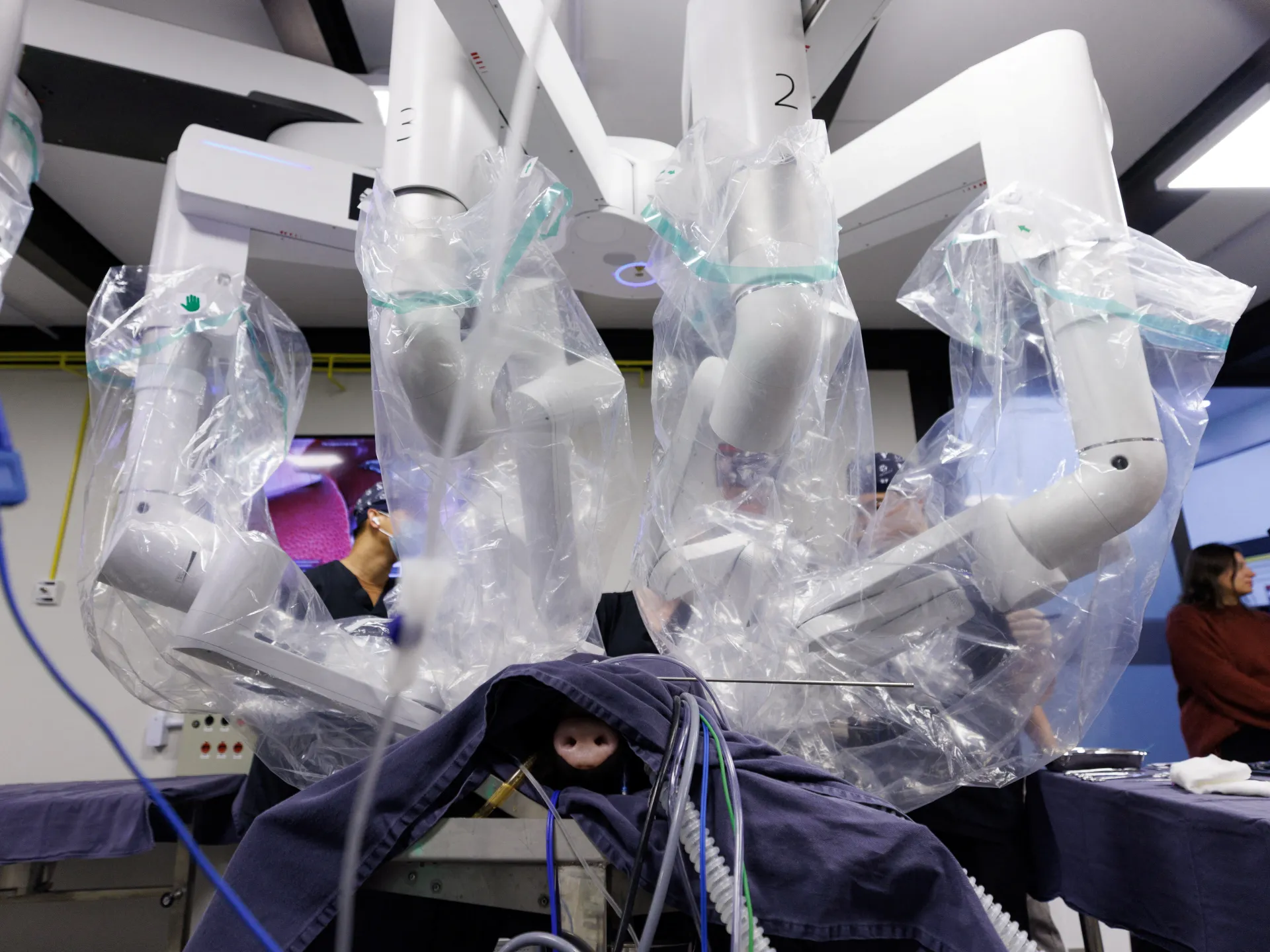
The sector of remote surgical robots has witnessed great development recently, as the idea emerged from testing laboratories and is ready for practical application in several countries around the world. Perhaps the prostate removal surgery performed by a doctor in London on a patient in Gibraltar, more than 2,400 kilometers away, was a living example of the spread of the idea, according to a report by the American technical website “TechRadar.”
The surgeon relied on a Chinese surgical robotic system called “Tomay” developed by Shanghai Microport Medbot, which is one of the first Chinese companies to obtain the necessary European accreditations in the remote robotic surgery sector.
The robot consists of three main parts: the surgical platform, the patient table, and the viewing table, which makes it easier for the surgeon to see the place where he is performing the operation and to control the robotic arm to perform the operation. The system allows surgeons to perform operations on the pelvic and stomach area.
British doctor Proskar Dasgupta performed the surgery on the 62-year-old patient, Paul Paxton, who confirmed that he was happy to undergo the operation and participate in making medical history, according to what he said.
Paxton’s case is not the only one of its kind that witnessed a remote surgery, as Dr. Sudhir Srivastava, a cardiothoracic surgeon at Georgetown General Hospital (GPHC) in Guyana, performed surgery on a patient in India, about 20,000 kilometers away from the hospital, according to a report by the American “Cardio Vascular Business” medical website.
The report describes this surgery as the longest remote surgery performed using surgical robots and high-speed communication networks, with the system used in this surgery having performed more than 173 similar surgeries globally.
The spread of these robots and the start of their use raises many technical and pivotal questions regarding their quality and ability to work under different circumstances.
Technical obstacles that may cost the patient’s life
The report on the website of Liv Hospital, which specializes in experimental treatments and advanced medical technologies, indicates a group of obstacles that stand in the way of the widespread spread of robotic surgery globally.
The cost of building robotic surgery systems and the cost of their annual maintenance is one of the most prominent obstacles facing this sector, as the cost of some systems reaches nearly a million dollars, with periodic maintenance costs exceeding 100,000 dollars.
It also reveals a major obstacle related to the medical procedure itself, as many surgeons rely on tactile sensation while performing various surgical operations to confirm the condition of the patient and the condition of the surgical procedure itself, which is absent when relying on remote surgical robots, which may increase complications after operations or lead to serious side effects.
The report confirms that technical obstacles, such as interruption of the Internet connection or the robot suddenly stopping working during the operation, are among the biggest risks related to robotic surgeries.
In some cases, the latency of communication may also be the difference between life and death, as the delay of even a fraction of a second between the movement of the surgeon’s hand and the response of the robot over the network is the most dangerous challenge, as any sudden interruption may lead to extreme danger.
Above all, the use of remote robotic surgery requires complex and lengthy training that includes strict accreditation requirements for medical staff, which is not currently provided by many medical training programs.
There are also legal and ethical considerations that raise questions about medical liability if a technical malfunction occurs in the robot during the operation, and where the responsibility lies (on the surgeon, on the host hospital, or on the manufacturer of the surgical robot).
Despite this, this technology holds hope for many patients residing in remote areas that do not receive adequate medical and health care.