

We live under it every day, but we may go long hours without seeing it. Walls surround us, towers block the horizon, and the wide sky turns into a narrow strip that appears between two buildings or from behind a small window.
The disappearance of the sky from the daily scene may seem like nothing more than an aesthetic detail, but increasing studies indicate that our relationship with nature, including trees, water, light, and open space, is linked to our psychological and physical health.
Not only does natural scenery give the eyes a break, it may relieve stress, improve attention, encourage movement, and is linked to a reduction in some risk factors for chronic diseases such as high blood pressure, diabetes, and heart disease.
As cities expanded and buildings became denser, researchers began asking a different question: What happens to us when we can’t see the sky?
Cities grow and sky shrinks
The world’s population has exceeded 8 billion people, and with the increase in population and rapid urban expansion, the natural spaces surrounding homes have declined, and have been replaced by tall, compact concrete blocks.
United Nations projections indicate that about 70% of the world’s population may live in urban areas by 2050. These transformations mean not only the loss of parks and trees, but also a shrinking amount of sky visible from streets, homes and workplaces.
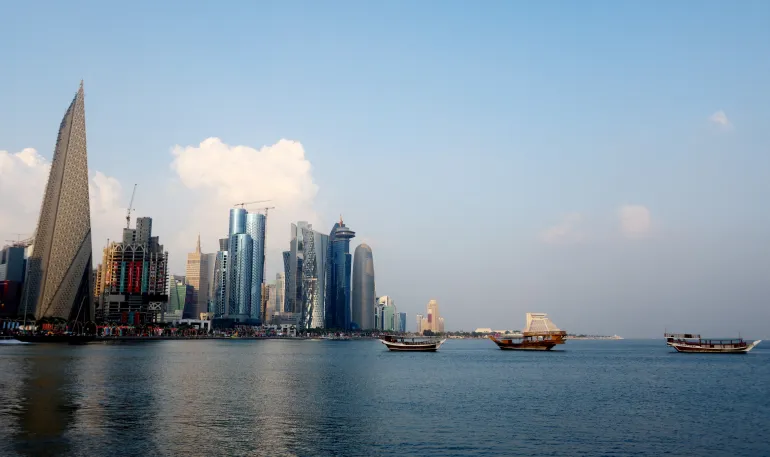
In many neighborhoods, the windows no longer look to the horizon, but rather to a nearby wall or an opposite tower. Thus, opportunities for exposure to natural light, the outdoors, and open views, which are interrelated elements, and the influence of one cannot be easily separated from the other, are reduced.
Therefore, researchers are not only asking about the number of trees in the neighborhood or the proximity of a house to a park, but they are also interested in what is called the “sky visibility coefficient,” that is, how much of it is visible inside the streets, between buildings, and through windows.

Nature…a free recipe that we neglect
Extensive research has linked exposure to nature with reduced stress, anxiety, and depressive symptoms, and improved mood, ability to concentrate, and mental presence.
Studies have also found a link between living near natural spaces and a reduction in some health risks, including high blood pressure, heart and respiratory diseases, and type 2 diabetes.
This does not mean that sitting in a garden cures these diseases, but rather that nature may act as a supportive factor for health by relieving psychological stress, encouraging physical activity, improving sleep, providing greater opportunities for social communication, and reducing exposure to noise and pollution in some areas.
Even in hospitals, studies have shown that viewing natural views from windows may help patients feel more comfortable during recovery, which is why natural views and daily light have become part of the discussion regarding health facility design.
During the COVID-19 pandemic, millions of people have experienced first-hand what it means to be deprived of nature. In a study published in 2020 that included about 3,000 people in Tokyo, seeing green spaces at home or going out to them during permitted periods of isolation was associated with higher levels of satisfaction, happiness, and self-esteem, and lower levels of depression and loneliness.
The sky…the ally we have not studied enough
Trees, gardens, and seas have received widespread attention in research, while the sky often remains part of the overall landscape, rather than an independent element.
But its wide visual presence, and the associated natural light and sense of openness, have led researchers to try to understand its role more precisely.
In 2024, Turkish researchers studied the effect of the duration of exposure to sunlight and the sky visibility coefficient in the design of hospital buildings, and concluded that it is important to take these two factors into consideration from the early stages of design, because they may provide support for the comfort and satisfaction of patients and workers within the therapeutic environment.
The idea is not only about a beautiful scene, but rather about an internal environment that allows light to enter, gives those present a sense of spaciousness, and reduces the feeling of closure imposed by closed corridors and rooms.
Does a clear sky protect the heart?
In a Chinese study that followed about 22,000 people aged 35 years and over for 5 years, researchers tried to find out the relationship between the number of days with clear skies and the incidence of cardiovascular disease. None of the participants had these diseases at the start of follow-up.
The results showed that each 10-day increase of exposure to clear skies per year was associated with a reduction in the risk of cardiovascular disease by about 3%, and a reduction in the risk of stroke by about 7%.
People who were exposed to clear skies for longer periods, especially those in rural areas, were 32% and 43% less likely to develop cardiovascular disease and stroke, respectively, than those who were less exposed.
But the skies here may not work alone: Clear days encourage people to get outside, move around and engage in physical activity, and may also mean exposure to more natural light and lower levels of air pollution.
These factors help improve blood pressure, blood vessel health, and insulin sensitivity, and may also contribute to alleviating anxiety and depression.
The researchers suggested that rural residents benefited more due to their spending more time outside due to the nature of work and daily life, in addition to lower pollution compared to many cities.
That’s why they stressed that the results reveal an association, and do not prove that seeing clear skies alone causes a reduction in heart disease. It is still necessary to separate their influence from the influence of clean air, physical activity, natural light and social and economic factors.
Can seeing the sky prolong life?
In May 2026, researchers from the University of Hong Kong published a study that attempted to measure what residents see from inside buildings, and its relationship to life expectancy.
The team used 3D models based on Google Maps, combined with deep learning algorithms, to simulate views from building windows and estimate how much of the trees, water and sky were visible. The researchers then linked this data to the city’s official death records.
The results showed that viewing natural elements from inside buildings was associated with an increase in life expectancy, and the association with viewing the sky was clearer than the rest of the elements analyzed.
This does not mean that looking out the window directly adds years to one’s life, as looking at the sky may be an indicator of better living conditions, such as lower building density, noise and pollution, and the presence of spaces that allow movement and social communication.
However, the finding raises an important question: Should seeing the sky be treated as part of housing quality and public health, rather than just an aesthetic feature that raises the price of a property?
The researchers recommended that city plans and building designs take into account residents’ ability to see nature and the sky, especially in crowded areas where residents spend most of their day inside homes and offices.

Looking up at the sky may give a person a temporary break from daily pressures, and help him see his problems within a broader framework.
An open space to clear the mind
Heaven’s potential benefit doesn’t stop at physical health. In a proposal published by Paul Conway in 2019, he indicated that looking up at the sky may give a person a temporary separation from daily pressures, and help him see his problems within a broader framework.
The sky does not provide many details that crowd the eye, but rather an open space that allows attention to calm down.
This scene may give the brain a short break from screens, rooms, and successive tasks, and bring the person back to the present moment.
It does not require a long trip or a long session. A few minutes on a balcony, park, or open street, away from the phone, can be an opportunity to breathe slowly and notice the light, clouds, and changing colors.
However, this simple habit does not replace psychological treatment or medical care, and should not be presented as an independent treatment prescription, but rather as an auxiliary daily practice that may support calm and mental presence.
Meaning beyond the body
Away from laboratories and numbers, the sky remains a space for contemplation and tranquility, and a window that reminds a person that the world is wider than the walls that surround him and the pressures that exhaust him.
The Holy Qur’an called for contemplation of it: “Have they not looked at the heaven above them, how We have built it and adorned it, and it has no openings?” Looking at the sky is not just a fleeting eye movement, but an opportunity to reflect, restore balance, and arrange priorities.
We may not be able to stop the sprawl of cities or remove towers from our windows, but we can look for spaces that still allow us to see the skyline, and give ourselves minutes to stop looking down and at screens. The sky, which seems far away, may be our closest means of calm.