

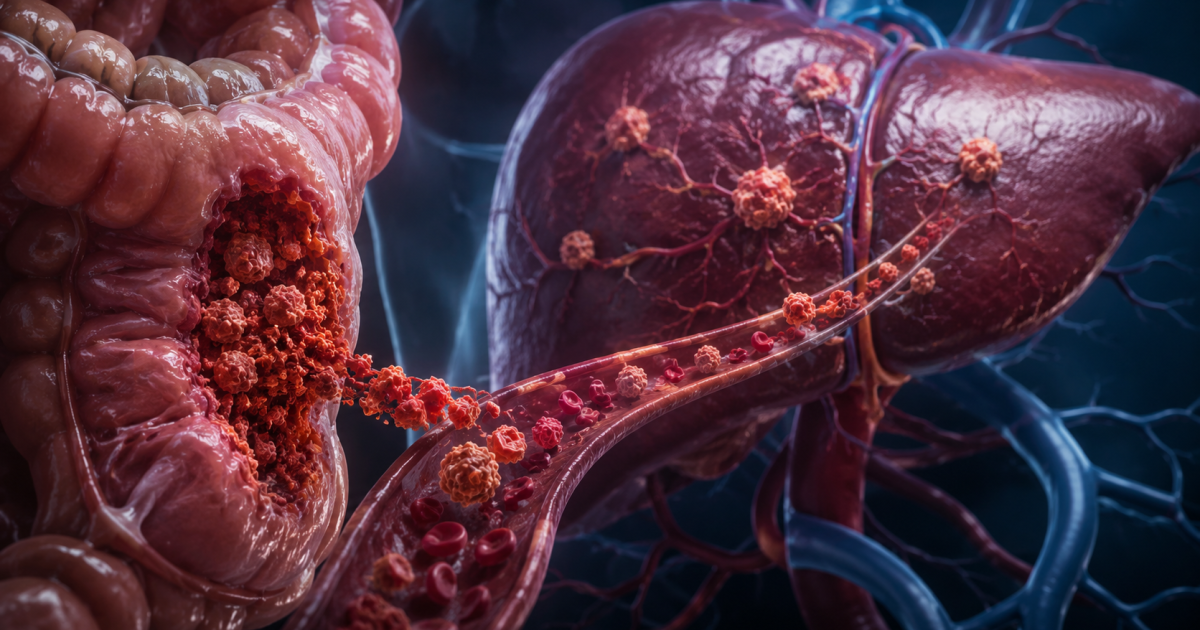
Cancer does not appear dangerous only because it grows inside the body, but because it sometimes knows how to leave its place. In colorectal cancer specifically, the disease may begin in the intestinal wall, but the decisive moment occurs when some cells succeed in separating from the original tumor, entering the bloodstream, then reaching the liver and building new tumors there.
This journey, small in size but large in risk, is what makes some cancer cases more difficult to treat. The spread of colon cancer to the liver does not merely mean a new location for the disease, but rather the entry into a more complex stage, where controlling the tumor becomes more difficult, and the treatment plan requires surgery, precise medications, and long follow-up.
The World Health Organization indicates that colorectal cancer recorded about 1.9 million new cases in 2022 and more than 900,000 deaths around the world, making it one of the heaviest cancers that burden public health, and the second cause of cancer-related death globally. The organization stresses that early screening and detecting tumors before they spread remain among the most important tools for reducing deaths.
Cell proliferation
Amid this scene, a recent study from researchers at Weill Cornell Medicine and the Massachusetts Institute of Technology sheds light on the question: Why do some colon cancer cells transform into cells capable of migrating and spreading, while other cells remain trapped in the original tumor?
The study, which was presented by ScienceDaily, indicates that the secret may not only lie in a new genetic mutation, but rather in changing the way genes operate inside the cell.
The key here is a transcription factor called GATA6. Its role can be simplified as being like an “identity guard” within the cells lining the intestine. It helps it retain its original nature and function.
When levels of this factor decrease, cancer cells begin to abandon their usual identity and transform into a more primitive and flexible state, somewhat similar to embryonic cells capable of adaptation and movement.
This flexibility is scientifically called “Cellular Plasticity,” and in the normal body, it may be beneficial. They help cells repair tissues after wounds or adapt to stress. But in cancer, the same advantage can turn into a danger. A cell that becomes more flexible may become better able to escape from its place, survive in the blood, and then settle in a new organ.
In this study, the researchers relied on models of tumor organoids, which are three-dimensional clusters of cancer cells grown in the laboratory that mimic some of the characteristics of a real tumor. They then transplanted these organoids into the intestines of mice to monitor the early stages in which the cells acquire the ability to metastasize. They found that decreased GATA6 was associated with the emergence of cells with a greater ability to reach the liver and establish new metastases.
Importantly, deletion of GATA6 in animal models increased the burden of liver metastases, while having no significant effect on the growth of the original tumor itself. This is a very significant point. Because she says that danger is not always measured by the size or speed of the tumor, but sometimes by the change in identity and behavior that occurs inside the cell.
The researchers also observed that cells missing GATA6 tended to switch from being LGR5-positive to being LGR5-negative, a state that previous research has linked to a higher ability to initiate liver metastases. In simpler terms, we are not just talking about a tumor that is growing, but about cells that are learning how to become more ready to leave.
These findings open an important door to precision medicine. If it is proven in the future that low GATA6 could be a sign of a tumor’s tendency to metastasize, this could help doctors identify patients who need more intense monitoring or more intensive treatment even before metastases are clearly visible.
It may also prompt researchers to develop treatments that not only target killing the cancer cell, but also prevent it from losing its identity and entering the flexible state that gives it the ability to spread.
A promising step
But it is important not to exaggerate, as this study does not provide a ready-made treatment for colon cancer patients, nor does it mean that GATA6 testing will tomorrow become part of all diagnostic protocols. It is an important research step to understand the mechanism of transmission, and it still needs broader studies, and to test the feasibility of using GATA6 as an indicator or therapeutic target in humans.
The real value of the study is that it changes the way you think about cancer. Instead of focusing only on the traditional question: What mutation caused the tumor? The new question becomes: How does a cell change its personality? When will she abandon her quiet identity to become a dangerous blood traveler?