

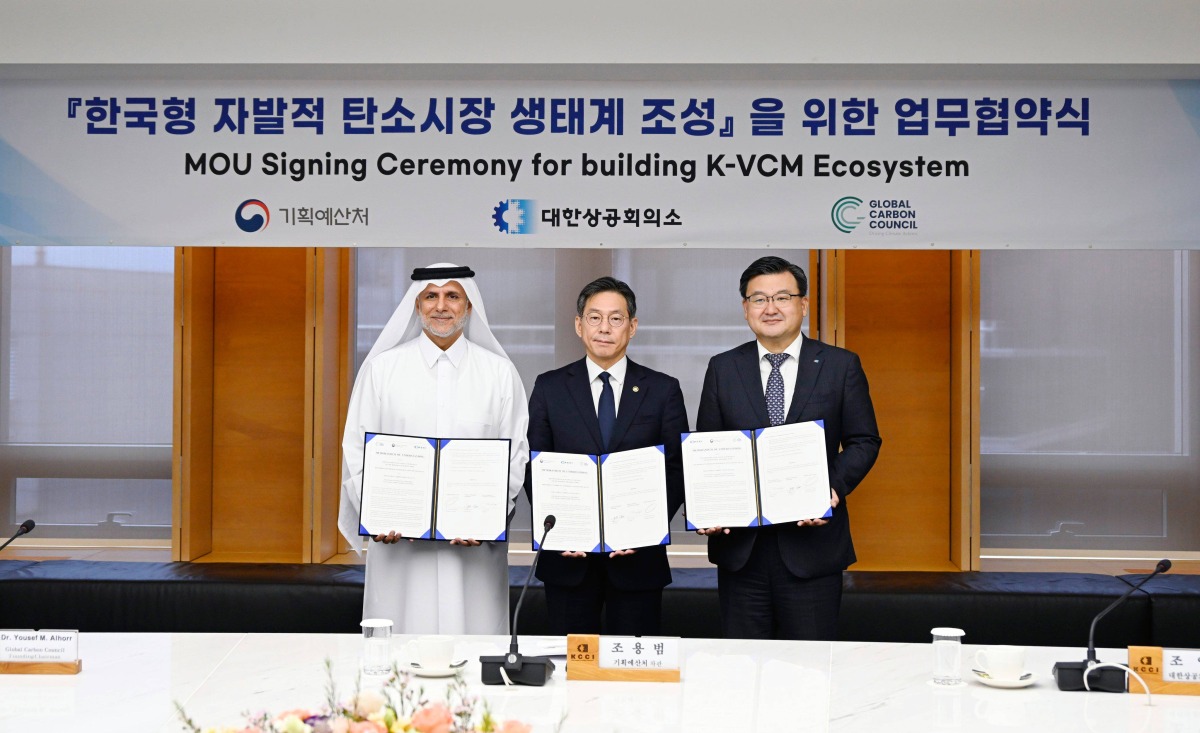
Today, the Global Carbon Footprint Council, the Ministry of Planning and Budget of the Republic of Korea, and the Korean Chamber of Commerce and Industry signed a memorandum of understanding establishing a strategic partnership between the three parties.
The memorandum of understanding was signed by Dr. Yousef bin Mohammed Al-Horr, founder and Chairman of the Board of Directors of the Global Carbon Footprint Council, Mr. Cho Young-beom, Deputy Minister of Planning and Budget, and Mr. Chi Tae-won, President of the Korean Chamber of Commerce and Industry, according to which the Ministry will undertake overall coordination and policy direction, and will support implementation through institutional frameworks and relevant budgets.
The three parties explained, in a statement, that this partnership, which was signed at the headquarters of the Korean Chamber of Commerce and Industry in the capital, Seoul, would develop and activate the voluntary carbon market system in Korea, noting that it comes at an important stage in its development process, as the ministry is proceeding with the draft voluntary carbon market law and preparing to launch it on the Korea Stock Exchange (KRX) by the end of this year, in addition to working to expand the supply and demand base for carbon credits in the country.
The statement indicated that this cooperation makes the Global Carbon Footprint Council, the first international program for issuing carbon credits in the Global South, recognized by a Korean government institution. It also opens paths for implementing digital monitoring, reporting and verification systems, achieving operability of carbon records, and enhancing connectivity to global markets, adding that within the framework of the emerging voluntary carbon market system in Korea, the Council is expected to be the only international program for issuing carbon credits participating in the initial structure of the market, benefiting from its international experience in carbon standards, methodologies, and certification. Verification, registration, issuance of credits, digital monitoring, reporting and verification systems and records infrastructure.
He pointed out that the memorandum of understanding sets a practical agenda for implementation that includes alignment with Article 6.2 of the Paris Agreement, the Carbon Compensation and Reduction Plan for International Aviation (CORSIA) of the International Civil Aviation Organization, and the Carbon Basic Principles issued by the Integrity Council for the Voluntary Carbon Market, in addition to international standardization of methodologies, digital monitoring, reporting and verification systems, capacity building, access to international markets, and infrastructure for interoperable records.
He highlighted that among the main components of the memorandum is the planned link between the unified Korean registry and the infrastructure of the World Carbon Council’s registries, establishing a digital base that supports the registration of carbon projects, issuing credits, tracking them, and linking the market, as well as opening a path for dealing with the Korea Stock Exchange and consulting with relevant institutions, including the Korea Stock Exchange, while preparing the detailed framework for implementation.
He also stated that the Global Carbon Footprint Council will contribute its expertise across the entire value chain of issuing carbon credits, including methodologies, certification, verification, registration, and issuance of credits, in addition to aligning eligibility with CORSIA requirements, the Carbon Integrity Council’s Basic Principles for a Voluntary Carbon Market, and Article 6.2 of the Paris Agreement. It will support the design of digital monitoring, reporting and verification systems and registry structures, strengthen local accreditation capabilities, and contribute to developing the expertise of certification and verification bodies. (VVBs) and the expertise of digital monitoring, reporting and verification systems in Korea, provided that the cooperation will also benefit from the Council’s experience in operating carbon market systems supported by digital monitoring, reporting and verification.
The Korean Chamber of Commerce and Industry, as the General Secretariat of the Korea Voluntary Carbon Market Alliance, will work to link supply and demand for carbon credits, expand corporate participation, support registry functions, and enhance local certification capabilities through its Carbon Reduction Certification Center. The Chamber will also enhance regional cooperation in carbon markets through the “Asian Alliance,” which provides an additional platform for linking to international markets. The memorandum of understanding specifically stipulates expanding participation in domestic and international markets through both the Korea Voluntary Carbon Market Alliance and the Asian Alliance.
The partnership also aims to enhance access to international carbon markets for the results of Korea’s mitigation activities, and to increase the liquidity and availability of high-integrity carbon credits, including CORSIA-eligible credits. This would provide additional opportunities to link Korean market participants to existing international frameworks for voluntary carbon markets and compliance markets.
For specific implementation activities, including developing the certification, monitoring, reporting and digital verification content necessary for the operation of the Korean Voluntary Carbon Market, Parties may enter into separate contractual arrangements that define the scope of work and associated financing, providing a mechanism for moving cooperation from institutional consensus to practical implementation.
Commenting on the agreement, Dr. Yousef bin Mohammed Al-Horr, founder and Chairman of the Board of Directors of the Global Carbon Footprint Council, said, “The Republic of Korea has an opportunity to build a voluntary carbon market that combines strong national leadership, international integrity, and digital readiness,” indicating that the Council will contribute, through its expertise in high-integrity standards, digital monitoring, reporting and verification systems, methodologies, and interoperable records systems; In helping to transform market ambition into reliable, scalable and internationally connected implementation.
The three parties intend to form a working group within 30 days from the date of signing, to work on preparing a detailed implementation plan covering international harmonization, the possibility of mutual recognition of local accreditation programs, digital monitoring, reporting and verification systems, the structure of records, capacity building, and communication with relevant institutions and parties, including the Korea Stock Exchange, followed by organizing a symposium for the sector with the participation of parties from the Korean market, in support of the involvement of stakeholders and the practical implementation of areas of cooperation.