

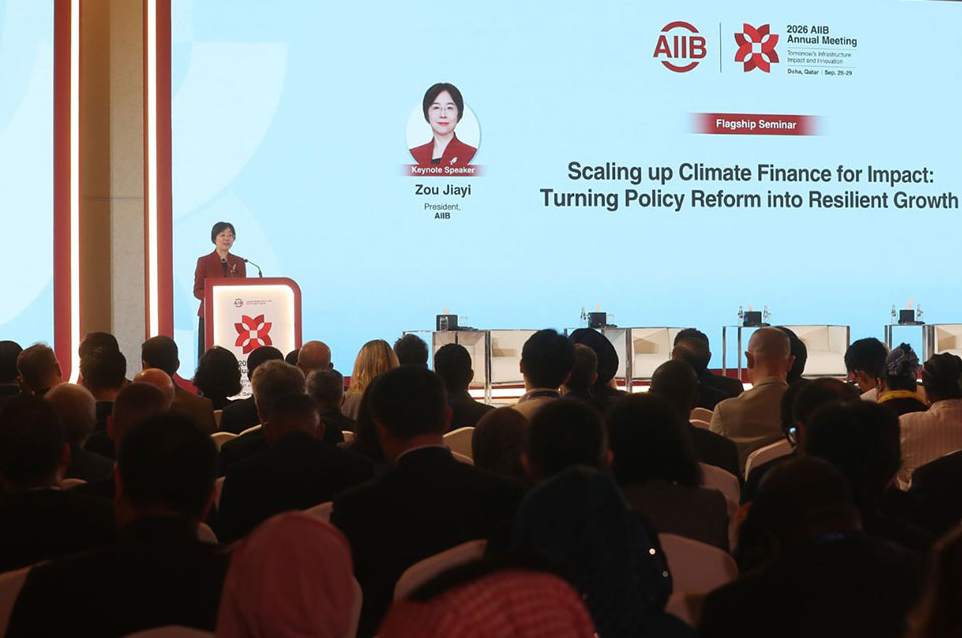
Her Excellency Ms. Zhou Jiayi, President of the Asian Infrastructure Investment Bank (AIIB), confirmed that there is great alignment between the Bank’s priorities and Qatar’s development agenda, noting that Doha plays an important role in regional development and enhancing interconnection in the region.
During her opening speech at the eleventh annual meeting of the Board of Governors of the Asian Infrastructure Investment Bank and in the press conference held on its sidelines, Her Excellency pointed out the importance of Qatar’s role in bringing the bank’s members together to continue putting development at the heart of international cooperation, pointing to the broad scope for implementing more projects in Qatar and serving its development agenda, explaining that the bank’s mission of supporting infrastructure, regional connectivity, and sustainable development intersects with Qatar’s goals and its national vision 2030.
She added that Qatar, as a founding member of the Asian Infrastructure Investment Bank, represents an important partner in the path of development cooperation, pointing out that the bank is ready to support the infrastructure needs of Qatar and the region, including connectivity in the transportation sector, water resources management, renewable energy and other fields.
The President of the Asian Infrastructure Investment Bank revealed that the bank aims to increase its annual financing on a large scale to reach about $20 billion by 2030, as part of a strategy aimed at expanding development impact through three main axes: impact, innovation, and integrity.
She said that increasing the volume of financing will not be at the expense of the quality of projects, stressing that the bank will continue to focus on achieving tangible results on the ground, on modern infrastructure for the twenty-first century, climate action, and regional connectivity.
She noted that climate-related financing constituted 71 percent of the bank’s regular financing during the past year, exceeding the annual target of 60 percent for the fourth year in a row.
Regarding the future of infrastructure, Zhou Jiayi said that modern technology and artificial intelligence will play an increasing role in developing projects, in addition to the continued need for traditional infrastructure, such as roads, railways, ports, and airports.
She explained that the application of technology could include port automation, developing intelligent transportation systems, improving city management, as well as supporting nature protection efforts.
She stressed that infrastructure must respond to the challenges associated with climate change, by investing in renewable energy, adaptation and mitigation projects, and enhancing the infrastructure’s ability to withstand disasters.
She also stressed the importance of developing digital infrastructure, allowing for the benefit of artificial intelligence on a broader scale, stressing that this technology should bring benefits to all countries and societies, and not to a limited group.
She stressed that development depends on cooperation, noting that the infrastructure needs in member states are greater than the ability of any single institution or public budget to meet them.
She pointed out that the bank will work closely with multilateral and bilateral development institutions, governments, markets and development partners, with the aim of mobilizing more private capital, adding that the bank, which includes 111 members from different regions and stages of development, will continue its focus on Asia while strengthening its ties with the rest of the world.
She explained that the Bank views infrastructure as a tool for transformation, not just physical facilities, explaining that the needs of member states in the areas of energy, transportation, water, and digital transformation are increasing, and that the Bank seeks to respond to these needs through multilateral financing and cooperation.
Zhou Jiayi highlighted that the Asian Infrastructure Investment Bank has entered its second decade, with the number of its accredited members reaching 111, and the continued growth of its portfolio of infrastructure investments. Since its establishment, the Bank has approved financing exceeding US$79 billion for more than 400 projects in 43 economies, while maintaining AAA credit ratings issued by major international credit rating agencies.
Her Excellency Ms. Zhou Jiayi, President of the Asian Infrastructure Investment Bank, said: “Impact, innovation and integrity will form the foundations of the bank’s work during the next phase. Impact means expanding the scope of development value in areas where infrastructure needs are still great. Innovation means developing the bank’s business model and financial tools to allow it to better meet customer needs. While integrity means adhering to the highest standards, principles of sound banking, and the bank’s mandate and basic objectives.”