

Oman- The breast cancer journey does not necessarily end with your last treatment or leaving the hospital. For many survivors, another no less important phase begins, during which they try to restore their daily lives, adapt to the changes that have occurred in their bodies, and deal with the fear of the disease returning.
In Jordan, where breast cancer is the most common cancer among women, the incidence of infection among Jordanian women is estimated at about 550 cases annually, according to information provided by the King Hussein Cancer Center to Al Jazeera Net. But behind the numbers are the personal experiences of women who found themselves after treatment facing a new question: How do you start life again?
Through special testimonies to Al Jazeera Net, 3 Jordanian women narrate how their lives changed after treatment, the fears and challenges they faced, and how each of them tried to recover the details of her life in her own way.
Life changed 180 degrees
For Jordanian Rasha Sawalha, the experience of contracting breast cancer was not just a period of treatment that ended in recovery, but rather a turning point that prompted her to reconsider her life priorities.
In 2023, Sawalha was diagnosed with breast cancer in its third stage, after the disease reached the lymph nodes, and she underwent chemotherapy, immunotherapy, and radiation, in addition to surgical operations that included the removal of the affected breast, the preventive removal of the other breast, as well as the ovaries for reasons linked to a genetic predisposition that increases the risk of infection.
Despite the difficulty of treatment and its effects, Sawalha was keen to continue her job, and she would arrange the dates of treatment doses to allow her to have a few days of rest before returning to work.
She told Al Jazeera Net that continuing to work helped her psychologically get through the treatment period, and gave her a feeling that she was still able to live her life despite the illness.
But about a year after the end of treatment, she left her job as a result of the restructuring of the organization in which she was working, a change that she says gave her the opportunity to devote more time to her health and recover from the stresses she experienced.
She added, “I gave more time to my health, and I started going to the club, swimming, exercising, walking, and meeting my friends more.”
Sawalha describes the experience as having changed her life “180 degrees,” after she became more concerned with her health, social relationships, and spiritual life, and rearranged her priorities to give her more space for herself.
Fear accompanies survivors
But the end of treatment does not always mean the end of anxiety, as the possibility of the cancer returning remains one of the most prominent fears facing some survivors, especially when the dates of medical examinations approach and awaiting their results.
Sawalha says that this fear is experienced by many who have experienced the disease, but she tries not to allow it to control her life, while committing to medical follow-up and paying attention to any unusual health changes.
Jordanian Roland Al-Bawab knows these feelings well, after she experienced breast cancer twice, about 5 years apart.
Rowland was 34 years old when she was first diagnosed about 18 years ago, and at the time she was the mother of four children, the oldest of whom was 12 and the youngest of three and a half.
The disease reached the third stage, and she underwent surgery followed by sessions of chemotherapy and radiation, in addition to hormonal therapy.
After 5 years, periodic follow-up revealed a second infection at an early stage, which required surgical intervention, radiation and hormonal treatment, without the need for chemotherapy this time.
Although many years have passed since the two experiments, Rowland tells Al Jazeera Net that the fear of the cancer returning does not disappear completely, and it may recur when conducting tests and waiting for their results.
She adds, “In the end, we are human beings,” explaining that she tries to deal with these feelings by committing to medical follow-up, instead of letting anxiety affect the details of her daily life.
Coming to terms with a different body
The effects of breast cancer are not limited to the fear of its return. Surgery and treatments may leave physical changes that affect a woman’s view of herself, especially if she undergoes a mastectomy.
Roland believes that accepting these changes is not easy for all women, given the association of the breast with the image of femininity for many, and the difference in the ability to adapt to its loss or change in shape.
She explains that some survivors choose to undergo breast reconstruction operations, while others prefer to adapt to physical changes without undergoing additional interventions, stressing that every woman has her own experience in dealing with her body after illness.
The importance of support and rehabilitation services that help patients overcome the physical and psychological effects of treatment is highlighted here.
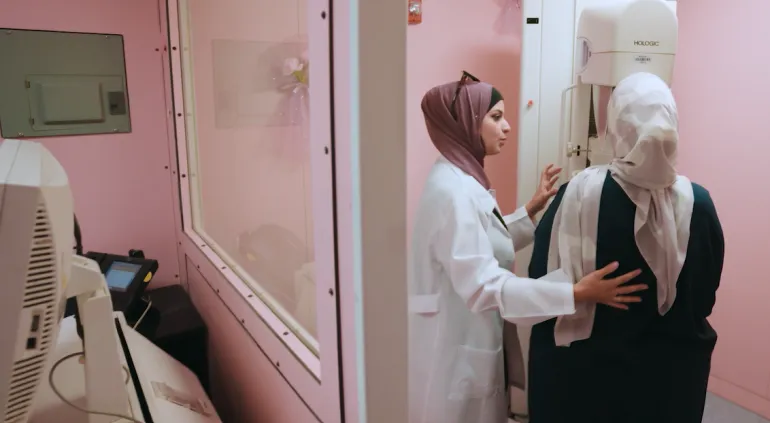
According to the information provided to Al Jazeera Net, the King Hussein Cancer Center provides special bras for women who have undergone surgery, and options for wigs, in addition to psychological and social support services, physical therapy, and nutrition.
The Breast Cancer Educational Clinic also includes clinical nursing coordinators, specialists, and survivors who share their experiences with patients and help them understand the treatment journey and deal with its effects.
From receiving support to providing it
For Roland Al-Bawab, her experience did not stop at regaining her personal life, but rather extended to helping other women going through the same treatment journey.
She joined the “Sanad” group concerned with social and psychological support for breast cancer patients, and began participating with other survivors in visiting patients receiving chemotherapy, to provide moral support and share personal experiences.
She says that the message she is keen to convey to them is simple: “You are not alone, and we have been through this experience.”
In her current life, Roland finds an extension of this message; The children she feared for when she was first infected have grown up, graduated from schools and universities, and joined work, and a few weeks ago she celebrated the marriage of one of her children.
As for Rasha Sawalha, she chose to share her experience via social media, and created pages called “Rasha Sawalha – Shafi,” in which she discusses her experience with the disease and the importance of early detection, self-care, and health.
The two women’s experiences reflect how some survivors can turn what they went through into a source of support and awareness, even if the ways in which each woman deals with the effects of the disease differ.
When protecting the family becomes a burden
While some survivors have difficulty adapting to physical changes or fear the disease will return, others find that restoring their normal lives also requires changing the perception of those around them.
This is what Jordanian Maysoon Taha faced after her treatment for breast cancer ended, as her family continued to treat her as a patient in need of constant protection and care.
Maysoon told Al Jazeera Net that her family members’ fear for her sometimes led them to prevent her from doing the work she was accustomed to, and to monitor her movement and the extent of her feeling of fatigue.
Although she realized that this behavior stemmed from their love and concern for her health, she felt the need to regain her independence and her ability to make her own decisions and live her life without excessive restrictions.
Over time, she began to regain her roles within the home, participating in family events and activities that she had stayed away from during treatment.
She explains that the moment she felt her true return to life was not when the treatment sessions ended, but rather when her family members stopped constantly asking her if she was tired, and returned to dealing with her normally.
For her, the family was not required to stop caring about her health, but rather to give her the space she needed to restore her life and her confidence in her abilities.
Follow-up that does not end with treatment
In addition to the psychological and social challenges, medical follow-up remains an essential part of survivors’ lives after the end of treatment.
The King Hussein Cancer Center stresses the importance of adhering to follow-up appointments, and informing the doctor of any new changes in the breast, chest, or armpit area, or the appearance of unusual and persistent symptoms.
The dates of visits and examinations vary according to the type of cancer, its stage, and the treatment the patient received. The visits may be close in the first years, then gradually diverge according to the doctor’s evaluation.
The American Cancer Society explains that follow-up after treatment does not only aim to detect any possible recurrence of the disease, but also includes dealing with long-term side effects, and monitoring physical and psychological health.
Not all survivors need periodic imaging examinations and extensive tests, as appropriate examinations are determined according to the condition, symptoms, and treatment history, with mammography performed when required.
Roland Al-Bawab narrates that she used to see her doctor every 3 months after the end of treatment, and then the visits became every 6 months, as part of continuous monitoring of her health condition.
A new life with different priorities
The recovery journey varies from one woman to another. One woman may find it difficult to adapt to the changes in her body, while another is preoccupied with the fear that the cancer will return, or trying to regain her work and family and social life.
The end of treatment does not mean that all of these challenges disappear, nor does the persistence of some fears mean that the woman is unable to regain her life.
For Rasha Sawalha, the experience was an incentive to pay attention to her health and rearrange her priorities, while Roland Al-Bawab found supporting other patients an extension of her experience, and Maysoon Taha focused on regaining her independence within the family.
These testimonies reveal that recovery from breast cancer is not limited to overcoming the disease medically, but also includes regaining self-confidence, adapting to physical and psychological changes, and obtaining the support that every survivor needs to continue her life in the way she chooses.