

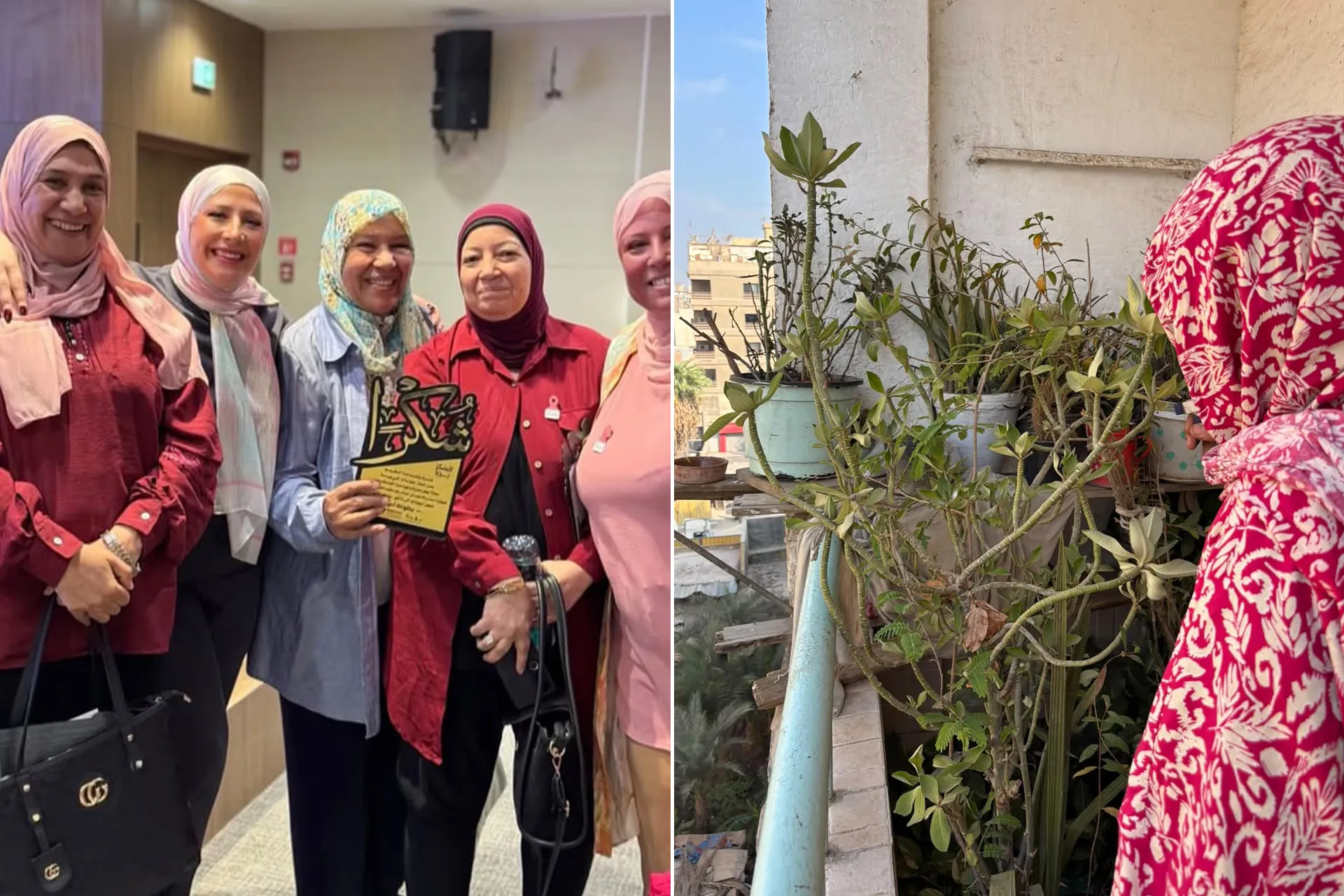
Cairo- After retiring from a government job, Najwa Al-Sayed’s life was proceeding at a calm rhythm, making her happiness from small details. She tends her roses and plants on the balcony of the house, goes to the club with her friends, enjoys sitting with her grandchildren, and taking some short trips.
A warm life that she did not imagine would be shattered by a feeling of a lump in her breast that led her to “confront a terrifying monster that I had always heard about, which is breast cancer.”
Najwa says: “I was living for my children and grandchildren, and I was always happy and living one day at a time, and I never imagined for a moment that I would get cancer.”
She did not know that a year of denial and fear, followed by surgery, fear of the mirror, and treatment, would change her outlook on life, and reveal to her the extent of the love that surrounds her, as well as the roles she could play in serving others in this life.
Fear and denial
About a year before the diagnosis, Najwa began to feel a lump in her breast, especially when she lay down on her bed or touched a slight pain point with her hand. Although she sometimes felt that it was large, she held on to the possibility that it was benign.
She says: “I was lying to myself, saying that it was a simple fibroid and would go away on its own.” She had no other symptoms, but she feared seeing a doctor more than she feared facing the possibility that haunted her.
She added: “I was afraid to go to the doctor so that I would not hear any word that would scare me, and at the same time it is impossible to imagine that I seriously have cancer.”
It was not her fear for herself that delayed her from revealing; She was thinking about her daughter, Aya, a girl in her twenties, with whom she shared the finer details of daily life, especially after the eldest son got married and became independent in his life.
Najwa says: “I was afraid to leave my daughter alone in her life without being able to check on her, and the feeling that this disease would end with death from which there was no escape increased the psychological pain.”
But coincidence finally pushed her to confrontation, after her daughter underwent surgery with a doctor close to the family, so he advised Najwa to get examined at Bahia Hospital, which specializes in treating breast cancer.
Daughter Aya started asking her colleagues about how to book, and she kept trying to contact the hospital for a whole week until she got an appointment, but she was forced to wait a month in the long waiting list.
Najwa entered the hospital holding on to the hope that the tests would prove that the tumor was benign, and while her daughter was waiting outside the examination room, Najwa noticed that she was moving from one stage to another, while the women who entered with her were finishing their tests and leaving.
Najwa says: “Every time I found myself moving from one stage to another in the examination, fear would creep into my heart and I would feel that the issue was bigger than I had imagined.”
When the doctor in charge of the examination at Bahia Hospital asked Najwa to perform a final analysis, she told her: “You must be satisfied with God’s will.”
Najwa took the sample the next day, then waited fifteen days, after which the hospital summoned her and her daughter for re-analysis.
At first, she thought that the first result might be negative, and she said to herself: “Thank God, there is no cancer,” but the doctor explained that the x-rays indicated something else, and that it was necessary to ensure that the test results matched them.
After a new sample and waiting another fifteen days, the diagnosis I had been dreading to hear came: “The tumor is malignant, and surgery is necessary as soon as possible.”
When the clock stopped
Najwa says: “When I heard the word cancer, I started crying intensely and disconnected from the world around me. I felt like the clock had stopped. The doctor was speaking, but I couldn’t hear him.”
While Najwa was immersed in shock, Aya took on the task of understanding the diagnosis and inquiring about the nature of the surgery required, whether the resection was complete or partial, and the possibility of her mother needing chemotherapy sessions.
Najwa and her daughter Aya were not satisfied with the opinion of one doctor, but rather consulted more than six doctors outside the hospital to be sure about the tests, x-rays, and treatment decisions.
Aya says: “I wanted to make sure of everything, and that we were on the right path, because the decision was related to my mother. I needed to be reassured that we were doing the right thing.”
As for Najwa, what hurt her most was that she became the one who needed someone to reassure her, after she had spent her life trying to protect her daughter and check on her.
Najwa returned to her home knowing that surgery had become inevitable. She performed ablution and prayed two rak’ahs, then spent a long night thinking and fearing the operation and treatment, especially the “chemo” sessions, which she had always heard about patients suffering from and its effects on their appearance.
She says: “That night I could not sleep because of the thought, and I was unable to comprehend that part of my body would be cut off and removed. I was terrified of the disease, treatment, and surgery, and very afraid of the chemotherapy sessions.”
On the morning of the operation, the eldest son, who works in one of the Gulf countries, had just returned to Cairo to be next to his mother in those difficult moments. Before leaving the house and heading to the hospital, the three Najwa, Aya, and Islam sat recalling memories, and the two sons tried to dispel the mother’s feelings of anxiety and fear by joking and telling funny stories.
Before entering the operating room, Najwa advised her son, his sister, and her daughter to take care of herself, and her fear intensified until the doctor had to postpone the operation a little until she calmed down.
She says: “The moment I entered operations was one of the most difficult moments I experienced, even though I had entered operations before that, but this time I was very afraid for my daughter, so much so that before entering the operating room, I called a number of relatives, Aya’s colleagues, and her friends to recommend her to them, especially since the feeling that these were the last moments in life was controlling me.”
Fear of the mirror
Najwa was discharged from the hospital two days after the surgery, but the psychological struggle continued. She was afraid to stand in front of the mirror, look at the surgical site, and close her eyes even when she went weekly to change the bandage on the wound.
She says: “I was afraid to look at myself in the mirror so that I would not see that part of my body was cut off, and this fear continued to haunt me for more than two months after the surgery.”
With the passage of time, Najwa began to adapt to her body after surgery, and was waiting to find out the nature of the treatment she would need at that stage. What frightened her most was the possibility of undergoing chemotherapy, until the doctor told her that her treatment would be hormonal, and she would not need chemotherapy sessions.
Najwa says: “Only then did I regain a large part of my calm and psychological balance, because during my stay in the hospital I used to see the patients receiving chemotherapy doses, how they were and how they looked.”
Najwa began physical therapy, gradually practiced sports, and returned to going out and participating in short trips organized by Bahia Hospital with her female warrior friends.
She no longer wanted to summarize her life as a patient waiting for the next examination. Rather, she began to regain the details of life that she had missed.
About five months after the tumor was removed, Aya decided to give her mother a special gift: a trip to the Two Holy Mosques to perform the Hajj.
Najwa rejected the idea at first, preferring to keep the money to prepare her daughter, but Aya and her brother insisted that the trip be a reward for their mother after the harsh experience she had gone through. Aya was keen to make sure that her health condition allowed for travel, and she asked the doctor about the necessary precautions, then accompanied her on the Hajj.
Najwa says: “My daughter came to me for Hajj, and thank God, God did not upset me and helped me in the procedures.”
From fear to gratitude
Najwa says that the disease changed many things inside her, and made her closer to God and more appreciative of those who stood by her during her most difficult days, adding: “The end of my experience with breast cancer is that I got closer to God, and I knew how much everyone around me loved me, and I no longer paid much attention to the things that bothered me before that experience.”
Despite periodic visits to the hospital to receive hormonal treatment and preventive examinations, Najwa has regained much of her normal life, and her day begins early in the morning by taking care of her roses and plants that she grows on her balcony, before she heads out to perform prayers and recite a daily Qur’anic recitation that she is keen on, and then continues to arrange the house and prepare the day’s food, and her dreams still exist; She hopes to see her son and grandchildren well, and for her daughter to be happy in her life.
Najwa also believes that she has a major role to play after God granted her recovery, by supporting the women who are fighting this war and reassuring them that the chances of winning the battle are very great, and instilling hope in their souls as she is one of the victorious warriors.
From the word she was afraid to face, “cancer,” that almost stopped her life, to the surgery and the mirror that she was afraid to look at, Najwa’s life changed, but it did not end with the disease. I discovered that fear may postpone confrontation, but it does not cancel the truth, and that life can give a person a new beginning after its harshest stations.