

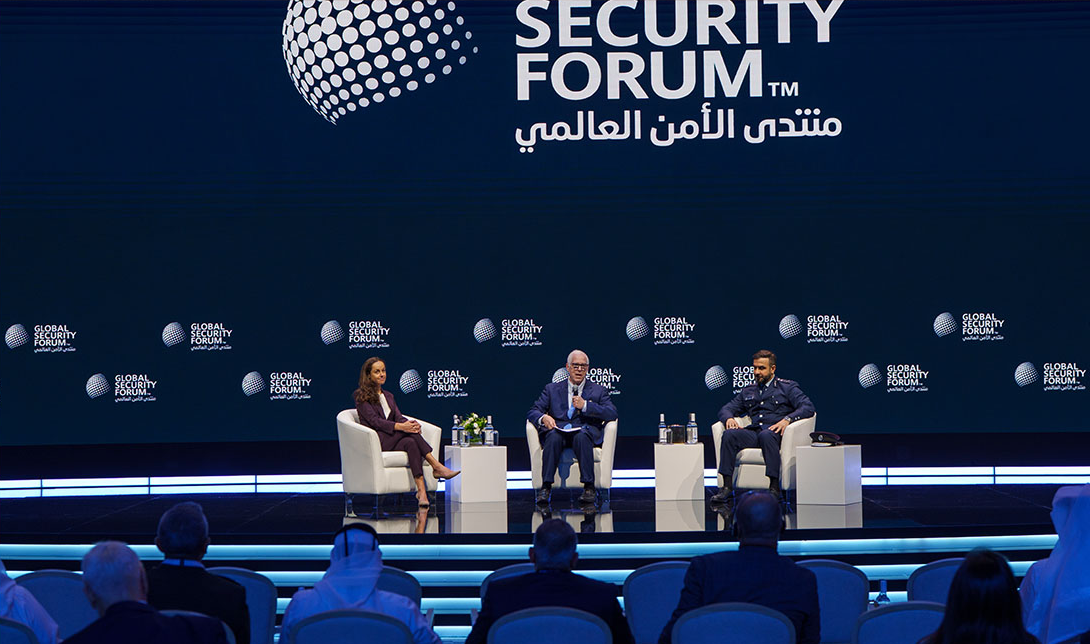
Participants in a discussion session within the activities of the Doha International Conference on Artificial Intelligence and Security, which is held in conjunction with the sixteenth session of the Milipol Qatar 2026 Exhibition and Conference, stressed the importance of promoting digital innovation and developing smart forecasting mechanisms, which contributes to raising the efficiency of responding to crises and developing the decision-making system in various vital sectors.
The session, which was held at the Doha Exhibition and Convention Center under the title “Predictive Intelligence, Crisis Leadership, and Decision-Making Excellence,” with the participation of an elite group of officials, experts and specialists in the fields of technology and digital security, highlighted the technical solutions and strategic directions for employing artificial intelligence in crisis management and decision-making support.
Mrs. Iman Ahmed Al Kuwari, Director of the Digital Innovation Department at the Ministry of Communications and Information Technology, stressed the pivotal importance of predictive artificial intelligence in enhancing the decision-making and crisis management system, noting that the main challenge during crises is not the lack of information, but rather the lack of time, the speed of changing circumstances, and the limited time available for action.
She pointed out the keenness of the Ministry of Communications and Information Technology to provide leaders and decision-makers with immediate information and mechanisms that allow them to make informed, proactive choices, reviewing the five most prominent integrated capabilities on which the State of Qatar is building its national artificial intelligence system.
She explained that these capabilities include the “data fabric”, to provide reliable and unified information from various agencies and bodies, the “prediction engine”, to help institutions anticipate the future with a high degree of confidence, the “decision-making cockpit”, to guide leaders towards the most accurate options and analyses, in addition to “governance and accountability”, to ensure human responsibility, auditability and data protection, and “interoperability and expertise”, to enhance government integration and serve citizens and employees efficiently.
The Director of the Digital Innovation Department pointed to the successes achieved by the State of Qatar in this field, especially the use of predictive systems during the FIFA World Cup Qatar 2022 to manage mass gatherings in eight stadiums, as well as the integration of artificial intelligence in the fields of legislation and research, which contributed to reducing the time required to prepare analyzes and responses from days to a few minutes.
For his part, Dr. Muhammad Saleh Ali Al-Sheikh, a postdoctoral researcher at Hamad Bin Khalifa University, stressed the importance of dealing with operational and cybersecurity challenges, noting that smart systems contribute effectively to monitoring anomalies and confronting potential cyberattacks that may target data tampering, as well as enhancing periodic and predictive maintenance to deal with dynamic loads and sudden electrical jumps, ensuring the stability of the power network in data centers.
He explained that research efforts at Hamad Bin Khalifa University focus on integrating artificial intelligence with physics to increase prediction efficiency, protect data center infrastructure, and improve the energy efficiency of graphics processing units (GPUs), central processing units (CPUs) and the electrical grid in a hot climate environment like Qatar.
For his part, Mr. Guy Diedrich, Senior Vice President at Cisco International, pointed out that the world is currently witnessing an accelerated and unprecedented wave of technological development in the field of artificial intelligence, stressing that flexibility, speed of adaptation, and immediate response to technical changes constitute essential factors for growth and continuity during the coming decades.
He explained that the successive developments in artificial intelligence and quantum technologies are directly reflected in network infrastructure and cybersecurity, which imposes the necessity of investing in smart networks that have high levels of security to confront emerging digital risks and challenges at the same speed with which these technologies are developing.
The Senior Vice President at Cisco referred to the results of the company’s Artificial Intelligence Readiness Index, which showed that only about 13 percent of company leaders around the world are fully prepared to deal with artificial intelligence technologies, despite the intense investment in this vital sector, which reflects the gap between the volume of investments and the level of actual readiness to adapt to this digital boom.
In turn, Mr. William Long, Head of the Global Defense Sector at Cycle AI, confirmed that artificial intelligence has become an essential element in the defense sector and modern warfare, stressing that it is no longer just an option, but has become an integral part of military strategies that should be adopted to avoid adverse results.
He explained that the rapid development in relying on artificial intelligence agents and dynamic planning allows military institutions to integrate multiple models and update visions to confront potential challenges and errors with greater flexibility compared to traditional static planning, indicating that the biggest challenge lies in how to accelerate the pace of decision-making and absorb the huge amount of data and information received from sensors, without falling into strategic mistakes or ignoring potential points of failure.
The Doha International Conference on Artificial Intelligence and Security, which continues until the twenty-second of this October, is a forum to discuss ways to employ artificial intelligence technologies to support security work and confront emerging challenges, in a way that reflects the status of the State of Qatar and its role in enhancing security cooperation at the regional and international levels.