

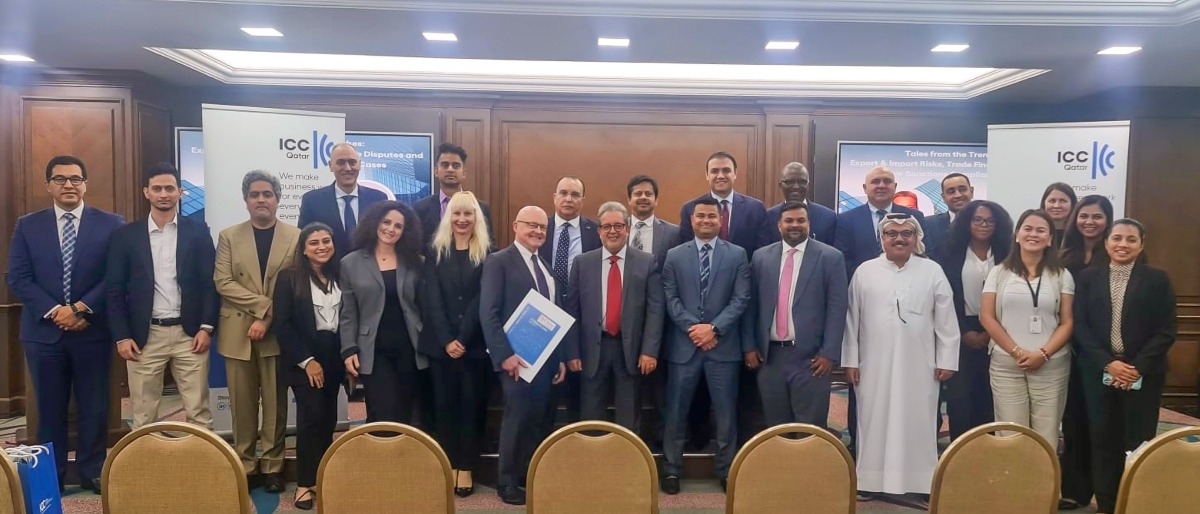
The International Chamber of Commerce, Qatar, in cooperation with the International Chamber of Commerce in the United Arab Emirates and Moody’s Agency, hosted a workshop entitled “The risks of export, import, trade financing disputes and compliance issues of new sanctions”, within the framework of the International Chamber of Commerce Awareness, which aims to help members overcome Common obstacles and promoting their commercial practices.
During the workshop, the mechanisms needed to face border trade challenges were discussed, including compliance with trade -based money laundering, legal frameworks, and the increasing complications of sanctions systems and risk management in international trade.
Mr. Vincent Operation, Director of the International Chamber of Commerce in the Emirates, reviewed global trade trends, the course of basic commercial documents, and discussed the common legal challenges and mechanisms for reducing risks associated with commercial financing tools, such as reserve accreditation letters and shipping bonds.
“This workshop organized by the International Chamber of Commerce gave me the opportunity to share the details of commercial conflict issues in the field of commercial financing, and to litigate in multiple judicial systems such as Singapore and the United Kingdom. These cases have provided instructions to the participants about the obstacles that must be avoided, and highlighted the importance of awareness And the correct application of the rules of the International Chamber of Commerce for commercial practices.
In turn, Mr. Mohamed Dawood, Director and Head of Industrial Practices in Compliance to Combat Financial Crimes in the Middle East and India at Moody’s Agency, moderated a discussion session on international sanctions systems and multi -dimensional challenges facing compliance teams in banks and companies. He also dealt with fundamental topics such as the required accuracy of companies, evading penalties, and warning indicators of financial crimes.
Daoud discussed during his intervention at the high -risk nature of the border trade, stressing that the money -based money laundering is still a major threat at the global level. He also pointed to the importance of capacity building in the banking and commercial sectors to meet the challenges of compliance and reduce risks.
The director and head of industrial practices in compliance with the combating financial crimes in the Middle East and India at Moody’s Agency concluded his intervention by saying: “The past three years have witnessed an emphasis in combating financial crimes in financing trade, due to the geopolitical sanctions related to the Russian -Ukrainian war. Financial institutions and companies operating in the field of commercial financing have become , Import, export, and across border business possess additional tools that exceed traditional sanctions And examining people with a good reputation. For example, it can use the total property information and the final beneficiary ownership to detect fake companies and hidden entities that may be used to evade penalties.