

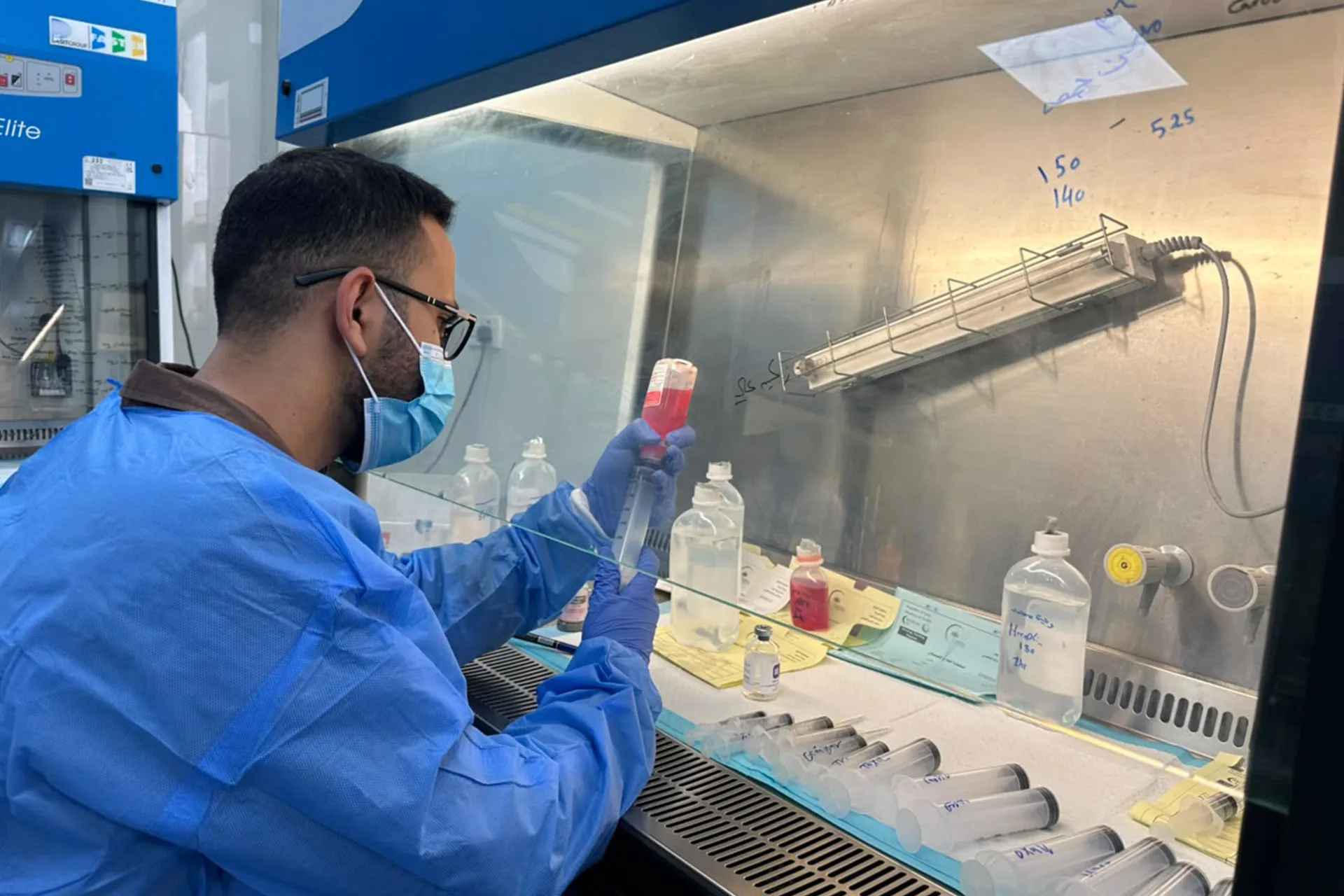
Baghdad- In a private clinic in Baghdad, Umm Mustafa, a woman in her forties, sits with her bag on her knees and reviews a prescription that includes the name of a drug that is difficult for her to obtain. She was diagnosed with breast cancer, and as the disease progressed and indicators appeared that required targeted treatment, obtaining medication became part of her battle, no less difficult than facing the disease itself.
The doctor wrote in the prescription “Trastuzumab deruxetcan”, commercially known as “Enherto”, which is a treatment intended for specific cases of breast cancer associated with the HER2 receptor, according to the nature of the disease and previous treatments. However, its inclusion in the treatment plan placed the patient facing a large financial burden, as the cost of one vial, according to a survey we conducted in Baghdad pharmacies, ranges between 1,500 and 1,800 dollars.
With every delay in securing the dose due to the cost, Umm Mustafa’s anxiety increases about the disruption of the appointments set by the doctor. It cannot replace the treatment or change its timing on its own, but it does not have a guarantee that the medicine will be available when the time comes. Thus, the distance between a treatment plan drawn up on the prescription and the possibility of implementing it on time increases.
Despite what is reported about the Iraqi Ministry of Health importing the drug “Enherto”, this does not necessarily mean covering the needs of all patients or securing the doses required for each case. The amount needed varies depending on the patient’s weight and the treatment protocol, while some cases may require multiple doses. The high price of the drug poses an additional challenge for patients who cannot afford it out of their own pocket.
Shortage of medicines in the governorates
The difficulty of obtaining treatment does not appear to be an isolated case in Baghdad. In Diyala Governorate, 35-year-old Alia Saadoun narrated her experience with breast cancer, explaining that she started chemotherapy in her city, then had to go to centers outside the governorate to obtain radiotherapy.
This reveals the suffering of cancer patients in the Iraqi governorates with the shortage of some medications and the cost of treatment and transportation between health centers.
Early detection is half the cure
On the other hand, the experience of Noura Samir, 32 years old and an employee in a real estate company, presents a different picture of the treatment journey. Her breast cancer was discovered at an early stage, and she began treatment inside Iraq. She underwent surgery, which was successful, and then continued to receive the doses according to the specified dates, without facing delays in the hospital or problems in obtaining treatment.
Her health record helped her dispense prescribed medications, allowing her to continue treatment regularly, in parallel with her work and daily life. Her experience highlights the importance of reaching an early diagnosis, in addition to the availability and continuation of treatment according to the medical plan.
Comparing the two cases does not mean that each patient’s journey is repeated in the same way. The different stage of the disease, the type of tumor, and the treatment plan, as well as the availability of medications, are factors that affect the course of treatment. But it reveals how patients’ experiences can vary between a case where they find treatment on time and another in which securing the dose becomes an additional challenge.
Treatment depends on the nature of the tumor
Oncology specialist and director of the Oncology Teaching Hospital in the Medical City, Dr. Weam Abdel Fattah, explains that breast cancer treatment is not subject to a single path, but rather is determined according to a group of factors, most notably the stage of the disease, the type of tumor, the patient’s age, and her general health condition. The journey begins with early detection and accurate diagnosis, leading to developing a treatment plan that suits the specificity of each case.
Abdel Fattah adds to Al Jazeera Net that the available options vary between surgical intervention, which may include partial or total removal of the breast and lymph nodes in the armpit, and radiation, chemical, immunological, biological and hormonal therapy, as well as targeted treatments. The selection and arrangement of these methods varies according to the nature of the tumor and the patient’s response, which makes providing all globally used medications a challenge for health systems.
He points out that no country can provide all cancer medicines to its patients, due to the multiplicity of treatment options and their high prices, as well as the varying response of patients to them. Also, the results announced by the producing companies do not necessarily mean achieving the same response in all patients, which requires that treatment options be subjected to medical evaluation before being approved. He explains that the Ministry of Health is developing an annual plan to import medicines.
In Iraq, the Cancer Council assumes the role of mediator between patients, institutions and health centers on the one hand, and the Ministry of Health and its capabilities on the other hand, by contributing to identifying the most appropriate treatments for disease cases, whether they are available within the country or require resorting to centers outside it.
Pharmaceutical dollar
Speaking to Al Jazeera Net, health sector advisor Dr. Muhammad Sherkhan called on the Iraqi government to adopt the “pharmaceutical dollar” by fixing the exchange rate of the dollar allocated for importing medicines, stressing that this measure is an urgent necessity to protect medicine prices and ensure their continued provision to citizens.
In statements to Al Jazeera Net, Sherkhan proposes a mechanism for coordination between the Central Bank and the Ministries of Finance and Health, which allows the transfer of suppliers’ dues directly in exchange for documented invoices, provided that this support is linked to adherence to the approved pricing, to ensure that its impact reaches patients, instead of turning into an additional profit margin in the import and distribution rings.
Prime Minister Ali Al-Zaidi agreed to establish a fund to support cancer patients in Iraq. It is expected that the establishment of the fund, if the necessary procedures are completed, will contribute to strengthening efforts to support cancer patients and reduce the financial burdens on them.
Sherkhan confirms that the peculiarity of cancer drugs lies in their being subject to an official pricing system, so their price to the patient is not supposed to change with every fluctuation in the exchange rate. Therefore, maintaining the approved prices requires providing the dollar needed for imports at a price consistent with the foundations on which those prices were built.