


Over the decades, cholesterol has transformed from an essential biological molecule into a symbol charged with both fear and false certainty. In the eyes of some, it is the silent enemy creeping into the arteries, and in the eyes of others, it is a victim of historical misunderstanding.
But the truth, as with most things about the human body, is much more complex than these simplistic images. Cholesterol is neither absolute good nor evil, but rather a molecule governed by the laws of biological balance, and when this balance is disturbed, the real story begins.
In medicine, the word “normal” does not mean an arbitrary judgment, but rather refers to ranges within which the body functions efficiently and stably. This applies to almost everything: glucose, blood pressure, iron, and even oxygen. No one disputes that glucose is necessary for life, however, its chronic elevation in the blood in the case of diabetes leads to very serious complications.
The same logic applies to blood fats. Cholesterol is necessary for building cell membranes, manufacturing hormones, and producing vitamin D and bile acids. The body not only consumes it, but also creates it itself because it cannot do without it.
But just because it’s necessary doesn’t mean it’s safe, no matter how high it is. Biology does not operate according to the logic of “the more the better” or “the less the better,” but rather the logic of a delicate balance. When levels get too high, or abnormally low, risks start to appear.
The danger is in cholesterol dysregulation
In recent years, a counter-wave to the traditional narrative has appeared on social media platforms, claiming that cholesterol, especially low-density cholesterol (LDL), is exaggerated. Some voices have even gone so far as to deny its relationship to heart disease.
This proposal, although it seems to be a rebellion against an old simplification, has fallen into a new, more dangerous simplification. Because the solid scientific fact still stands: LDL cholesterol is a scientifically proven causal factor in atherosclerosis.
Atherosclerosis is not a theoretical idea, but rather the biological process behind heart attacks and strokes. These diseases are still, to this day, the leading cause of death globally. We are not talking about a marginal threat, but rather a silent epidemic that kills millions every year.
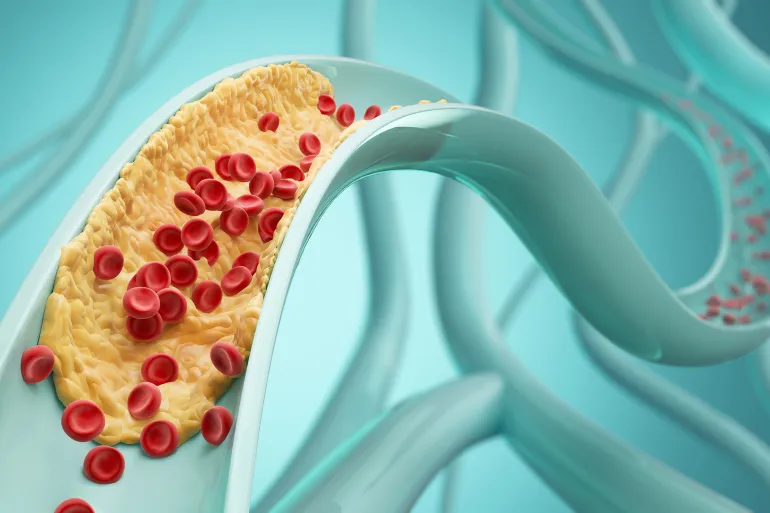
When levels of LDL particles in the blood rise for long periods, they infiltrate the arterial wall, undergo chemical changes, and trigger a series of inflammatory reactions that ultimately lead to plaque formation. It is true that this process is affected by other factors, such as inflammation, oxidative stress, and metabolic disorders, but LDL remains a pivotal element in this equation. Without him things don’t work the same way.
This is confirmed by repeated scientific studies: people who are born with very low levels of LDL due to rare genetic mutations are almost completely protected from heart disease. Lowering LDL with medications in people at risk has also consistently reduced the incidence of strokes and deaths in clinical studies.
But this fact does not negate the complexity of the picture, but rather complements it. Yes, context is important. Someone with good physical fitness, a healthy lifestyle, and low levels of inflammation does not have visceral obesity, insulin resistance, and multiple metabolic disorders, even if their LDL cholesterol numbers are close. But this does not mean that LDL cholesterol can be ignored, but rather that the risk should be understood, not denied.
The belief that fitness confers absolute immunity to these biological mechanisms is a common delusion; The body does not negotiate on the basis of impressions, but rather on the basis of cumulative exposure. Your arteries don’t know that you’re exercising, so much as they know how long you’ve been exposed to high levels of LDL cholesterol.
Despite all this scientific accumulation, today we are witnessing a disturbing phenomenon: influencers on social media reduce the danger of high cholesterol, and even offer natural alternatives or nutritional supplements and special programs that they claim treat the problem without the need for real medical intervention.
Between individual experiences and studies
These messages are often not based on controlled clinical studies, but rather on individual experiences and selective success stories. Here the problem lies not only in scientific error, but in a deeper error: the source of knowledge.
Health is not an area where opinions are taken from the most followed or most persuasive person on screen. Health advice should be based on rigorous science: on clinical studies, on epidemiological analysis, and on knowledge accumulated in peer-reviewed scientific journals.
Medical decisions are not formulated in short clips, but rather in a long and complex research context led by specialized doctors and scientists. An influencer may be adept at persuasion, but it is no substitute for knowledge.
The danger is that underestimating LDL cholesterol may lead to delayed diagnosis, neglect of treatment, or reliance on scientifically unproven solutions, increasing risks in the long term.
What is presented as natural or alternative is not necessarily safe or effective and, in some cases, may be misleading and dangerous. Science is not infallible, but it has a self-correcting mechanism, while trend culture only has the speed of spreading.
The real problem, then, is not to choose sides of the debate: either cholesterol is everything, or it means nothing. Both positions are misleading reductions. The truth lies in an integrated understanding: cholesterol is part of a complex network that includes metabolism, inflammation, genetics, and lifestyle, but it is a part that cannot be ignored.
Health messaging has often failed because it chooses simplicity over accuracy. But accuracy, even if less attractive, is what saves lives.
Medical history
Another important point. It is not possible to talk about cholesterol and its dangers without stopping at a group that is often neglected in public discussion: people with a family history of heart disease.
These people do not start from the same point as others, but rather enter the equation while they are more at risk due to genetic factors that may affect the way their bodies deal with fats, especially low-density cholesterol.
In some cases, such as in familial hypercholesterolemia, LDL levels are high from an early age, which means that the arteries experience a greater cumulative burden over a lifetime, even if the person appears fit.
The problem is that this danger is often invisible, with no early symptoms and no clear signs, which makes relying on a sense of health or outward appearance misleading.
The presence of a family history of heart attacks or strokes, especially at an early age, should be a real alarm bell, prompting early examination, regular medical follow-up, and serious treatment of any high cholesterol. In these cases, it is not enough to only be assured of a healthy lifestyle, but rather an evidence-based medical evaluation becomes a necessity, not an option.
In the end, perhaps the most important message is not biological as much as it is cognitive: cholesterol is not the enemy… but it is not innocent.
Between exaggerated fear and dangerous underestimation, the balance, as in everything in medicine, remains the irreducible truth.