


The human body contains a huge number of cells, estimated at about 30 trillion cells, distributed among different organs and tissues, and specialized in about 215 types, each of which performs a specific function programmed within the genetic material contained in its nucleus.
But not all of these cells live the same amount of time. Some of them only last a few days before being replaced in a continuous and controlled process, while others accompany us from birth to death.
Here the question arises: How does this fact agree with the common belief that the human body completely replaces itself every 7 years?
Cells only live for days
Some white blood cells, such as neutrophils, eosinophils, monocytes, and granulocytes, are among the shortest-lived cells in the human body, as they may live for hours or days, and the life of some may extend to a few months.
This type of cell regenerates to maintain the efficiency of the immune response against pathogens and reduce the effects that may result from chronic inflammation. As for red blood cells, they are replaced every about 4 months within a continuous cycle that maintains their characteristics and functional ability.
They are joined by epithelial cells lining the intestine, which are estimated to be only about 5 days old, in accordance with the nature of their work, which requires constant contact with food, exposure to acids, and participation in the absorption of nutrients.
The cells of the outer layer of the skin are renewed every about 20 days, and this period may increase by about 10 days with age, while the regeneration process accelerates in the areas most exposed to the external environment.
Cells that may accompany us for life
On the other hand, there are cells that live for long periods, and some of them may accompany a person throughout his life. For example, memory T-cells found in the blood, lymph nodes, lungs, and intestines can live for a period ranging from one to two years, while their lifespan in the spleen extends between 3 and 10 years.
These results come according to an analysis conducted by researchers from the United States and published in September 2025 in the journal Immunity.
As for liver cells, their average lifespan is estimated at less than 3 years, which is consistent with the high metabolic activity of the organ, as they are replaced in a way that maintains the vitality of the liver and its functional efficiency, despite the limited studies that have addressed the actual lifespan of human liver cells.
The heart… limited regeneration
Heart cells, in turn, show a different pattern. Researchers from Sweden used radioactive carbon isotope 14 to determine the lifespan of heart cells. The results showed that about 1% of these cells renew annually in humans at the age of twenty.
The percentage gradually decreases with age, reaching about 0.3% at the age of 75 years. Consequently, the total number of heart cells replaced during a normal human life remains less than half.
Brain cells…the age of a person himself
Neurons are also classified among the longest-lived cells in the human body, as the lifespan of gray matter cells in the cerebellum is estimated to be approximately the same age as a person, accompanying him from birth, or during the following two years, until death.
In contrast, gray matter cells in the occipital cortex (the brain’s visual processing center located at the back of the head) appear younger, suggesting that the rate of cell turnover may be higher in the cerebral cortex than in the cerebellum.
Neurons constitute about 92% of the gray matter in the cerebellum, which means that a large part of the brain’s neural structure has accompanied a person since childhood, and is not renewed after its formation is complete.
These results are based on an analysis published in July 2005 by researchers from Sweden and the United States, in which they used radiocarbon-14 to determine the age of cells in the occipital cortex.
Do hippocampal cells regenerate?
But this does not mean that all neurons in the brain do not regenerate. For about three decades, scientists have been trying to resolve the controversy regarding the possibility of regenerating neurons in the hippocampus region of the brain, which is located deep in the temporal lobe of the brain within the limbic system, and is primarily responsible for forming memories and converting them from short-term to long-term.
The continuation of this controversy is due to the conflicting results of immunochemical studies of tissues, which were divided into two directions. One suggests that hippocampal neuronal regeneration continues during physiological aging, while the other suggests that the regeneration process stops early in childhood.
In 2017, Professor Jonas Friesen from the Karolinska Institute in Sweden, accompanied by a number of his colleagues, published a study indicating that microglia in the brain, which perform immune functions, regenerate slowly.
According to the researchers, the renewal rate of these cells is about 28% annually, which means that more than 96% of them are replaced during a person’s life.
Thus, cell renewal rates vary depending on their functions and the body’s need for them. Some are constantly renewed, some very slowly, while other cells may remain throughout life without being replaced.
Why does the body not return to youth?
But if the body replaces a large portion of its cells, why does it not return to being younger over time?
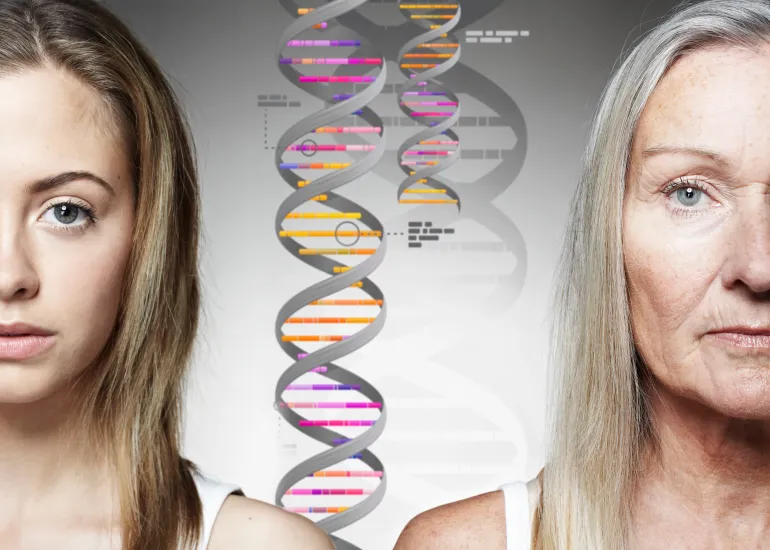
The simple answer is that the body is exposed with age to a group of internal and external factors that affect the stability of the genetic material and the information it carries.
These factors include physical, biological and chemical influences, in addition to oxidative processes and errors that may occur during chromosome division or duplication of genetic material. This leads to the accumulation of mutations and molecular changes within cells.
As cells continue to divide, some cells may carry these mutations while others survive, a phenomenon known as “genetic mosaicism.”
Therefore, cell division and renewal does not mean that the body returns to its youthful state, as new cells continue to work within an aging physical environment, and the efficiency of mechanisms for repairing damage to genetic material also declines with time.
Thus, the aging process continues despite the renewal of a large number of cells, and its impact is reflected in the organs and the external appearance of the body.
Where did the idea of the seven years come from?
The belief that the body’s cells are completely renewed every 7 years likely spread after a news article was published in the reviews section of the journal Nature Reviews Molecular Cell Biology, based on the study published by Professor Jonas Friesen in 2005.
The article indicated that the average lifespan of cells in the adult human body ranges between 7 and 10 years. However, the same results of Friesen and his colleagues showed a significant difference between cell types, as some brain cells can live for periods that greatly exceed 10 years, while others only live for days or months. Therefore, there is no single period after which the body can be said to have completely replaced all of its cells.
The body does not start over
Although scientific debate continues regarding the mechanisms of regeneration of some cells, what is certain is that the human body does not completely replace itself at once, and there is no biological clock that reconfigures itself every 7 years.
Cells renew at different speeds according to their nature and functions. Some of them are replaced within days, some within years, and some may accompany a person throughout his life.
While scientific research continues to try to determine the exact age of different cell types and their regeneration mechanisms, the more realistic goal remains to maintain a healthy body and reduce the risk of diseases with age, rather than pursuing the idea of restoring complete youth.