

Cancer is one of the most complex challenges in the world of medicine, not only because of the diversity of its types, but also to the contrast to the treatment among those with it.
According to the statistics of the World Health Organization, in 2022, about 20 million new cancer infections, while the deaths caused by about 9.7 million cases, remained one of the most prominent causes of death globally.
It is estimated that one out of every 9 people will have cancer at some point in his life, while the disease causes almost the death of one man out of every 9 men, and one in every 12 women.
Expectations indicate that by 2050, annual injuries may exceed 35 million cases, an increase of 77% compared to 2022.
Medicine has witnessed a tremendous development and in recent decades, enabling unprecedented achievements in the diagnosis and treatment of cancer, from surgery to chemotherapy and radiotherapy, but the traditional approach based on “one size that suits everyone” is still unable to meet the unique needs of each patient.
Doctors have noted that the results of medical interventions may differ greatly from one patient to another, and while there are interventions that may be beneficial to specific groups, they may be useless or even harmful to other groups that suffer from the same type of cancer.
This gap prompted scientists and doctors to search for new ways to understand this disease at a deeper and more specialized level, and here a new trend promised a revolution in the way we understand and treat cancer, which is precision medicine.
In this report, we will learn about the concept of precise medicine, how to change the method of cancer treatment, the areas of its application, and what challenges facing it, before we look at the future and its hopes.
What is precise medicine?
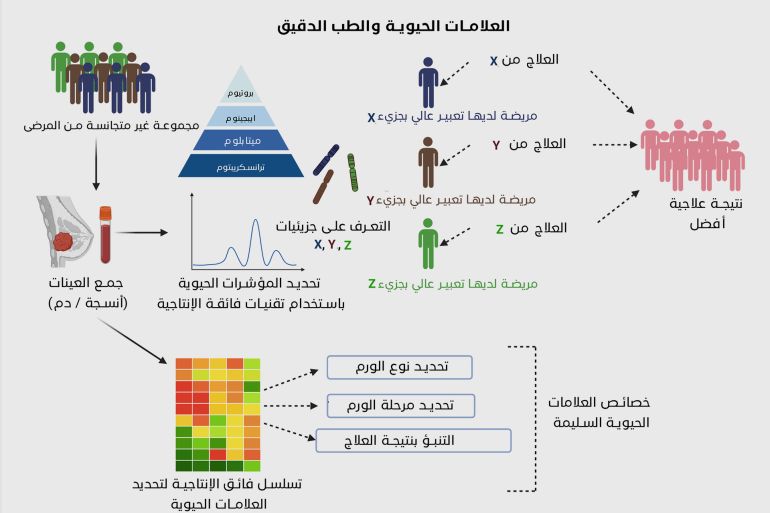
Define is a medical approach that aims to allocate treatment and prevention for every patient or group of patients whose tumors are similar, and takes into account the individual differences between people with cancer, including genetic, environmental factors, and lifestyle to become more effective and less vulnerable to unwanted side effects.
Instead of relying on the type of cancer only, doctors are looking for the fine details of the tumor itself: What are the genetic mutations in it? How do its cells behave? And what medicine can be targeted with these changes accurately?
It can be likened to the entirety as if you have one key trying to open different locks, it can succeed with each other, but it will fail with many of them, so is the case with the traditional treatments of cancer: one protocol given to all patients, hoping to achieve the best result, but precise medicine came to change this rule, and makes a “special key” for every patient.
Genome is currently the main factor in determining the treatment plan within delicate medicine in oncology. However, there are other factors that can be taken into account, such as the patient’s symptoms, gender, lifestyle, and exposure to possible factors that may cause cancer, such as smoking.
Raded precise medicine changed the way to deal with cancer, moving from the “one treatment of all patients” model to care for each individual according to the unique characteristics of his disease. This approach follows a comprehensive and accurate analysis of the tumor properties, taking advantage of in -depth knowledge of how the disease develops with the aim of improving health care management.
Doctors, in accurate medicine, are guided by the results of prestige and advanced laboratory tests to detect changes in the genes or proteins of cancer cells, and to understand their effect on tumor behavior and possible treatment options that target these mutations accurately, instead of resorting to general traditional treatments such as chemotherapy.
These tests are known by several names, including: vital indicators test, genetic or genetic test for tumor (genomic stereotypes, genome sequence, next generation sequence), molecular test or molecular stereotype.
You can also use computer tools, digital medicine, or artificial intelligence to determine the extent of the tumor aggression or its speed of growth.
How does careful medicine change the way to treat cancer?
Deficient medicine is used to treat multiple types of cancer, including colon and rectal cancer, breast cancer, lung cancer, certain types of leukemia, certain types of lymphoma, melanoma, esophageal cancer, stomach cancer, ovarian cancer, and thyroid cancer.
Treatment strategies are vary in delicate medicine to suit the properties of each tumor, and Targeted Therapy is used to target specific changes in cancer cells without harming healthy cells.
Immunotherapy is a powerful tool for stimulating the immune system to identify and attack cancer cells. It sometimes includes genetically modifying immune cells to enhance their ability to eliminate the tumor.
For example, but not limited to, in breast cancer some tumors contain high levels of protein called HER2, which makes the tumor more aggressive and speed in growth, and this protein can be targeted with custom medications such as antibodies, including trastuzumab.
According to the American Society for Cancer Research, these drugs are given only about 20% of patients who reveal the tests that their tumors contain this protein, while the drug is not prescribed to other patients because it is not effective in their condition.
Comprehensive genetic tests help analyze dozens of genes at once to determine the mutations and changes that can be targeted with accurate medicines, which contributes to the design of an integrated treatment plan for each patient, which enhances the chances of healing, reduces side effects, and provides costs of non -remedies.
The role of accurate medicine is not limited to treatment, but also extends to preventive and diagnostic fields, as it helps to identify people most vulnerable to cancer to help them reduce risks, early detection of some tumors, and achieve a more accurate diagnosis, in addition to following up the effectiveness of long -term treatments to ensure the best results.
It may also include support for patients with cancer. For example, genetic pharmacy is used to improve cancer -related pain relief, by controlling the prescription of opiates in proportion to individual differences between patients. This approach guarantees greater effectiveness of analgesic treatment while reducing side effects, which improves the quality of patients ’life, especially in the advanced stages or when dealing with chronic pain.
Using artificial intelligence in careful medicine to treat cancer
Artificial intelligence is used to provide personal care for cancer patients, starting with examination and early detection, to choosing the most appropriate treatment for each patient. For example, deep learning algorithms help distinguish between breast cancer and non -serious inflammatory conditions that affect breasts, while automatic learning techniques are used to analyze radiology images and evaluate tissues and blood vessels more accurately.
Artificial intelligence, for example, can predict the transmission of cancer to the lymph nodes before surgery, which facilitates surgical planning. There are other innovations such as 3D printed injections after breast removal to improve the effectiveness of radiotherapy, and artificial intelligence systems that help to anticipate high -precision skin infections, thus improving treatment results and reducing side effects.
On the other hand, modern techniques help to analyze the patient’s data accurately to determine the best medications and doses for each case, especially when using vehicle treatments that include several drugs, after doctors relied on the method of gradually increasing the dose to determine the maximum dose allowed for each drug, without taking into account the individual properties of each patient or complex interactions between medications.
In this context, smart drug delivery systems are one of the most promising innovations, as it monitors the vital indicators of the patient and automatically seizes doses according to his condition, which enhances the effectiveness of treatment and reduces side effects, despite the need for more studies before they are widely applied.
Mache and healthcare costs
Deficient medicine reduces some costs and increases others. Experts believe that accurate medicine can contribute to reducing health care costs by choosing the most appropriate treatments for each patient, which reduces the receiving of less effective drugs and limits its expensive side effects.
Deficient medicine may increase the costs in some cases; Advanced genetic and protein tests may be expensive, especially if they include several analyzes, and may not be covered by health insurance completely. Also, some advanced treated and immune treatments are expensive, whether for the patient or for a health care system.
In addition, some people who show their tests need to have a genetic mutation inherited to preventive follow -up and additional periodic examinations to reduce the risk of cancer, which increases costs in the short term, although this helps in early detection and reduce future treatment expenses.
The cost of some advanced treatments, such as directed treatment or immunotherapy that is chosen based on a specific genetic or protein change, is higher compared to traditional treatments.
For example, an Australian study published in 2024 was estimated in the NPJ Precision ONCOLOI Journal of $ 12,743 Australia ($ 8223.76) for each patient, and $ 14,262 Australia ($ 9204.05) to determine the molecular cause.

Challenges in front of the application of careful medicine
Accurate medicine faces several challenges in its practical application, despite the great hope it provides in improving the results of cancer treatment and reducing suffering. In addition to the high costs, as mentioned above, accurate medicine needs an advanced infrastructure, including specialized laboratories and accurate devices for the analysis of genes and proteins, in addition to trained medical teams that can understand the results and make appropriate therapeutic decisions.
This approach also depends on the availability of a large amount of data and accurate information about the development of the disease and tumor at the molecular level, which is a major challenge for many medical centers, especially in countries that do not have sufficient capabilities.
The moral aspect and privacy protection cannot be ignored. Genetics tests reveal very sensitive information about the patient and his family, which requires strict policies to protect this data and prevent their use inappropriately.
Access to accurate medicine is still universal, as it is often available in advanced centers or in some countries only, which limits the benefit of all patients around the world.
The future of careful medicine in cancer
Delayed medicine is no longer just a future concept, but has become a tangible reality that changes the lives of patients. In light of the scientific acceleration, we approach more than one stage in which it becomes “the appropriate treatment, for the appropriate patient, at the right time” is the rule, not the exception.
With our increasing ability to analyze and integrate patients ’characteristics, we may witness a faster and broader implementation of careful medicine in the field of cancer care, starting with prevention and early detection, to treating the disease in its advanced stages.
The future has more hope, especially with the integration of artificial intelligence to analyze genetic data, develop personal vaccines against cancer, and design unique treatment plans for each patient based on an in -depth analysis of his cells and genes.
It is also expected that the use of precise medicine will extend to the treatment of other diseases in the future, as the tumors have so far the pioneering field of this approach, given the extensive knowledge of the role of genetic mutations in the development and progress of cancer.
It is important to emphasize that careful medicine does not promise to recover for everyone yet, but it opens a wide door towards more humane and effective treatments, as every patient becomes a special case that deserves a unique treatment plan.