

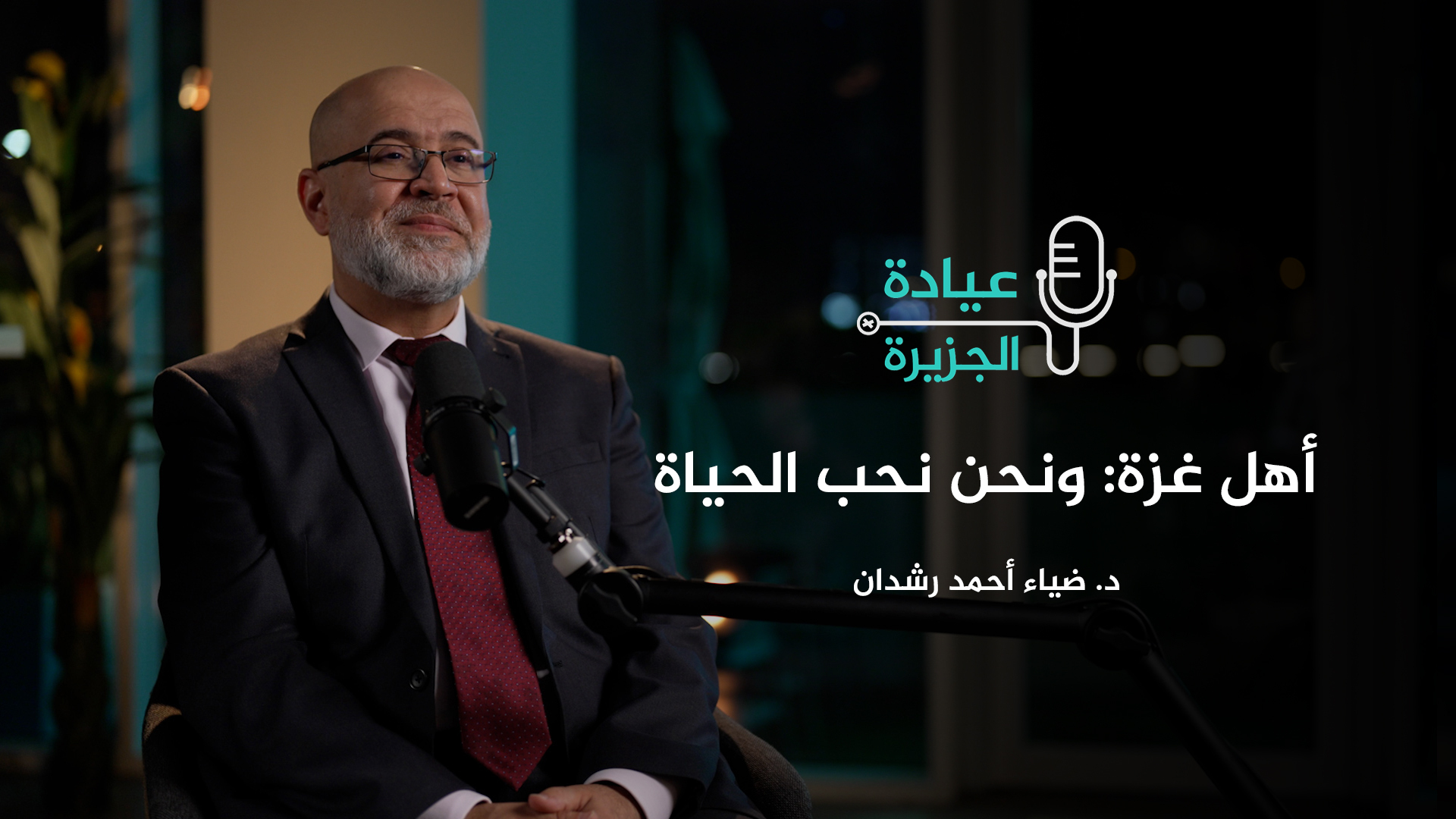
Dr. Diaa Ahmed Rashdan, a first consultant in ophthalmology and its wounds, and head of the ophthalmology department at Sidra Medical Hospital in Qatar, who was in Gaza, said that its people are good despite the pain, and they were patient despite the difficulties, and they are represented by the saying of the poet Mahmoud Darwish, “And we love life if we can a way.”
Dr. Rashdan’s statements came in a special interview with “Al -Jazeera Clinic”, after he returned from his trip to Gaza.
-
At first, he told us about the arrangements of the mission, when did you leave Doha, and even when did you visit Gaza?
The mission is the number 32 of the tasks organized by the “Rahma around the world”, and it began to arrange for it from November last year, and the mission began on April 17.
The travel was through Amman, and we arrived in Amman a day ago, and it was a long day. This is due to waiting until a permit to enter Gaza. The approval late at night arrived at a limited hours of travel time.
Unfortunately, not all participants obtained the permits. The crew that was in Amman was 22. The permits reached only 9, 5 from Indonesia and I was among the 4 doctors from Qatar. The trip started on Thursday morning at six and a half in the morning. And it lasted for 13 hours, all the way to the first place in Gaza.
Of course, 13 hours are a very long period for the cut distance. But it was in stages, and we moved from one bus to another, with a total of 4 buses. We reached the result of Gaza after sunset, thanks to God.
-
Where was your work in the Gaza Strip?
The team was divided into two parts, the largest part went to the Nasser Medical Complex. I was from the team that went to the European Hospital in Khan Yunis.
I was a colleague of chest surgery in the hospital. From the beginning, we started a hospital tour, where we got acquainted with it and the members of the medical crews at that time, each according to his specialization, and we started immediately after that medical consultations to patients in our specialties.
-
What are the nature of the cases that you have been appointed and dealt with?
Cases related to eye health can be divided into two types: the first type that directly relates to war, which is mainly either eye wounds, face wounds, fragments inside the eye and around the eye. The second type is bruises and closed injuries. I mean injuries to the non -comprehensive eye of a wound. But this is never less dangerous than the injuries that have a wound or even fragments inside the eye.
Among these injuries, bleeding injuries in different sections of the eye, the front or within the retina, and have seen repeated cases, 3 striking cases, all of which have bleeding from one nature in one place in the retina. The presence of all these cases in the same place, and the same circumstances, means that they return to the same cause. They are cases that I have never seen in my life during my career. This requires me to read, research and study on the mechanism that developed in these cases.
Because during my entire career, and in all cases of bruises that I have seen, I have never seen such cases before. On the other hand, during a very short visit to Gaza, I saw 3 of them.
Cases related to eye injuries or eye problems that treat them are the chronic conditions that are late treatment, especially the cases of cataracts – or white water – which is simply the density of the lens in the eye, whose cataracts lead to a lack of vision, whether due to bruises on the eye, cataract or congenital white water, of course it needs a very rapid treatment without delaying children, in order for the vision to develop and delay that leads to major problems.
Plain cases associated with age also surgically delayed the difficulty and seriousness of surgical work in terms of harshness and more orders to crystallization, and then the possibility of complications or problems within surgical work is greater.
By the grace of God, 86 in -kind and different types were conducted by approximately 36 consultations and checks, whether for patients in clinics or consulting in the wings of patients.
-
This is with regard to eye -related cases, we now want to know the most important cases that are not related to the eye that you saw while you are in Gaza.
The nature of our viewing was dependent on a request to consult in -kind, whether for patients in ambulance, patients in care, or patients in operations, which are as a result directly related to war.
I am talking about cases that have been bruised and multiple wounds, very critical cases, cases that require more than one medical team that dealt with, such as the nervous surgery team, the chest surgery team, the general and digestive surgery team, and the orthopedic team. And dealing with these very critical cases is according to the priority of arrangement, importance and danger, the most dangerous, the least dangerous, and then I was subjected to such cases or asked me to help provide an eye consultation for such cases, so I was subjected to them outside the framework of the clinic in kind or outside the framework of the ophthalmology room.
-
With your appreciation, how much effort and time needs the health sector in Gaza to return as it was before the war?
If we take into account that the health sector is on the brink of the abyss, we are talking about a health sector close to the zero point, and therefore it needs to be rebuilt and not only restoration. We are talking about the hospitals that have been targeted since the beginning of the war. The targeted medical staff, we are talking about medical staff in hospitals or in places of displacement.
Hospital infrastructure needs to be rebuilt. The devices need to be replaced, not just repair, because the devices are very exhausted. Ambulances that were destroyed in need of replacement, archiving systems, and sterilization systems in hospitals also need maintenance, to openly rebuild.
Medical cadres of Gaza residents, they also suffer, and they were also targeted, medical cadres are greatly exhausted.
Doctors under training have lost a great opportunity to train during the past year and a half, they need to accelerate training and support training. The medical team is very wonderful, whether they are doctors, trainees, specialists, or consultants, and they work hard, without boredom, but they are human. Some of them live in tents, some of whom cannot come to the hospital due to the difficulty and high cost of transportation, the health sector needs a very tremendous effort, and this is not strange, and it is not difficult for the people of Gaza, especially if the great giving and giving are available in the world to help with that.
-
How did you find people in Gaza?
Frankly, people are exhausted, people are tired, all people suffer, for every person you spoke with here stories, stories of pain, loss and displacement, but for all this there is a humor superiority, there is a very big insistence, there is an incredibly amazing patience, there is a very big insistence.
The poet Mahmoud Darwish may have been looked at for a long time when he said, “We love life if we can a way.” I often heard it, they say, “We love life.” This thing I saw in the people of Gaza. This thing calls for optimism, and calls for hope that this patient people, God willing, will rise, as the Fenik bird, which is the slogan of the Gaza municipality by the way. The legend says that the Fenik bird rose from the ash, I do not believe in myths, but what we see in Gaza is like myths.
-
We want us to talk about a human situation that affected you.
Allow me to present two positions, not a single position. The first position, which is a beautiful humanitarian position, during the first hour of our presence in Gaza, after we traveled a distance within the Strip, the bus stopped pending coordination to give safety to complete the road. Waiting was for an hour and a half an hour. Of course, throughout this period we are seeing the destruction, we see passengers, we see old cars, we see cars with a very massive number of passengers.
The human position is children who play khedy in their hands. There was no child or two, but many enjoy the rubble of their homes in the difficult streets and insist on life, this is the first position.
The second position is a difficult position, after one difficult night of the near bombing. Ambulances started arriving at the hospital. The painful was when the ambulance arrived at the hospital, stopping at the hospital gate to download or more injured, and then continue its way to wrap and return towards the dead refrigerators. This is a scene that has been repeated more than once, and this is a very difficult scene and a very difficult situation, regardless of the numbers that are recorded for the martyrs, the missing and the injured, but each of these martyrs has a name, has family, has friends, has neighbors, has a story, has life, the martyrs are not numbers, the family flock, and part of them go towards the hospital, and others go behind the ambulance towards the martyrs’ refrigerators.
-
Let me ask a personal question, what was the family’s reaction when you decided to go to Gaza?
First of all, my parents are deceased – may God have mercy on them – but I had no doubt, even for a moment, that they would support me if they were alive, my brothers told them about two months ago with the intention of going, and I found encouragement despite their surprise and natural fear because of the seriousness of the mission.
My wife told her from the beginning, because she will be responsible in my absence from the house, and this time it differs from all the previous times.
My children were known by chance after a Ramadan breakfast, during which the next task was announced, and that doctors from Qatar will be within this task, so the middle of the middle indicated to me a particular, so I nodded to my head after breakfast and told him, and made sure that what he meant was that I should participate, so I said to him: By the grace of God, I am among the participants, God willing, if God is pleased with that.
I also told my older son, but my little daughter told her late after the mission ended, and at that time everyone breathed a sigh of relief, that the mission ended well and peace and that I will return the next day – God willing – to Qatar.
-
Is there a final word about what you saw in Gaza?
What we saw in Gaza is much worse and more difficult than we see or what we have seen before on television and social media, but the people of Gaza are good people despite the pain, patient despite the difficulties, generosity despite the difficulties they live, a very wonderful example of the generosity of the people of Gaza the gifts that they sent with me to my little daughter, despite the difficulties they were interested It is appropriate for the generosity of the people of Gaza.
They did not forget to buy cakes with dates with coffee even though it is high and difficult to provide, in an attempt to honor very expensive Ali, the estimate was very wonderful and very large from the people of Gaza, which motivates me and invites me to encourage my colleagues to go to Gaza, God willing, and I hope that the return will be in better conditions and with the war and security and safety for the people of Gaza.