

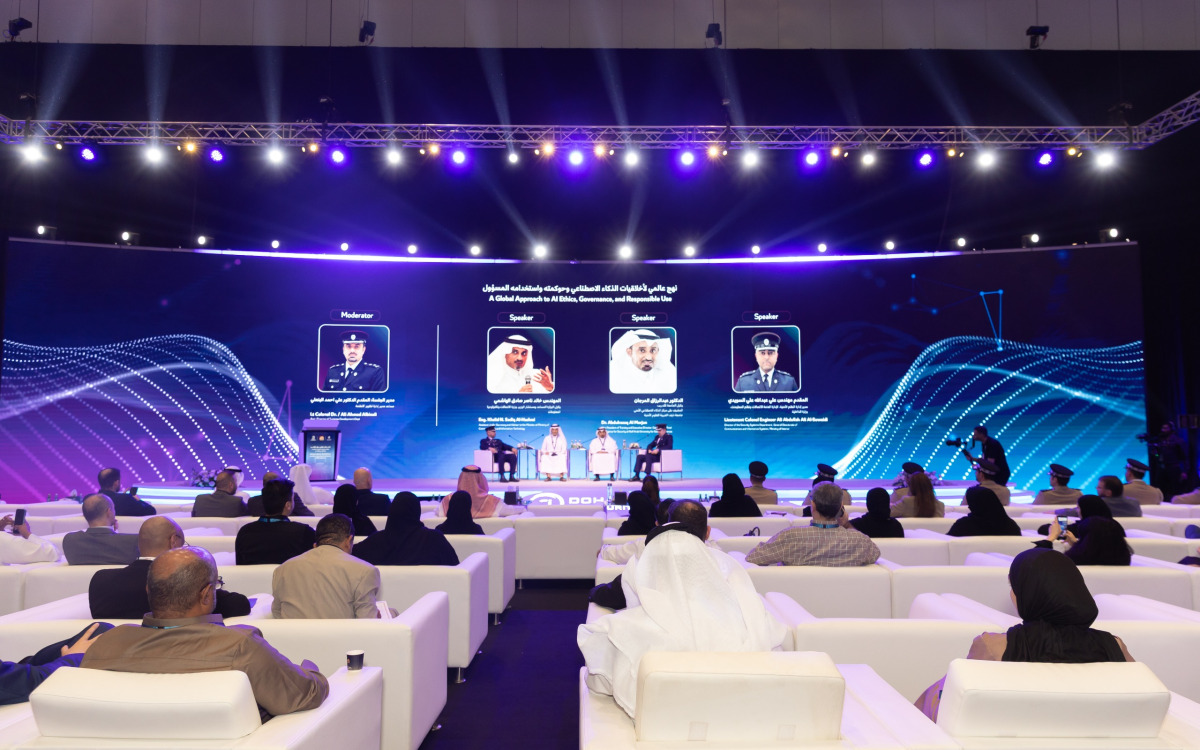
Participants in a discussion session within the activities of the Doha International Conference on Artificial Intelligence and Security, which is held in conjunction with the sixteenth session of Milipol Qatar 2026, stressed the importance of strengthening artificial intelligence governance frameworks, achieving a balance between technical innovation and responsible use, in addition to protecting data and confronting cyber challenges, in order to ensure safe and sustainable use of modern technologies.
The session, which was held at the Doha Exhibition and Convention Center and moderated by Lieutenant Colonel Dr. Ali Ahmed Al-Binali, Assistant Director of the Systems Development Department at the Ministry of Interior, shed light on the global approach to the ethics, governance and responsible use of artificial intelligence, with the participation of an elite group of officials, experts and specialists in the fields of technology and digital security.
During the session, Engineer Khaled Nasser Al Hashemi, Advisor to the Minister of Communications and Information Technology, stressed the importance of adopting a comprehensive partnership and a balanced approach in formulating frameworks for governance and regulation of artificial intelligence, ensuring the encouragement of innovation and creativity, while at the same time protecting society and providing a safe digital environment.
He called for adopting a broader concept based on partnership between the public sector, the private sector and citizens, pointing out that the traditional concept of partnership between the public and private sectors is no longer sufficient if it remains just a slogan.
He added that developing the governance model in Qatar is based on the involvement of the private sector and the industrial, technological and media sectors, along with citizens, in relevant dialogues, given the direct impact of policies on individuals and future generations.
Regarding the knowledge economy, Al-Hashemi considered that the knowledge economy is not limited to the digital economy, but rather depends primarily on intellectual property and innovations produced by the public and private sectors and citizens.
For his part, Lieutenant Colonel Engineer Ali Abdullah Al Suwaidi, Director of the Security Systems Department at the General Administration of Communications and Information Systems at the Ministry of Interior, confirmed that the Ministry has taken advanced steps in the fields of data analysis and security analysis supported by artificial intelligence techniques, which contributes to improving the public security and safety system.
He added that thanks to smart systems and video analysis techniques without direct human intervention, more than 53,000 traffic accidents and violations were monitored, including violations of stopping in the yellow box, wrong overtaking, using a phone while driving, and slow speeds in fast lanes, stressing that these systems provide early warning that supports field operations and enhances the efficiency of decision-making.
Regarding the framework for employing artificial intelligence, he stressed that the use of these technologies is being done responsibly according to basic pillars, including legal compliance, privacy, transparency, fairness, accountability, and emphasizing that artificial intelligence is a tool to support the human element and not a substitute for it, in addition to achieving justice in resource management.
He pointed out the existence of an independent unit for data flow, risk management and policies, which works to evaluate economic and operational feasibility, develop and approve tests, and monitor potential challenges, allowing immediate institutional response to contain them.
The Director of the Security Systems Department at the General Administration of Communications and Information Systems at the Ministry of Interior stressed that the success of the artificial intelligence system depends primarily on building mutual trust and adhering to good governance standards, ensuring the safe and responsible use of these technologies, and enhancing the leadership of the State of Qatar in this field.
In turn, Dr. Abdul Razzaq Al-Murjan, Vice President for Training and Executive Director of the Center for Artificial Intelligence for Security at Naif Arab University for Security Sciences, stressed the importance of building national capabilities and enhancing technical sovereignty in the field of artificial intelligence, verifying the working mechanisms of its systems and ensuring the safety of its outputs.
He considered that, in light of the current international discussions regarding artificial intelligence and its relationship to decision-making, the importance of linking the risks of these technologies to the decision-making process at the national and global levels is increasing, pointing to the role that academic institutions can play in helping countries build their capabilities to verify and tighten control over artificial intelligence systems.
Al-Murjan noted the role of security and academic universities in providing a safe environment and infrastructure that includes laboratories and personnel necessary to test data and systems and verify their integrity before adopting them operationally.
The Doha International Conference on Artificial Intelligence and Security, which continues until the twenty-second of this October, is a forum to discuss the use of artificial intelligence technologies in supporting security work and confronting emerging challenges, in a way that reflects the status of the State of Qatar and its role in enhancing regional and international security cooperation.