

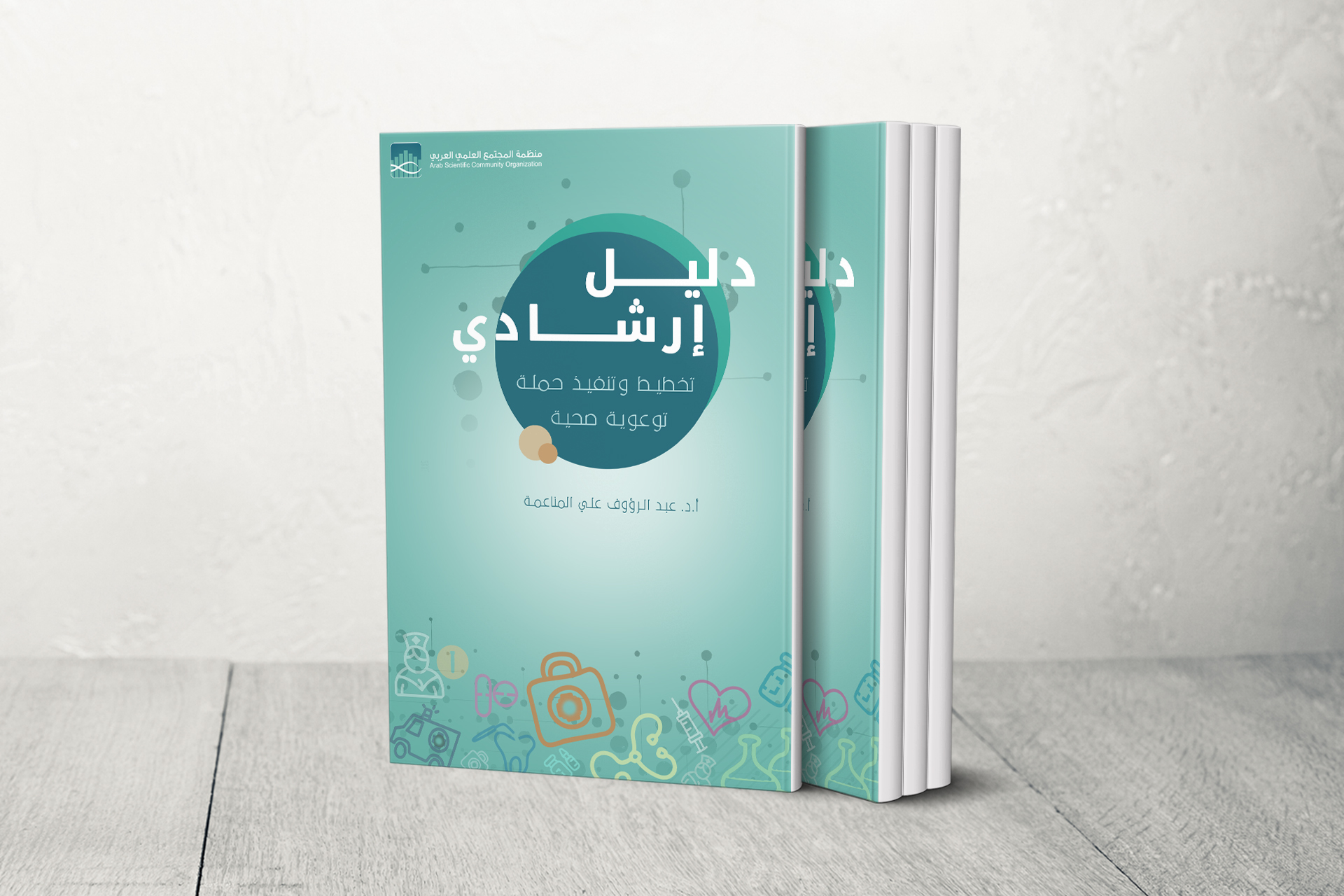
The guide was recently released “Planning and implementing a health awareness campaign” by the Arab Scientific Society Organization, which provides theoretical directives and practical steps to build systematic health campaigns, starting with planning and ending with evaluation.
The evidence is written by Prof. Dr. Abdel -Raouf Al -Manna, Professor of Public Health Sciences at the University of Islamic Sciences in Gaza, and it is located in 84 pages.
Al -Na’amah is a professor at the Islamic University of Gaza holding a professorship degree in microbiology, and he has held several positions, including the Vice President for Scientific Research and Graduate Studies, Dean of the College of Health Sciences, Dean of Quality and Development, and the Dean of Admission and Registration.
Al -Manhama has published more than 100 scientific research, most of which are in the field of bacterial resistance to antibiotics and infectious diseases. He leads annual campaigns to raise awareness of the risks of misuse of antibiotics, and he is the ambassador of the American Association of Microbiology in Palestine, a representative of the Arab Scientific Society Organization, a representative of the E-Bug Microbial Project (E-Bug) and a member of the Editorial Board of the Arab International Journal of Antibiotics.
The author wrote in the introduction that health awareness campaigns aim to spread awareness about health issues and enhance positive behaviors. The planning and implementation of a successful campaign also requires a deliberate steps to ensure the delivery of the message to the target groups effectively.
Examples of successful campaigns include: anti -smoking and awareness campaigns about its damages, vaccination campaigns against infectious diseases such as polio, and awareness -raising campaigns to reduce the spread of diseases. The campaign may target a specific group of society (such as: pregnant women, with disabilities, smokers …) or more than one category, or all groups of society, according to the issue of the campaign and its goals.
The awareness campaigns must be characterized by flexibility, in order to be able to adapt to any variables that may require a change in the approach or the nature of the messages. There are ongoing awareness campaigns that cover specific topics, and another emergency implementing a response to developments that may affect the health of the population (such as: the new Corona virus). Various parties can carry out awareness campaigns, such as: government agencies, civil society organizations and societies, international organizations, individuals, and institutions.
Al -Manaya said that the general goal of the guide is to provide a systematic framework for planning and implementing an effective health awareness campaign, to increase awareness about a specific health issue. This is in order to save time and effort, and to ensure elaborate planning and smooth implementation of health awareness campaigns.
According to the evidence, the goals of health awareness campaigns include increasing awareness and knowledge about a specific issue or health issues among the target audience, enhancing positive health behaviors, reducing harmful practices of health, improving health indicators at the individual and societal level, enhancing community participation in health issues and encouraging volunteer work, and providing simplified and reliable accurate information to combat health rumors.
The guide included several chapters that dealt with health education in terms of concept, importance, tools and contemporary applications. The book also dealt with volunteer work and its importance, the steps to implement a health awareness campaign, the elements of sustainability and development in health awareness campaigns, how to define the target group in health awareness campaigns, how to formulate smart goals, create an internet page for the campaign, and employ social networks in health awareness campaigns.
The evidence aims to consolidate the concepts of volunteer work, clarify the importance of health education, facilitate the planning and implementation process for awareness campaigns, and provide a reference that can be resorted to when facing problems in the campaign.
Infectious diseases at the time of wars and disasters
Last March, the Arab Scientific Society Organization was issued by the book “Infectious Diseases Time of Wars and Disasters”, which was prepared by a few professors and researchers from the Department of Laboratory Sciences at the College of Health Sciences, at the Islamic University of Gaza, under the supervision of Dr. Al -Manna. The book is in 270 pages.
Dr. Mahmoud Al -Omar – who reviewed and presented the book – said that the people of Gaza are still setting us great examples of sacrifice and giving, despite the devastating war and the genocide practiced on Gaza, their children insist on giving, as these are a few Gaza sons who prepare this book to be a scientific beacon that provides science and health education to the Arab world through their own experience in the time of wars and disasters.
The book “Infectious Diseases Time of Wars and Disasters” contained 11 chapters that covered the most important infectious diseases in the world, especially in the time of disasters and wars, and diseases transmitted through water and food, how to transmit infection, health education, personal hygiene in wars and disasters, the importance of vaccination in preventing infectious diseases, disinfectants, methods of sterilization, antibiotics, and challenges facing health care in Wars and disasters, the difficulties and challenges facing shelters in preventing infectious diseases, and the role of society in preventing infectious diseases.
Al -Jazeera interviewed the health of Dr. Moza bint Muhammad Al -Rabban, head of the Arab Scientific Society Organization, on these two editions, and the following is the text of the dialogue:
-
What is the importance of publishing a guide “planning and implementing a health awareness campaign”, at this time, and a writer from Gaza is Prof. Dr. Abdel -Raouf Al -Manaya?
The publication of this guide at the present time is a scientific and realistic response to a state of practical void that our Arab societies suffer in dealing with health awareness in a professional and systematic way. We live in an Arab world in which pressure increases on health systems, and crises are intertwined, and healthy and health education is overwhelmed by local individuals and initiatives, often lacking scientific and directive support.
That this guide comes from a researcher who lives in Gaza, where the disaster is a daily routine and not an exception, as this gives the work an additional value. It is not only a theoretical evidence, but the summary of a practical field experience that was accomplished in extreme conditions, which gives it a special credibility and weight. We have monitored as a vocabulary destination how Dr. Abdel -Raouf Al -Manahiah, despite the suffocating reality surrounding him, chose to turn his experiences into a useful science and a tool of rescue to others.
-
What is this guide to the Arab reader?
This guide gives the Arab reader rarely: an application plan in a clear Arabic language to design and implement an effective health awareness campaign. It is not satisfied with the theoretical explanation, but rather provides ready tools and models, and takes the reader on an organized journey from the moment the targeted group and the message, up to the measurement of impact and sustainability.
More importantly, the evidence is written in an Arab spirit, addresses our reality, and depends on field experiences from our environment, not from distant laboratories. It integrates the scientific method and social flexibility, which makes it useful for workers in official institutions, civil initiatives, and even independent activists.
-
How can the application of the recommendations of this guide reflect positively on the health of the Arab public?
When awareness campaigns are built on thoughtful foundations, they turn from passing slogans into actual change tools in healthy behavior of individuals and societies. This is reflected in the prevention of diseases, relieving pressure on health systems, and strengthening community immunity, not only in biological aspect, but in terms of the ability to collectively respond to emergency conditions.
The evidence helps to activate the audience as part of the solution, by incorporating into understanding, discussion, and participation, rather than keeping a negative recipient of messages. This is the transformation that we need in our region: from the transferred consciousness to participatory awareness.
-
What message does the book “Infectious diseases at the time of wars and disasters” carry?
The message is clear and direct: Health does not wait for the end of the disaster, but rather it must be taken into account from its first moment.
This book shows how epidemics quickly infiltrate the affected societies, taking advantage of poor infrastructure, malnutrition, crowding, lack of hygiene, preoccupation with those concerned with reconstruction and the absence of preventive health planning.
The book is not satisfied with diagnosing reality, but rather proposes solutions, plans, and response forms, and depends on a realistic experience from Gaza, where the researchers worked under the pressure of war, electricity and medicine, and they came out with a great study: that prevention is possible even in the most difficult circumstances, if there is awareness, commitment, and organized scientific work.
Dr. Al -Rabban concluded by saying that “in the Organization of the Arab Scientific Society we do not see in these books merely scientific publications, but rather we consider it a living testimony that the voice of science can emerge even from the rubble. The author and his team have influenced, not to retain their experience for themselves, but rather as an open science, free, available to everyone, because they believe that science is a message and responsibility.”
“We published these two books, because we believe in the vital role of the scientific community in times of emergency, and we believe that awareness and prevention is not a luxury, but rather the first line of defense of people’s lives,” she added.
These books are an open invitation to every institution, and for every initiative, and for each individual: to take our responsibility to enhance awareness, share knowledge, and provide science that improves people’s lives, whatever the circumstances.
Dr. Moza bint Muhammad Al -Rabban holds a PhD in Atomic Physics, Laser and Plasma Physics, and she is the head of the Arab Scientific Society Organization, her founding member, editor -in -chief of the “Arab Journal of Scientific Research”, formerly Ajsr, and its institution, and a lecturer and head of the Department of Physics at Qatar University, formerly.