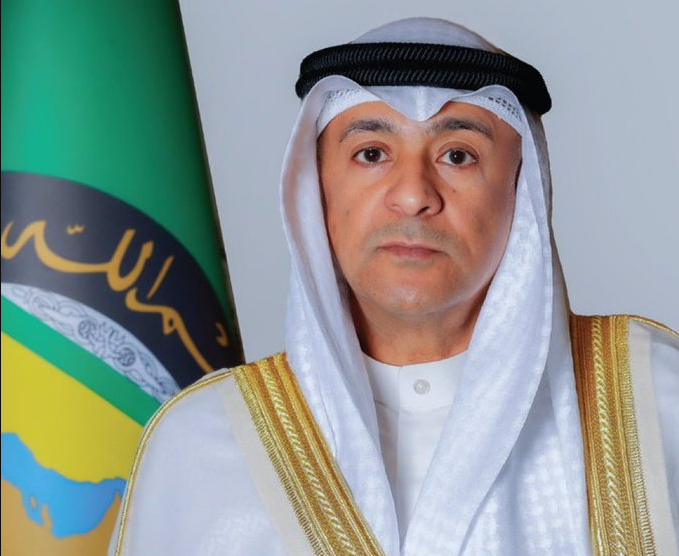
Mr. Jassim Mohammed Al-Budaiwi, Secretary-General of the Cooperation Council for the Arab States of the Gulf, affirmed the support of the Council countries for international initiatives aimed at ensuring freedom and smooth navigation in the Strait of Hormuz, and the aspiration to contribute to keeping it open to global trade movement.
This came during his participation in the informal leaders’ meeting between the European Union and the main regional partners, which was held in the Cypriot capital, Nicosia, and hosted by Cypriot President Nikos Christodoulides, and chaired by European Council President Antonio Costa, in the presence of a number of leaders and heads of Arab and European countries.
Al-Budaiwi stressed the importance of the strategic partnership between the Gulf Cooperation Council and the European Union and the need to strengthen it in a way that serves the interests of both sides and contributes to supporting regional and international stability, stressing that the current stage requires more coordination and activation of existing mechanisms within the framework of this partnership.
He touched on the importance of the Arabian Gulf region and the Strait of Hormuz and the efforts made in cooperation with international partners to ensure freedom and smooth navigation in the strait, stressing the support of the GCC states for relevant international initiatives.
In this context, the Secretary-General of the Council stressed that dialogue and negotiation represent the best way to reduce escalation in the region, indicating that any comprehensive solution with Iran must include its nuclear file and its ballistic missile program, in addition to stopping the activities of its agents in the region.
He pointed to the potential repercussions of closing the Strait of Hormuz and its direct impact on European energy security and vital sectors, including the aviation sector.
In this context, he noted the importance of strengthening cooperation in the field of energy supply security, working to develop alternative paths for its transportation, including via pipelines, rail and air connections, and opening strategic connectivity channels between the two sides, in a way that enhances infrastructure integration and serves common interests.
On the other hand, Al-Budaiwi stressed the centrality of the Palestinian issue, the necessity of ending the Israeli occupation, and establishing an independent Palestinian state on the 1967 borders, with East Jerusalem as its capital, in accordance with the Arab Peace Initiative and international legitimacy resolutions.
Regarding the Lebanese issue, the Secretary-General of the Gulf Cooperation Council appreciated the initiative of French President Emmanuel Macron to hold an international conference to support and rebuild southern Lebanon, stressing the importance of reaching a comprehensive solution that guarantees Lebanon’s stability and avoids further escalation in the region.
The Secretary-General of the Gulf Cooperation Council expressed his aspiration to hold the second summit between the Gulf Cooperation Council and the European Union during the current year, to discuss a number of files of common interest, including the free trade agreement, Schengen visa exemption, digital transformation, logistical connectivity, clean energy, and investments, in a way that enhances the prospects for the strategic partnership between the two sides.