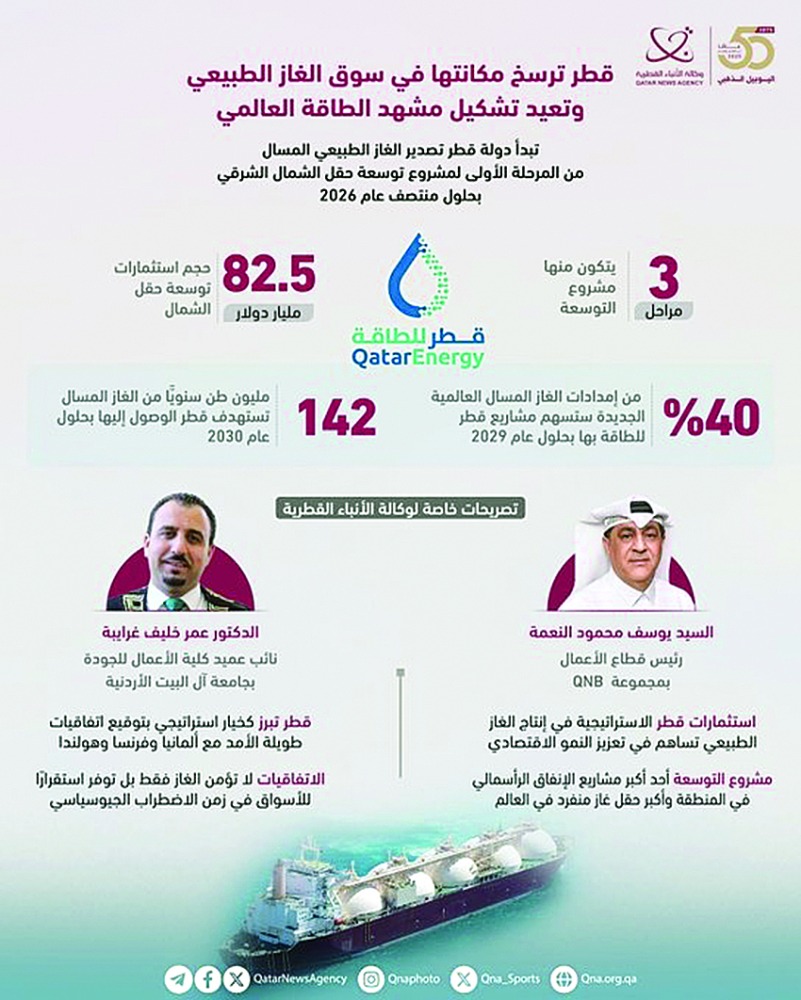
In a strategic step that enhances its position as a major global source of clean energy, and supports global energy security in light of the increasing demand and escalating challenges, the State of Qatar begins exporting liquefied natural gas from the first stage of the expansion project of the northeast field by mid 2026. In this regard, two experts stressed, in exclusive statements to the Qatar News Agency «Qena), on the role of the great State of Qatar in supporting the foundations of the economy, and pushing growth rates in the country during the years during the years The next, in addition to the reshaping of the global energy markets, is expected to contribute to Qatar Energy projects with about 40 percent of the total new global LNG supplies by 2029.
It is noteworthy that His Excellency Eng. Saad bin Shaida Al -Kaabi, Minister of State for Energy Affairs and CEO of Qatar Energy Company, had announced in the Qatar Economic Forum earlier this year that the expansion work is proceeding according to the planned timetable, and that the first liquefied gas exports from the northeast field will start in the middle of next year.
The State of Qatar, through this major expansion, which is the largest of its kind globally, aims to reach a production capacity of 142 million tons annually by 2030, after the completion of the development of the “Northwest Field” project, which is still in the engineering design phase.
This stage is part of an ambitious expansion plan that will double the production capacity of liquefied natural gas in Qatar, to increase from 77 million tons annually to 110 million tons by 2026, to reach 126 million tons annually by 2027 after the completion of the second phase of the project in the southern northern field.
In this context, Mr. Youssef Mahmoud Al -Nama, head of the business sector of the QNB Group, said in a special statement to the Qatar News Agency «Qena) that Qatar’s strategic investments in the field of natural gas production contribute to advancing economic growth.
The head of the business sector in the QNB Group referred to the North Field expansion project, as one of the largest capital spending projects in the region, and the largest unilateral gas field in the world, and that it is one of the main engines to enhance this growth. He said: «The development of eight new production lines for liquefied natural gas in the framework of this project in three stages represents the cornerstone of these efforts.
Al -Nama expected that these investments will support Qatar LNG production rates by 85 percent by 2030, to reach 142 million tons annually. The North Field expansion project will also include a parallel expansion in the refining industries, final refining operations, and the production of petrochemical. The returns of these projects will reflect positively on supporting economic diversification efforts, structural reforms and accelerating the pace of economic growth, while raising the level of spending in the manufacturing and services sectors.
He pointed to the GDP growth governorate, to accelerate the start of the stages of the North Field expansion project, where the growth rate is expected to increase by 2.4 percent in 2025, 5.6 percent in 2026, and 7.9 percent in 2027.
He said: “This development will enhance the Qatari banking sector, which will continue to benefit from this great growth, abundant liquidity, adequate capital levels, quality of high assets, and strong profitability.”
On the other hand, Dr. Omar Khalif Gharaiba, Deputy Dean of the Business College of Quality at the Jordan Al -Bayt University, stressed in exclusive statements to «Qena», that the State of Qatar is investing today in one of the largest expansion operations in the history of the gas industry, by developing the northern field, which is the largest in the world, and said: “With this step, the production capacity of the liquefied natural gas will rise from 77 to 126 million tons annually by 2027, an increase of more than 63 percent. It is not just numbers, but the features of a new global energy system that is formed from Doha. ”
He pointed out that the energy compass in Europe has witnessed changes in the past few years, as it started searching for reliable partners. Here, Qatar appears as a strategic option, by signing long -term agreements with Germany, France and the Netherlands. These agreements not only secure gas, but also give the markets to be lacking in the time of geopolitical turmoil. He added, “Economically, the Qatari expansion contributes to alleviating global price fluctuations. Gas prices are expected to decrease from levels exceeding $ 30 per million thermal units to about 10 – 15 dollars by the end of the contract.
Dr. Gharaibeh stated that Qatar is re -drawing the map of the energy industry in the world. While the major powers seek to re -position it in a multi -polar world, energy is highlighted as a balance of balance and influence, and Qatar as a quiet force that manages smart investments with more than $ 45 billion in infrastructure, ports and carriers.
He pointed out that at a time when energy security challenges intersect with the necessities of environmental transformation, Qatar offers an advanced model: sustainable production, global positioning, and long -term partnerships that reformulate the future from under the depths of the Gulf.
It is mentioned that the expansion project consists of three stages; The first of which concerns the eastern region, and includes four giant production lines, with a production capacity of 8 million tons annually per line, with a total of 32 million tons. The second, southern stage includes two additional lines, with a production capacity of 16 million tons annually. As for the third, western stage, it is under development, and it is expected to add another 16 million tons annually.
It is expected that the Western project will enter into construction by 2027, to complete the national plan to increase liquefied gas exports.