

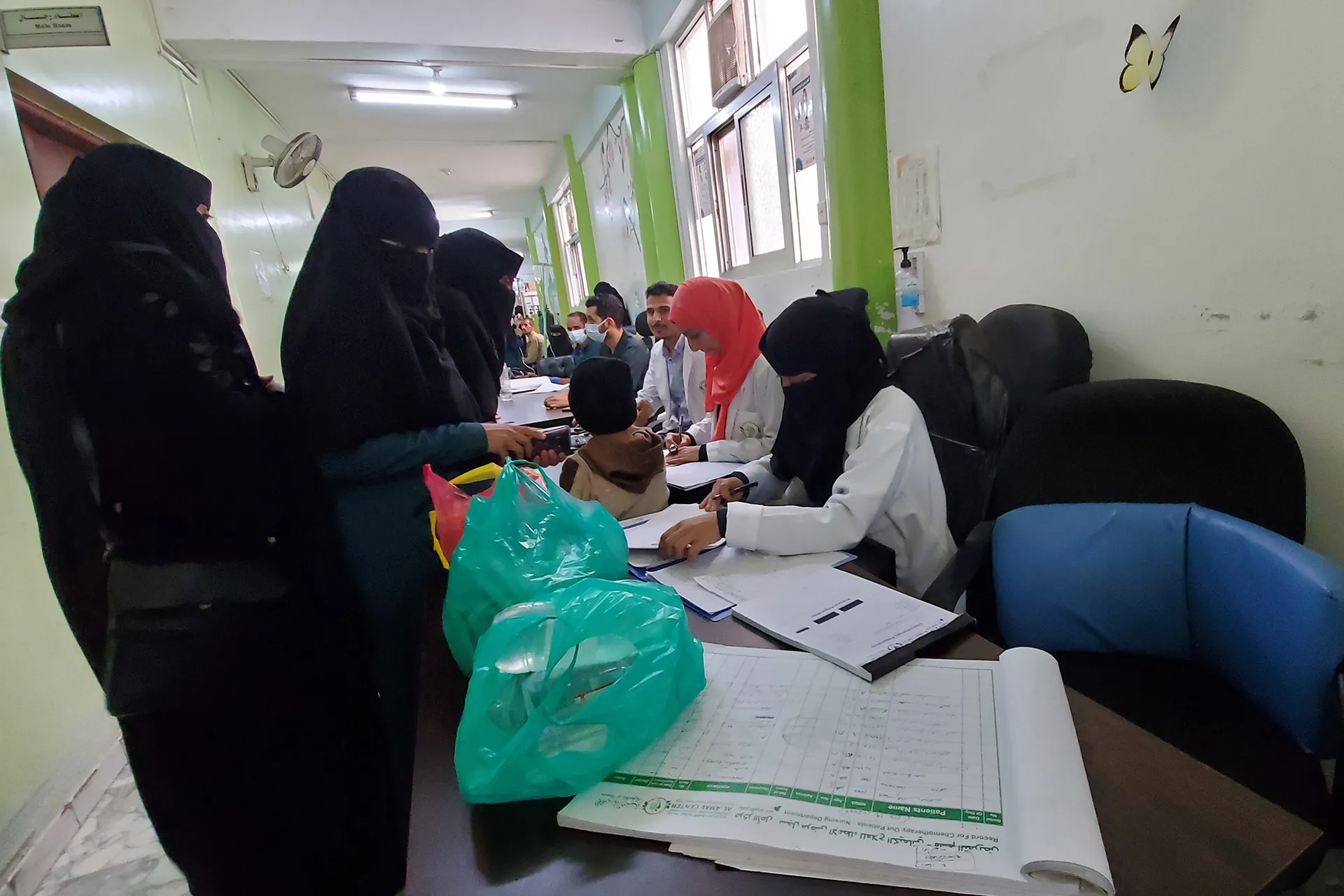
Taiz- With a pale face and a body exhausted by illness, Fatima Awad Salem Abdullah sits on the bed in Al-Amal Hospital for Oncology in Taiz Governorate, southwest of Yemen. She bites her nails anxiously, and tries to gather her voice to talk about a treatment journey that lasted 3 years, before words fail her and her tears flow.
Cancer is not the only thing that is burdening her. The young woman, Fatima, who comes from the city of Mokha, finds herself stuck in Taiz, far from her family, preparing to begin chemotherapy without anyone by her side. She came to the city to seek treatment, hoping to return to her family, but the circumstances of the war prevented that, so her medical trip turned into a stay that she did not know when it would end.
Between siege and disease
Fatima tells Al Jazeera Net, “I am suffering from cancer and displaced from Mokha. Rather, I am not displaced. I was being treated here, on the basis that I would return, but with the withdrawal in Mokha, I was trapped inside Taiz. I was unable to return to Mokha.”
She adds that her suffering began 3 years ago when she felt small lumps in her breast, and she moved between doctors in Aden, Mokha, and Taiz, before the tumor increased in size and she underwent brain surgery.
Fatima explains that she had breast surgery, and one of them had benign cancer, and the other had malignant cancer, but the surgery did not put an end to her journey with the disease, as subsequent tests showed the continued presence of cancer cells in the bone and under the armpit, which required medical reviews and other surgeries.
After surgeries and tests, Fatima was transferred to Al Amal Oncology Center in Taiz, where she is preparing to begin chemotherapy. She says that the results of the latest examination confirmed the continued presence of cancer cells, and that she will receive her first dose. However, waiting for treatment coincides with psychological and living conditions that make it more difficult for her to confront the disease. She says, “The tears from yesterday have not stopped. Cancer kills slowly.”
In the hospital, Fatima does not find anyone from her family to accompany her, and she cannot return to Mocha, so she faces the disease far away from the people she needs at this stage. She added, “I am suffering now with severe illness and my conditions inside Taiz. I am besieged, and I have no companion or family with me, and no one is with me. I am tired from extreme fatigue and staying up late, and not just illness, but illness and suffering from everywhere.”
She says that she had two surgeries in the brain on July 15, 2026, and moved to Al-Amal Hospital in Taiz last August, where she completed examinations and prepared for treatment. She explains, “I started my treatment journey in Taiz from last September until today, and I still am. This is my first day that there will be chemo, the first dose.”
According to Dr. Aseel Al-Dabai, who is following up on her condition, Fatima arrived at the hospital after discovering a tumor in her breast, and the results of the biopsy showed that it was malignant.
Al-Dabai explains to Al-Jazeera Net that chemotherapy may be given before or after surgery, depending on the patient’s condition and the treatment plan, indicating that Fatima will begin treatment before undergoing the next surgery. As she begins a new phase of treatment, she remains preoccupied beyond medical appointments, how she will face the illness journey without family or companions.
Pain does not exclude anyone
Nearby, in one of the beds in Al-Amal Hospital, lies Ibtisam Talib Abdullah, 50 years old, who comes from the Jabal Habashi district, west of Taiz. She speaks with difficulty about a journey with breast cancer that began with pain she did not know the cause of and initially thought it was an infection.
She told Al Jazeera Net, “The first thing started was pain, and after a year the tumor appeared in the breast and body in a large way. I arrived here, and they told me it was a malignant tumor.” She adds that she was suffering from severe pain that prevented her from sleeping, while her mother believed that what she was feeling was just inflammation.
Ibtisam did not know the nature of the illness until after visiting the hospital. She received treatment in a hospital close to her area, then underwent surgery at Al-Daqaf Hospital, before being transferred to Al-Amal Hospital to complete treatment.
She told Al Jazeera Net that she took medications for two months before the surgery, and then began chemotherapy afterward. According to her, she has reached the fourth dose, and only the fifth and sixth doses remain.
While Fatima prepares to undergo her first chemotherapy session, Ibtisam is close to completing a treatment phase, but the two cases reveal two aspects of one journey: diagnosis, surgery, and ongoing treatment, and the anxiety and waiting that accompany them.
Al-Dabai confirms that breast cancer is one of the most common types of cancer in Taiz and on a global level, noting that the center receives new cases frequently. He says, “Maybe not a week goes by without one or two breast cancer patients entering the registry,” pointing out the importance of early detection and medical follow-up in dealing with the disease.
Decline in early detection
The suffering of women suffering from breast cancer does not begin upon admission to the hospital. It may begin before that, when the woman is late in undergoing examinations or it is difficult for her to reach a medical center.
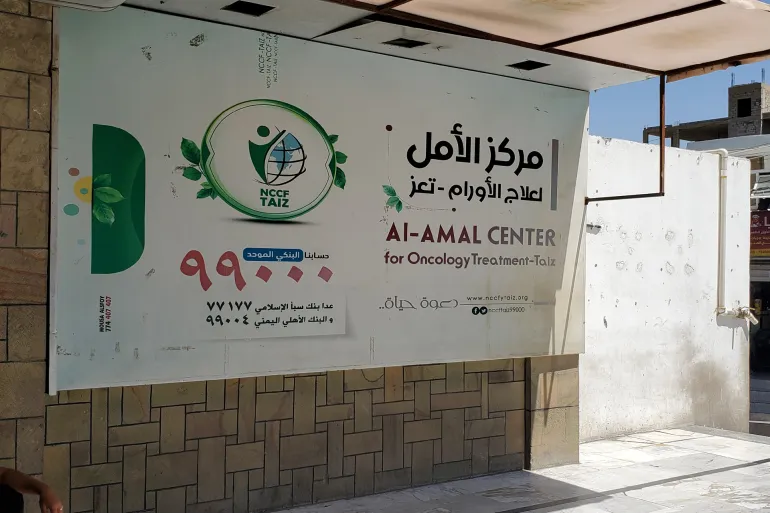
For her part, Imtiaz Al-Zubair, Director of the Media Department at the National Cancer Control Foundation in Taiz, says that the current circumstances, the oil derivatives crisis, and the difficulty of movement have affected the demand for early detection services.
She explained to Al Jazeera Net that the center registered more than a thousand beneficiaries of early detection last September, while demand declined during this October, despite its dedication to breast cancer awareness. She adds that the center used to receive between 600 and 700 beneficiaries during October of previous years, but the difficulty of reaching the center located in the center of Taiz city limited the turnout this year.
According to the Director of the Foundation’s Media Department, the number of breast cancer cases recorded from the beginning of 2026 until this October reached 195 cases, including two cases in males. She points out that the disease represents the most common type of cancer in the governorate compared to other types, as it exceeds 20% of the total registered cancer cases, according to her testimony.
Al-Amal Center for Oncology statistics show that the total number of breast cancer cases registered from its opening in 2008 until October 17, 2026 reached 2,558 cases, including 2,528 in females and 30 in males. The center also recorded 195 cases from the beginning of this year until October 17, with the number of beneficiaries of early detection services reaching 983 beneficiaries.
While waiting for the first chemotherapy dose, Fatima has no choice but to continue treatment and cling to the hope that she will be able to overcome the disease, while her tears remain a witness to a battle she is fighting not only with cancer, but also with circumstances that surround her life from all sides.