

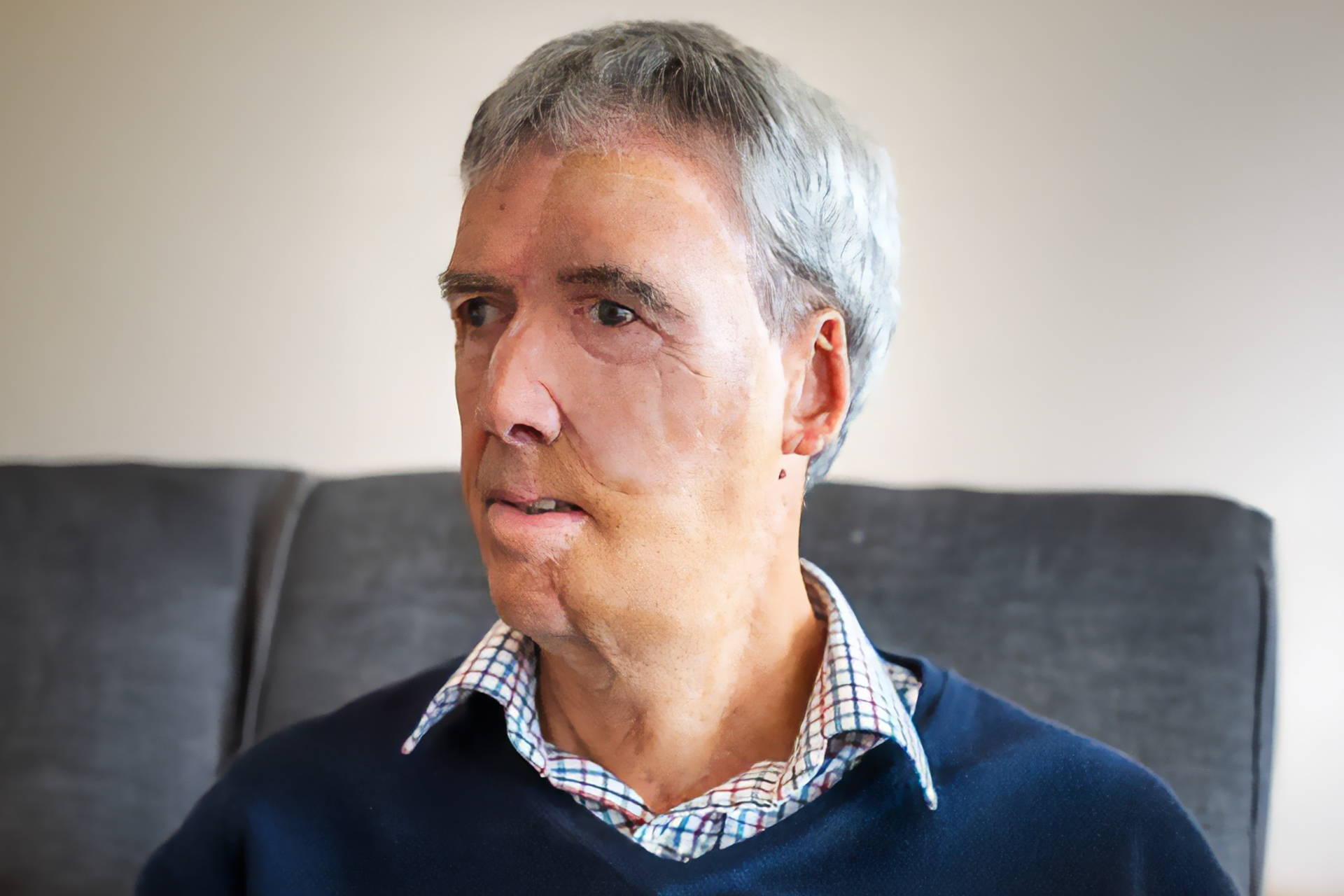
3D printing restored some of the features of a man who lost half his face when he was hit by a drunk driver while riding a bike with his friends, through a 3D-printed prosthetic to hide his facial deformities.
Dave Richards, 75, was enjoying a trip with his friends near his home in the United Kingdom when he was involved in a horrific traffic accident in July 2021, according to the British Daily Mail.
Richards suffered third-degree burns – where every layer of skin, including fat and muscle, was affected – to one side of his face.
The man was seriously injured and suffered damage to his back and pelvis, and suffered multiple fractures in his ribs on one side of his body.
He was rushed to Bristol Royal Infirmary, where he was told that he was lucky to be alive.
Richards said: “The surgeons tried to save my eye, but they were concerned that any infection might spread from my eye to the optic nerve and on to the brain, so the eye was removed, and then the decision was made to implant a free flap (a piece of tissue taken from one part of the body and transferred to another) where tissue was taken from arteries and blood vessels and tied into my neck.”
Casts and splints
During his recovery, Richards was referred to the Department of Reconstructive Prosthetics, which recently opened the Bristol 3D Medical Centre, the first center of its kind in the UK to undertake 3D scanning, design and printing of this type on a single NHS site.
Richards received a 3D prosthetic that fit the area of his face and mimicked his hair, eye and skin color, and said working with the center helped him build his self-confidence and rehabilitation.
He added: “It’s not the most fun process. They relied on various molds and wax prints from hand processes, and took a lot of photos to record what it looked like, and there was a lot of work involved in making the molds.”
Richards continues to visit 3D Bristol Medical Center and has also received a large eye socket prosthesis and neck scar splints to help soften the scar tissue.