

The General Tax Authority announced the new mechanism for the selective tax on sweetened beverages, which will be implemented as of next July 6. It confirmed in a post on the
This decision aims to encourage consumers to choose healthy alternatives and adopt a more balanced lifestyle.
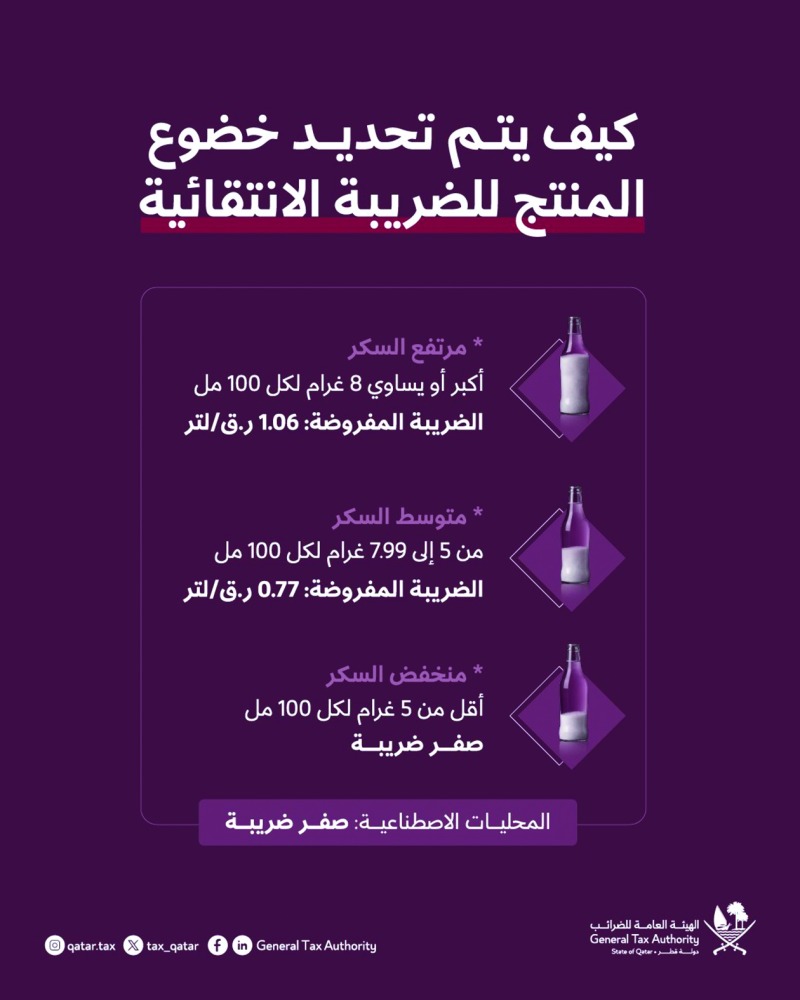
* How is the product subject to excise tax determined:
*High sugar
Greater or equal to 8 grams of sugar per 100 ml
Tax imposed: 1.06 riyals/litre
* Average sugar
5 to 7.99 grams of sugar per 100 ml
Tax imposed: 0.77 riyals/litre
* Low sugar
Less than 5 grams of sugar per 100 ml
Tax imposed: zero tax
* Artificial sweeteners..
Tax imposed: zero tax
Limit consumption of high-sugar products
Law No. (2) of 2026 amending some provisions of Law No. (25) of 2018 regarding excise tax will enter into force as of next July 6.
The General Tax Authority said in a number of its publications, “The new mechanism for calculating the excise tax on sweetened beverages comes in support of reducing the consumption of high-sugar products and promoting healthy lifestyles. The law will enter into force as of July 6, 2026, allowing taxpayers a sufficient period to settle their situations.”
She added that the most prominent amendments to the law are:
– Adding sugar-sweetened beverages to the list of excise goods subject to tax (such as: soft drinks and juices that contain added sugar).
– Implementing a new mechanism to calculate the excise tax on sweetened beverages, based on a graduated volumetric model, whereby the tax is calculated based on the amount of sugar or sweeteners in each size of the product, instead of a fixed percentage of its price.
– The obligation of everyone who possesses selective goods to submit tax returns to disclose the balance or stock when the law enters into force, as well as when any new selective goods are added to the table of taxable goods.
Taxes stressed the need for everyone who possesses selective goods to submit tax returns to disclose balances or inventory upon the entry into force of the law through a tax platform.
The General Tax Authority confirmed that the goals of the new amendments include reducing the consumption of high-sugar products and promoting healthy lifestyles, in addition to supporting the national trend towards health prevention and enhancing societal sustainability.
Achieving social policy goals
The excise tax is a consumption tax that is applied to specific goods that the State of Qatar considers harmful to human health and the environment, with the aim of limiting or minimizing their consumption in order to build a healthier society. The revenues generated from the excise tax are invested in improving public services, including hospitals, infrastructure, and education.
The excise tax also contributes to achieving the goals of the social policy of the State of Qatar within the framework of the National Vision 2030, and will help secure a sustainable future for the State of Qatar and its future generations.
The new mechanism for the excise tax on sweetened drinks is based on a graduated volumetric model, whereby the value of the tax is calculated based on the amount of sugar or sweeteners in the drinks or products subject to the tax.
The table of taxable selective goods attached to the law has also been amended to include sugar-sweetened beverages such as soft drinks and juices that contain added sugar.
The scope of application also includes all products that can be converted into beverages and contain sugar or sweeteners, whether they are concentrates, powders, extracts, or any other similar products.
This trend comes within the framework of the state’s efforts to reduce the consumption of high-sugar products, and to motivate manufacturers to reduce the levels of sugar in their products, in a way that enhances the health of society. This mechanism also falls within the country’s strategic directions, in line with international best practices, and achieves a balance between economic and health goals.