

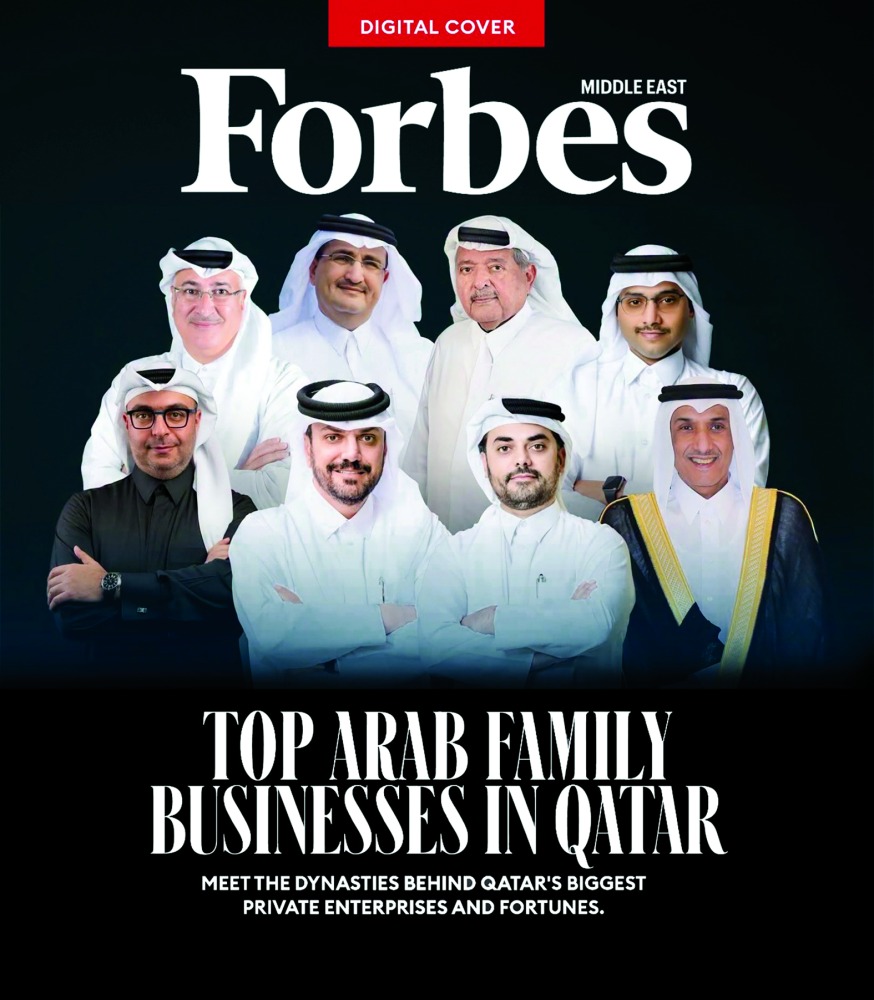
Forbes Middle East revealed its annual list of the 100 most powerful Arab family companies for the year 2026, which included 10 Qatari companies, to shed light on the most important long-standing family companies in the Middle East region, which have succeeded in continuing across generations, and established their mark in the region’s markets. The Forbes Middle East research team evaluated each family business, according to a set of criteria that included: the size of assets, subsidiaries, business performance over the past year, the history and legacy that the company represents, in addition to the diversity of activities in terms of sectors and geographical expansion. The list highlighted the largest, most valuable and profitable family companies in Qatar, which included: Power International Holding, Al Faisal Holding, Al Darwish Holding, Al Fardan Group, Abu Issa Holding, Mohammed bin Hamad, Al Muftah, Al Mana, Al Jaidah, and Marzouq Shamlan Al Shamlan.
Power International Holdings
According to the Forbes list, Power International Holding, led by the brothers Moataz and Ramez Al-Khayyat, topped the list of Qatari companies on the list, and ranked seventh in the Arab world. The group’s portfolio is located in five main sectors: general contracting, real estate development, agriculture, food industries, lifestyle, entertainment, hospitality, and services.
Al-Faisal Holding
While Al Faisal Holding, led by His Excellency Sheikh Faisal bin Qassim, ranked second among Qatari companies on the list and eighth in the Arab world, as the company is committed to maintaining its leading position and is active in several sectors, including real estate, hospitality, trade, education, culture, entertainment, services and manufacturing. It also owns a majority stake in “Aamal” Company listed on the Qatar Stock Exchange.
Darwish Group
As for Al-Darwish Holding Group, whose Board of Directors is chaired by Badr Al-Darwish, it ranked third in Qatar and 28th in the Arab world. The group includes a number of prominent companies that provide high-quality products and exceptional services to individuals and the commercial sector in the State of Qatar. Today, it includes diverse business interests within a series of industries, including the fields of distribution, investment, retail trade, real estate, commercial services, and technology.
Alfardan Group
Al Fardan Group ranked fourth in Qatar and 58th in the Arab world. It was founded for the first time by Mr. Hussein Ibrahim Al Fardan under the name Al Fardan Jewelry Company. The group works in the fields of jewelry, financial exchange, real estate development, cars, hospitality, marine services, and investment.
Abu Issa Group
It was followed by Abu Issa Holding Group, whose Board of Directors is chaired by Ashraf Abu Issa, ranked fifth in Qatar and 70th in the Arab world. The group started out as a luxury store under the name (Blue Salon) in 1981. Today the group includes more than 70 companies in 11 sectors, including retail, e-commerce, hospitality, real estate, broadcasting, contracting, and engineering services.
The list also included Mohammed bin Hamad Holding Company, whose Board of Directors is chaired by His Excellency Sheikh Jassim bin Mohammed Al Thani, ranked sixth in Qatar and 73rd in the Arab world, then Al Muftah Group, whose Board of Directors is chaired by Mr. Abdul Rahman bin Muftah Al Muftah, in seventh place in Qatar and 77th in the Arab world, followed by Al Mana Group, whose Board of Directors is chaired by Saud Omar Al Mana, in eighth place in Qatar and 78 in the Arab world, and Al Jaidah Group, headed by Mohammed Al Jaidah, in ninth place in Qatar. And 89 Arabs. Marzouq Shamlan Al-Shamlan Holding Company, whose board of directors is chaired by Tariq Marzouq Al-Shamlan, came in tenth place among Qataris and 94 among Arabs.
A set of standards
Forbes Middle East prepared the list according to a set of criteria: the size of family business investments, including the value of subsidiaries, companies listed on financial markets, the value of assets in the real estate and hospitality sectors, and their revenues from other assets. And commercial activity during the past year, such as offering subsidiaries in the financial markets, new investments and projects, and the extent of business diversification in terms of sectors, geographical expansion, and the performance of the main sectors in which the company operates. The company’s history, legacy, and number of employees.
Forbes said that Arab family businesses are an integral part and a major component of the economic history of the Middle East and North Africa region, as they have contributed over decades to shaping the region’s economic landscape. Today, family-owned and operated businesses continue to play a pivotal role in building wealth, providing jobs to millions of people, and supporting growth across strategic sectors, such as energy, construction, retail, healthcare, logistics and financial services, among others.
The Gulf Cooperation Council countries still dominate the classification, as it includes 86 companies, including 32 companies in Saudi Arabia, 31 companies in the Emirates, and 10 companies in Qatar. The list also included companies from Egypt, Jordan, Morocco, Lebanon, and Algeria, which confirms that Arab family companies go beyond the borders of the Gulf region, and in many of these markets they represent a major driver of employment in the private sector and economic growth.
In 2025, the Arab region’s GDP reached about $3.8 trillion, and it is expected to exceed $4 trillion in 2026, according to the Arab Corporation for Investment and Export Credit Guarantee (Daman).