

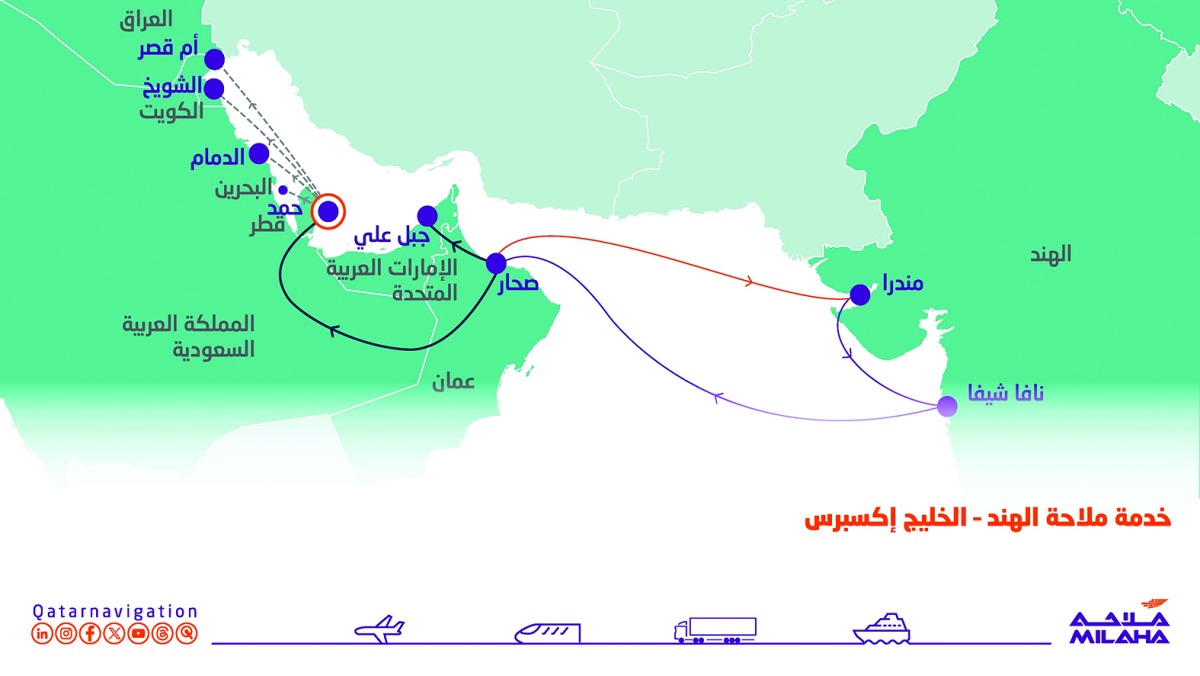
The flights serve Hamad Port in Qatar and Jebel Ali in the UAE via trucks
The service network through Hamad Port includes the ports of Dammam, Shuwaikh, Umm Qasr and Bahrain
Qatar Navigation Company “Milaha” revealed the modernization of the India-Gulf Express (MIX) navigation service, in a step aimed at enhancing maritime and logistical connectivity between India and the Port of Sohar in the Sultanate of Oman and Hamad Port in the State of Qatar, and expanding access to the network of the Gulf Cooperation Council countries. According to the update issued by the company through its official account on the “X” website, the service provides a direct weekly flight linking the ports of Mundra and Nava Shiva in India with the port of Sohar in the Sultanate of Oman, which supports trade movement and provides regular transportation options for exporters and importers between the Indian subcontinent and the Gulf region.
The flights serve the ports of Hamad in the State of Qatar and Jebel Ali in the United Arab Emirates via trucks, as shipments are transported by trucks from Sohar through guaranteed customs lanes, which increases the flexibility of transport operations and provides an integrated route that combines sea and land freight. The upper Gulf ports are also connected to the service through transshipment operations at Hamad Port.
The service operates with two ships, each with a nominal capacity of about 1,200 TEUs, while providing between 150 and 200 delivery points for refrigerated containers, which supports the transportation of food, agricultural and pharmaceutical products, and goods that require specific temperatures.
The service network, through Hamad Port, includes the ports of Dammam, Shuwaikh, Umm Qasr and Bahrain, enhancing Qatar’s role as a regional center for transshipment and distribution of goods to Gulf markets. Service data show that the transit time west from Mundra to Sohar is about two days, and to Hamad Port about seven days, while it reaches Jebel Ali via the land bridge in about 12 days, according to the published operating schedule.
Milaha is one of the most prominent providers of feeder container shipping services in the region, as its network extends between Qatar, Oman, India, Sri Lanka, Bangladesh and Europe, and it operates a specialized fleet to serve the needs of importers and exporters.
The modernization of the service comes within the framework of Milaha’s efforts to develop maritime transport and logistics solutions, raise the efficiency of supply chains, and provide more flexible routes between the Asian and Gulf markets. The modernization also supports Hamad Port’s position as a major link in the regional trade and re-export movement.
The service modernization comes at a time when Hamad Port continues to strengthen its position as a regional logistics center, benefiting from a wide network of direct shipping lines and advanced infrastructure, which supports re-export movement and connects Asian markets with the Gulf Cooperation Council countries via Doha.
In recent years, the port has strengthened its position as a major hub for maritime trade in the region, benefiting from its strategic location and advanced operational infrastructure, supporting Qatar’s vision to diversify the economy and consolidate its position as a global center for transport and logistics services.
The port is characterized by an advanced infrastructure that includes specialized stations for handling containers, general cargo, cars and livestock, in addition to modern facilities that enable it to receive the largest international commercial ships. Its final capacity is about 7.5 million standard containers (TEU) per year, along with 1.7 million tons of general cargo, 500,000 vehicles, and about one million heads of livestock per year.
Hamad Port plays a pivotal role in enhancing food security and supply chains for the State of Qatar. It has also become a regional transshipment and distribution center thanks to a wide network of direct shipping lines linking it to dozens of ports in Asia, Europe and Africa, in addition to its integration with Hamad International Airport, logistics zones and free zones.