

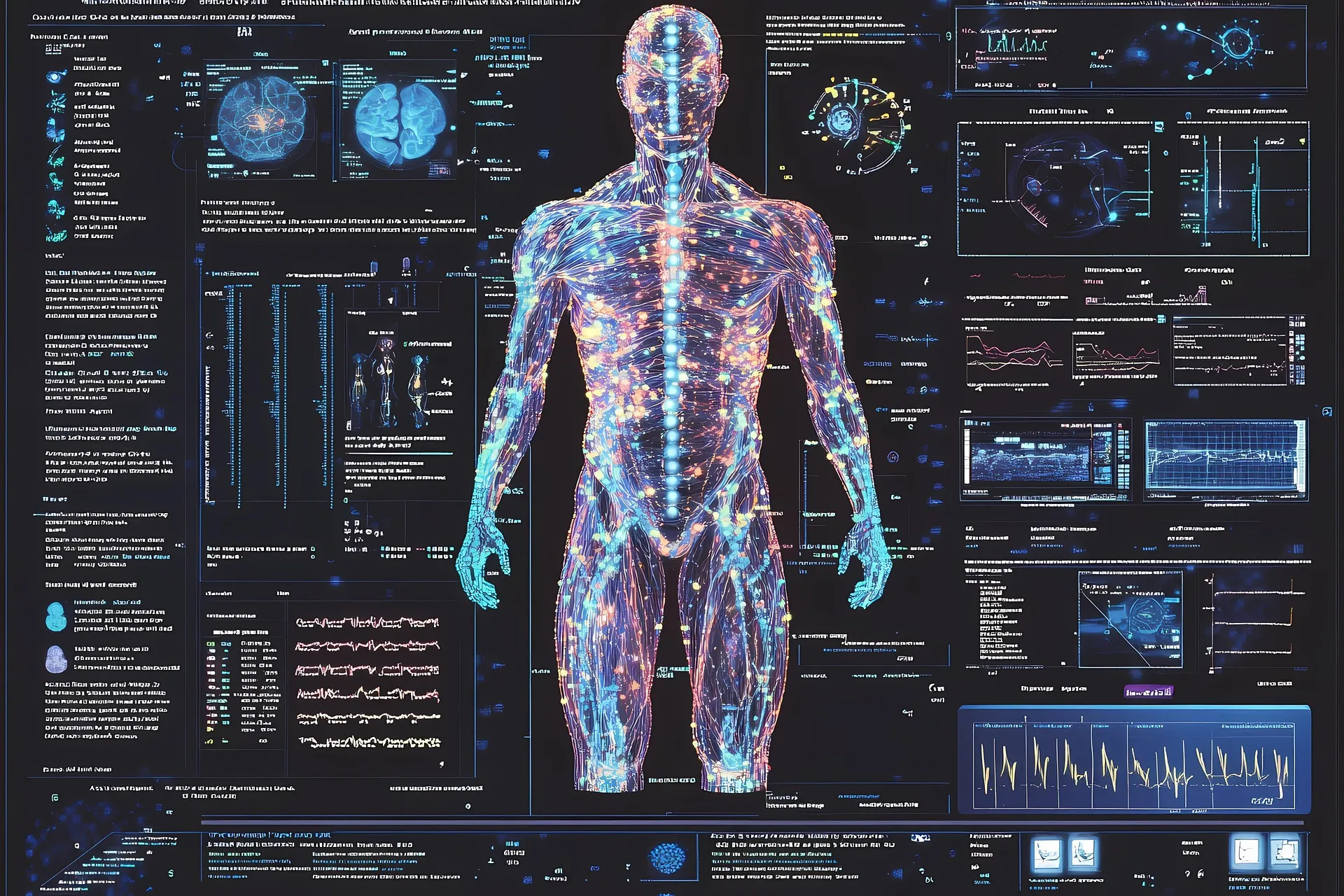
What if your doctor could identify the disease years before its first symptoms appeared, and what if he tested dozens of medications on a digital copy of you before prescribing any treatment, as research centers and biotechnology companies are working to develop a digital genetic twin with the aim of supporting medical decision-making.
This digital version represents a qualitative leap in the world of medicine, and simulates some of the patient’s biological characteristics by combining DNA sequences, genomic data, and daily clinical and health records from wearable devices, supported by artificial intelligence models.
This digital genetic twin allows the simulation of some therapeutic and biological scenarios with the aim of supporting response prediction, which helps in estimating the probability of developing some diseases or predicting the therapeutic response early.
The intersection of DNA sequencing and artificial intelligence
For years, the digital twin concept has been used in heavy industries and aviation to simulate the performance of complex machines before they are actually put into operation.
Companies, such as General Electric or Boeing, build a virtual replica of a jet engine, providing it with continuous data to predict when any part will fail and maintain it before a disaster.
But transferring this concept to medicine represents a different qualitative leap, represented by building a virtual copy that is synchronized with the real body, relying on periodic or continuous updates depending on the type of system.
When genetic data meets algorithms, it creates a digital genetic twin, which changes with your lifestyle and simulates different biological scenarios to estimate the odds of developing a disease.
The “Doctor Twin AI” project from Predictive AI is a prominent example, as it turns genomic data into a searchable twin that predicts the risks of more than 22,000 diseases and the response to more than 210 drugs, according to the developer.
In a study from Johns Hopkins University, researchers created the “GenoDT” system to simulate the heart based on specific genetic data, which helps predict heart rhythm disorders.
Genomic models have also appeared on the scene, which are artificial intelligence systems inspired by the structures used in large language models, but trained on DNA sequences rather than texts.
The most prominent of these models is the “Evo Two” system developed by the “Ark” Institute in partnership with “NVIDIA” and researchers from the universities of Stanford, Berkeley, and San Francisco.
This model was trained on 9 trillion base pairs of DNA extracted from a comprehensive genome atlas covering all kingdoms of life, enabling it to accurately predict the functional effects of genetic changes.
This model has proven its ability to identify disease-causing mutations with high accuracy in some tests for classifying genetic variants associated with a gene associated with breast cancer, according to what was reported in the scientific journal Nature.
A revolution in preventive medicine heralds the end of the era of standardized treatment
Throughout the past centuries, medicine has been based on the principle of reaction, meaning that a person waits until symptoms appear, then goes to the doctor in search of a treatment, which has limited the opportunities for early intervention in many diseases, such as cancer, as the symptoms of some types do not appear until they reach advanced stages.
Here comes the role of digital genetic twins, which may contribute to bringing about an important change in the philosophy of health care, redefining preventive medicine, and moving to proactive medicine that predicts disease before it occurs and opens the door to early interventions that prevent the development of the disease in the first place.
Instead of a patient undergoing a trial of a new drug directly, their genetic, clinical and lifestyle data are fed into a digital model that virtually simulates their body’s likely response to that drug, including expected effectiveness and potential side effects, before the patient actually takes it.
UnLearn AI has developed virtual patients used as digital control groups within clinical trials based on historical data from previous clinical trials, rather than relying entirely on real volunteers.
The European Medicines Agency has shown openness to using these methodologies in specific cases within clinical trials, while the US Food and Drug Administration has dealt with some of these uses within its regulatory frameworks for artificial intelligence-based tools.
A partnership between UnLearn AI and Johnson & Johnson also demonstrated the potential to reduce the size of control groups in phase III trials for Alzheimer’s disease by approximately one-third, according to the study results.
This progress contributes economically to reducing the costs associated with treating chronic diseases in their late stages. It also has a humanitarian impact by allowing individuals to make life decisions based on accurate knowledge of actual health risks instead of general estimates based on broad population averages.
But this technical leap is not without clear scientific limits, as most of these models work exploratory or complementary to traditional experiments and not a complete substitute for them, and they still need to accumulate additional regulatory evidence before they replace direct human testing in crucial decisions.
Also, a person’s knowledge of the possibility of contracting a serious disease in the coming decades, even if this knowledge is statistical and not certain, may impose a heavy psychological burden that is difficult to deal with.
Researchers warn of a phenomenon they call “anxious healthy people,” where constant prediction without actual therapeutic intervention may lead to a deterioration in the individual’s psychological state instead of improving it, through what is known as the “nocebo effect,” which makes the mere knowledge of potential danger a source of pathological anxiety.
A comprehensive analytical review indicates that the prevailing assumption in this field, that more information necessarily leads to better results, is scientifically inaccurate.
Research in behavioral economics shows that prediction without actual intervention may reduce quality of life rather than improve it, by triggering excessive anxiety or paralysis in decision-making.
When a healthy future turns into a business profile
Researchers believe that the success of this technology depends on the legal and ethical frameworks that govern its use, in addition to the accuracy of the algorithms, as the integration of artificial intelligence, genomic and clinical data results in models capable of building a predictive health profile.
This file estimates future health risks, and raises questions regarding ownership of this data and mechanisms for accessing it, with concerns that some insurance companies or employers may seek to benefit from it if legal frameworks allow this.
Currently, health insurance companies require traditional examinations and family medical history, but researchers warn that in the age of digital twins, providing access to this twin may become a mandatory requirement for obtaining an insurance policy.
To illustrate, imagine a hypothetical scenario in which the twin simulation shows that a person may develop a rare type of colon cancer when he reaches the age of fifty. The insurance company has two options: either refuse to insure him, or impose insurance premiums that he is unable to pay.
This means that this person may be exposed to economic or social discrimination because of a disease that he does not currently suffer from, but rather because of a programming possibility shaped by algorithms for his future.

As for the job markets, imagine that you apply for a job in a technology company, and pass all the tests successfully, but in the last stage the human resources department requests that your digital genetic twin be subjected to a job simulation extending for the next five years.
At this stage, the algorithm predicts that, under constant work pressure and based on your genetic predisposition, you may develop chronic fatigue syndrome or severe depression after three years, and a decision is issued to refuse to hire you based on this predictive health profile.
This scenario amounts to digital genetic discrimination that deprives a person of the right to work based on an event that has not yet occurred, and this may lead to new forms of discrimination based on genetic data, where humans are divided into digitally qualified and genetically unqualified.
Do current laws protect us in light of the legislative vacuum?
A study from the Petrie Flom Center for Bioethics at Harvard Law School suggests that current laws suffer from structural problems when it comes to digital twins.
These laws are characterized by a very narrow scope, limited powers of oversight bodies, conflicts between requirements for corporate intellectual confidentiality and requirements for public accountability, and the absence of uniform standards for data use, making the issue of genuine informed consent an unresolved ethical challenge.
The US Genetic Information Discrimination Act prohibits employers from using genetic information in hiring, firing, promotion, or wage determination decisions, and prohibits health insurance companies from using this information to determine eligibility, premiums, or deny coverage.
However, the scope of this law’s protection is limited to the results of direct genetic tests and family medical history, and is not sufficient in the era of comprehensive digital twins, as it does not include life insurance, long-term care, or disability insurance.
In contrast, the European General Data Protection Regulation law classifies genetic and health data into special categories of personal data that enjoy the highest level of legal protection available, prohibiting its processing in principle except with explicit consent or for legally specified purposes.
The European Artificial Intelligence Law strengthens this protection by classifying many medical artificial intelligence systems that affect health care pathways, including predictive diagnostic tools, into the category of high-risk systems that are subject to strict transparency and monitoring obligations.
Dilemmas on the road to change
This technology faces several technical obstacles, such as the amount of data required, the validity of the mathematical model, and an advanced infrastructure capable of keeping up with the constant influx of new data.
Building an accurate model requires the collection of genetic, biochemical, environmental and clinical data from multiple sources, and this entails a challenge in the speed of processing and storage, in addition to ensuring the quality and integrity of the data, and a large part of the delay and cost is associated with waiting for the collection of sufficient samples.
Any error in the accuracy of deep learning algorithms or bias in the training data set may lead to incorrect conclusions, and medical AI models may become less effective when used on populations that are not adequately included in the training data.
In other words, if the system is not sufficiently exposed to a diverse genetic sample, it may fail to recognize disease patterns that strongly affect a heterogeneous population. This is why research teams pay great attention to continuous verification and evaluation of models to ensure the reliability of predictions before using them in actual medical care.
In conclusion, digital genetic twins hold promises to improve early detection of some incurable diseases, prolong healthy lifespan, and transform hospitals in the long term into centers for maintaining health, but leaving them unregulated may change their basic role.
A number of researchers believe that it is necessary to develop unified international frameworks that stipulate that the digital genetic twin is the exclusive property of its owner, and that it legally criminalizes any third party accessing it, or using it as a tool for job or insurance evaluation.
Between the promise of reshaping medicine, and fears that genetic data will become a tool for discrimination, the future of digital genetic twins remains dependent on the ability of health systems and legislators to achieve a delicate balance between innovation and protecting human rights.