

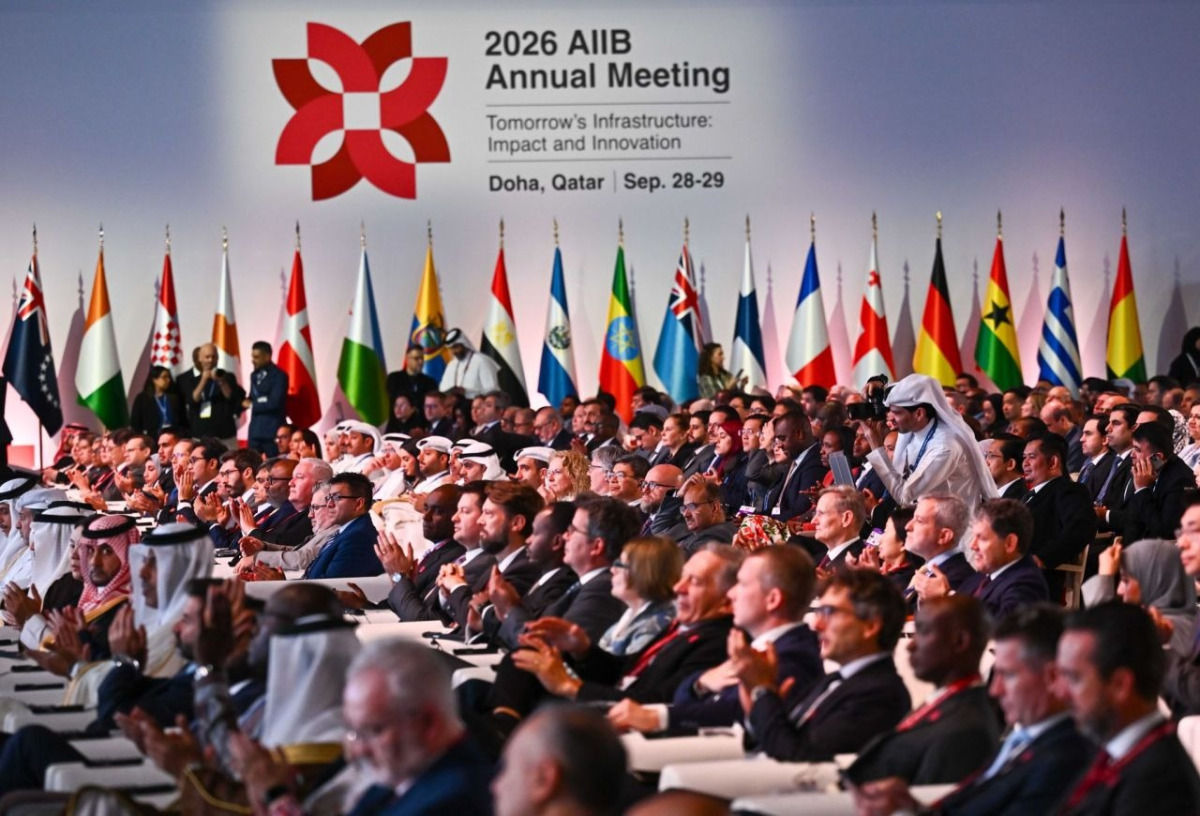
Participants in a discussion session held today under the title “Across Borders: Connecting Regions and Building Resilience,” as part of the activities of the last day of the annual meeting of the Asian Infrastructure Investment Bank, stressed the importance of transforming regional connectivity from mere separate national infrastructure projects to an integrated regional system that supports trade and investment, and enhances economic flexibility and shared prosperity.
Participating in this session were His Excellency Mr. Mikayil Japarov, Minister of Economy of Azerbaijan and Governor of the Asian Bank for the Republic of Azerbaijan, Mr. Serhat Koksal, President of the Black Sea Trade and Development Bank, Ms. Ekaterin Gontadze, Deputy Minister of Finance of Georgia, Mr. Yukun Huang, Member of the International Advisory Committee of the Asian Bank and Senior Fellow at the Carnegie Endowment for International Peace, Mr. Konstantin Limitovsky, Chief Investment Officer of the Asian Infrastructure Investment Bank, and Mr. Yalçin Egyun, Director General of the Turkish Ministry of Transport and Infrastructure.
Speakers explained that realizing the full potential of regional connectivity requires going beyond the idea of abstract physical infrastructure; This requires developing integrated transportation and logistics networks, building stronger regional cooperation, activating digital innovation, as well as providing innovative financing solutions that link markets and communities with cross-border investment opportunities.
The session shed light on practical models, most notably the “Middle Corridor” designated for transporting goods between Asia and Europe, where it discussed how to develop these corridors to go beyond the scope of individual national investments and transform them into coordinated regional systems linking the regions of Central Asia, the Caucasus, and Europe to global markets.
The discussions also addressed the integration mechanism between railways, ports, logistics centers and digital technologies to facilitate the movement of trade and enhance economic resilience in the face of geopolitical challenges and supply chain disruptions.
The discussions centered on planning national projects along the economic corridors within a unified regional investment program, while reviewing the material and procedural requirements necessary to make these corridors more reliable and competitive.
Participants touched on the importance of coordination between governments and commitment to implementation, in addition to mobilizing private capital to work alongside government funding.
In this context, the role of regional cooperation and joint governmental coordination between the countries of the Caucasus and Central Asia in enhancing economic security and the sustainability of trade flows was emphasized, while stressing the need for national plans to be consistent with comprehensive regional goals.
The session, which opened with a visual presentation that explained that the volume of trade between the two continents reached $850 billion in 2025 with its continued upward growth and its ability to create jobs, open markets and raise productivity, concluded with the conclusion that transport corridors are no longer just solid paths, but rather have become economic platforms that generate added value when their physical structure is integrated with the digital structure and financing solutions, and that building sustainable regional resilience is based on coordinated planning that transcends national borders.