

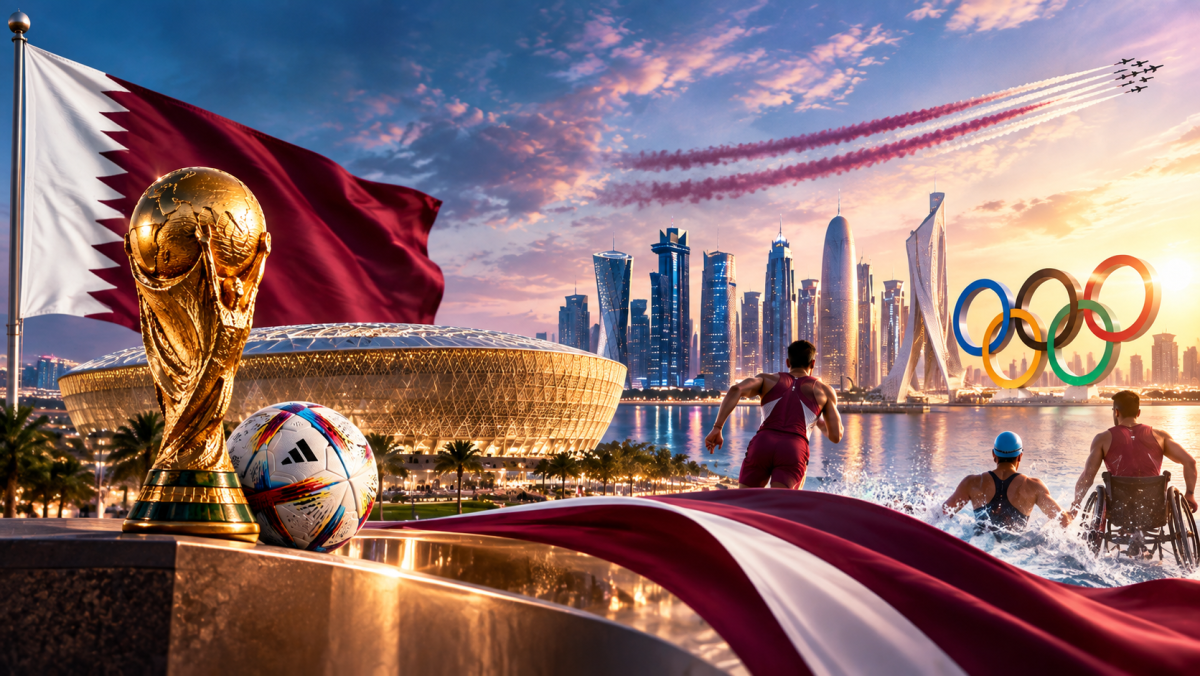
From the legacy of the World Cup to the horizons of the Olympics, Qatar is writing a new chapter in its sporting career, setting before it the goal of running to host the 2036 Olympic and Paralympic Games, based on accumulated experiences in organizing major world championships, and on a system of sports facilities, infrastructure, and organizational expertise that have been formed over the years.
With the State of Qatar receiving the flag of the 2030 Asian Games, a new stage begins on this path, as the next Asian Games represent a practical test of the readiness of the facilities and the organizational system and their ability to accommodate large-scale continental competitions and events.
The upcoming hosting of the Asian Games also carries a significance that goes beyond competitions, as it is a translation of the confidence placed by the Olympic Council of Asia and the sports community on the continent in Qatar’s ability to continue hosting major sporting events.
Qatar is entering the bidding race to host the 2036 Olympics, putting its extensive experience in organizing major international sporting events on the path of a new ambition, which hopes that Doha will one day reach the stage of hosting the largest sporting event in the world.
The International Olympic Committee’s official inclusion of the State of Qatar on the list of countries interested in hosting the 2036 Olympics constitutes an important foundation upon which the candidacy process can be built, in a step that reflects the growing presence on the map of global sports, and opens the door to an Olympic project whose details carry an ambition that goes beyond hosting a sporting event, to providing an exceptional experience that reflects the ability of the State of Qatar to transform ambition into reality.
The Qatari ambition to host this event does not appear to be just an attempt to enter the hosting race, as it is based on years of investment in sports, facilities and organizational expertise, which has placed Qatar in front of an opportunity to present a file based on operational readiness more than its reliance on creating a new structure specifically for the event.
Qatari efforts to host the Olympic and Paralympic Games go back to July 2025, when the Qatar Olympic Committee, headed by His Excellency Sheikh Joaan bin Hamad Al Thani, Chairman of the Nomination File Committee, confirmed its participation in the ongoing discussions with the International Olympic Committee regarding hosting the Olympics.
Qatar places among the components of its file an advanced sports system, as estimates indicate that about 95 percent of the infrastructure required to host the tournament is already available, which reflects years of work on developing sports facilities and supporting facilities in accordance with international standards, and benefiting from the legacy left by Qatar’s hosting of many major tournaments and sporting events.
This system includes modern stadiums and specialized facilities for various games, in addition to training and preparation facilities, aquatic facilities, and facilities for athletics and team sports, as well as an integrated network of hotels, accommodation facilities, medical and logistical services, and is supported by advanced infrastructure in the fields of transport, roads and communications, providing an integrated base for receiving athletes, delegations and fans.
This readiness is of particular importance in light of the nature of the Olympic Games, which requires hosting dozens of sports in multiple locations, in addition to providing facilities for training, accommodation, transportation, and accompanying services at a high level of efficiency. These are requirements that Qatar has made great strides in providing through its continuous sports and development investments.
The elements of strength in the Qatari file are not limited to facilities, as Qatar has accumulated extensive organizational experience by hosting global, continental and regional sporting events, which has contributed to the development of an integrated system for managing major competitions and enhancing the human, organizational and technical capabilities associated with them.
In the broader dimension of the file, the concept of sport emerges as a means of rapprochement between peoples and cultures, which was confirmed by His Excellency Sheikh Joaan bin Hamad Al Thani, President of the Qatar Olympic Committee and Chairman of the Nomination File Committee, in July of last year when he stressed the power of sport and its impact on empowering individuals and unleashing their abilities, especially young people.
This trend has a dimension that goes beyond the organizational aspect of the event, as it is linked to Qatar’s vision of the role of sport in building bridges of communication, enhancing understanding between peoples, and supporting the values of peace and rapprochement, which are principles that Doha seeks to highlight within its vision of hosting the largest global sporting gathering.
The Qatari bid to host the 2036 Olympic and Paralympic Games gained an Arab dimension with the Arab League Council at the ministerial level supporting the candidacy of a country to host, in a position that reflects Arab support for the bid, which gives a regional dimension in addition to the technical and organizational components it presents.
This support, in addition to readiness and advanced expertise, confirms that the competition to host the 2036 Games for the State of Qatar is not based on the idea of building a new Olympic city as much as it is based on employing an existing sports system and developing it in a way that suits the requirements of the event, while maintaining a long-term vision for the sports legacy after the end of the competitions.
While the International Olympic Committee continues its consultations and selection of the path to determine the host city, Qatar continues to present its capabilities as a country that possesses an advanced sports structure, experience in organizing major events, a supporting infrastructure network, and a vision that seeks to link hosting the Olympics with broader goals related to developing sports, empowering youth, and enhancing communication between peoples.
Hence, Qatar’s bid to host the 2036 Olympic and Paralympic Games gains importance beyond just competing to organize an Olympic Games, as it provides a test for a model based on benefiting from an already accomplished sports structure and organizational experiences accumulated over years, and transforming this legacy into a base for hosting a tournament aimed at leaving a sustainable impact on sports, society, and the region.
This readiness is based on a wide system of sports facilities covering various games, in addition to the stadiums that were built and developed to host the FIFA World Cup Qatar 2022, and after the tournament they became part of the country’s sustainable sporting legacy.
The system is not limited to football stadiums, but extends to halls and facilities specialized in team and individual sports, water sports and athletics, providing a base on which to build to host a multi-sport Olympic programme.
The Aspire Academy for Sports Excellence stands out within this system with its halls, stadiums and training facilities equipped according to international specifications and standards, in addition to specialized facilities for sports preparation and rehabilitation, making it one of the important pillars of the hosting and training system.
Al Janoub Stadium also represents another example of the ability of the facilities that hosted the FIFA World Cup Qatar 2022 to continue to play their role in the global sports scene, as the stadium was transformed after the tournament into a multi-use sports facility, and is preparing to host the 2027 Basketball World Cup, reflecting a trend based on preserving the value of major facilities and using them to host successive international events. The same applies to Lusail Stadium, which has established its position as one of the most prominent sporting monuments in Qatar, after hosting A number of the most important football events, to remain part of a sporting legacy that can be used in hosting more international events.
Qatar also has a wide network of facilities specialized in a large number of sports, training facilities, accommodation, medical and logistical services, supported by an advanced network of roads, means of transportation, hotels and service facilities, as well as a metro network that provides a quick and easy way to move between various regions of the country and sports facilities.
This integrated system gives those arriving to attend competitions great flexibility of movement, allowing the fan to follow more than one sporting event per day without the hassle of traveling long distances. This is an experience that was clearly demonstrated during Qatar’s hosting of the FIFA World Cup Qatar 2022, the Asian Cup 2023, and the FIFA Arab Cup Qatar 2025, when the proximity of the facilities and their connection to the transportation network allowed fans to attend two or three matches on the same day, a feature that can constitute additional value in any scenario for hosting. Olympic and Paralympic Games.
The nomination file is also supported by Qatar’s diverse tourism capabilities, which combine cultural and heritage attractions with modern entertainment destinations, in addition to its moderate climate during the winter months, which makes it an attractive destination for visitors during the period in which the competitions are held.
The destinations that can attract athletes, fans and delegations vary between museums that present aspects of Qatar’s history and culture, Souq Waqif with its presence of local heritage, the Doha Corniche extending along the waterfront, the Public Foundation for the Cultural Village “Katara”, as well as the modern city of Lusail with its high-level tourist and entertainment facilities and destinations.
The mild winter climate enhances the possibility of organizing sports and tourism events in suitable conditions for visitors, and the geographical nature of the country and the proximity of its urban areas allow visitors to combine attendance at competitions and exploration of tourist attractions within a short period of time.
This geographical proximity constitutes a factor that can also be reflected in the athletes’ experience, by reducing travel times between accommodation, training and competition places, which is of particular importance in a tournament that includes thousands of athletes participating in a large number of games.
These options allow the visitor to combine following sports competitions, discovering cultural and heritage landmarks, the legacy of our ancestors, and enjoying recreational activities in one trip, thus enhancing Qatar’s attractiveness as a destination to host a global event of the size of the Olympic and Paralympic Games.
The elements of readiness do not stop there, as Qatar also has a wealth of national cadres who possess extensive experience in managing and organizing major sporting events, and a group of them participated in the preparation and operational plans for the 2026 World Cup in the United States, Canada and Mexico, benefiting from the experiences it gained during the organization of the 2022 World Cup and the management of its various operational aspects.
This participation reflects the transfer of Qatari experience to other international sports forums, after national cadres possessed practical knowledge in planning, operating, managing facilities and events, and dealing with the regulatory requirements of events of a global scope.
These human experiences represent one of the most important elements of the legacy that can be built upon in any future Olympic hosting, as the success of an event of this size depends not on the facilities and infrastructure alone, but on qualified cadres capable of managing daily details, operating sites, and coordinating between various sectors, and this is experience that Qatar has accumulated through a series of major sporting tournaments and events that it has hosted over the past years.
As the race to host the 2036 Olympics approaches its final stages, Qatar appears to be facing a file based not only on the desire to organize the event, but also on integrated components and readiness, components accumulated through years of investment in sports, infrastructure, organizational expertise, and tourism.
If the Olympic Games are looking for cities capable of embracing athletes and fans and providing an integrated experience, then Doha enters the race with a solid sports heritage, and seeks to transform its experiences and facilities into an Olympic vision whose impact extends beyond the conclusion of the competitions.