

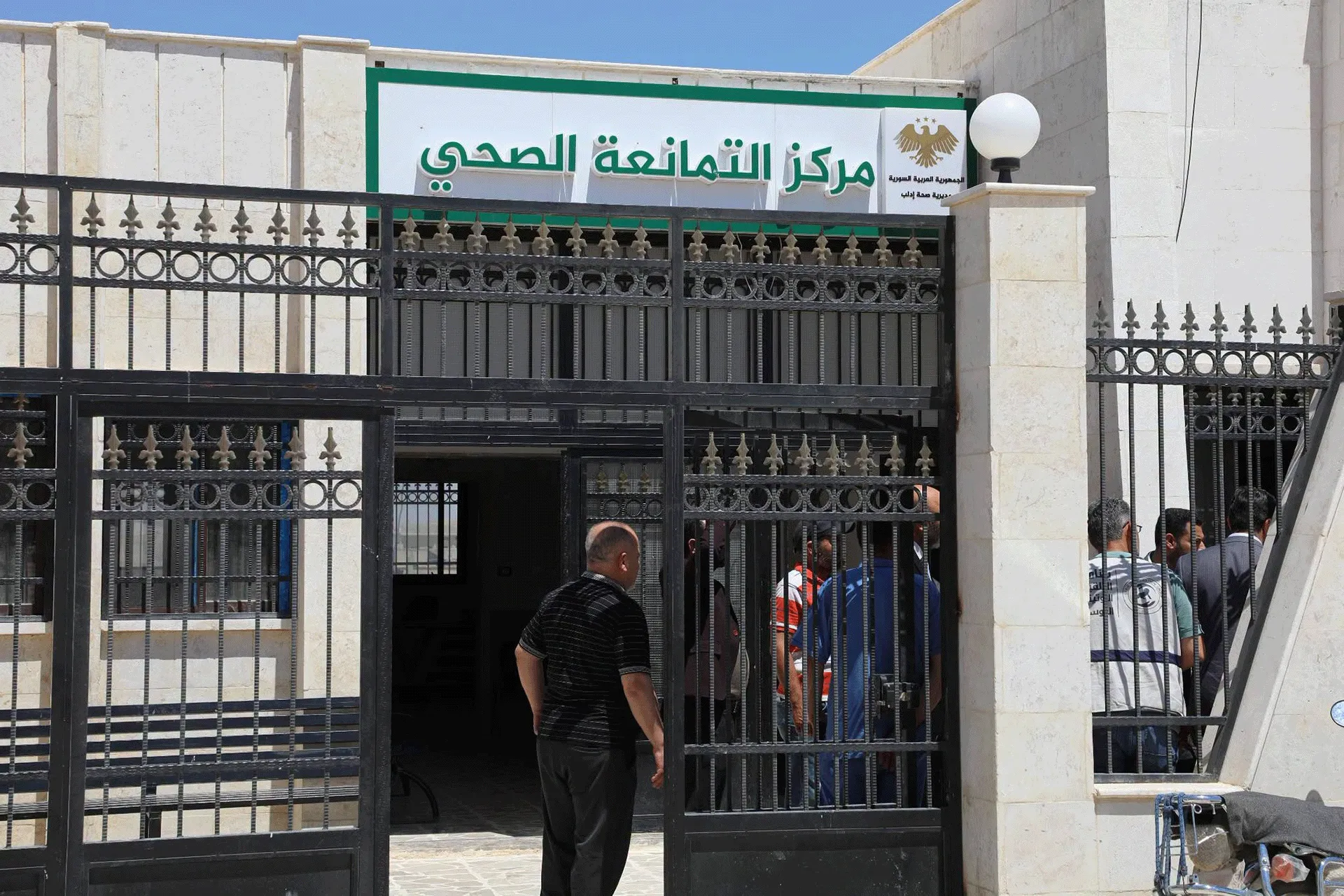
What Faisal Al-Mustafa, from the village of Jabala in the countryside of Idlib Governorate, was exposed to was not an exceptional event, but rather an episode in a series of daily suffering experienced by residents of the devastated areas south of the governorate. After he was bitten by a snake while harvesting olives, he was forced to travel a distance of 35 kilometers to obtain the antiserum and receive appropriate treatment.
Al-Mustafa says that he first went to the Kafranbel Health Center, but the lack of vaccine at the center prompted him to head to the city of Idlib, on a long, arduous journey that revealed the extent of the shortage in medical services.
He added to “Syria Now” that health facilities were “completely non-existent” in his village, and that the nearest health center was about 4 kilometers away in Kafranbel, and when he arrived there, he was referred to the university hospital in Idlib due to the lack of appropriate treatment.
Long distances and high costs
As people continue to return to the countryside of the eastern and southern Idlib Governorate, medical services appear insufficient to meet medical needs, specifically their quality, which forces them to travel long distances to reach equipped hospitals.
The suffering is not limited to the distance, as Al-Mustafa points out that moving to secure medical services entails not only the costs of treatment and long distances, but also very high transportation costs in light of the high prices of fuel and the high tariffs for transportation and transportation in general.
The situation is not much different for Muhammad al-Atrash, who comes from the village of Moqa in the Khan Shaykhun countryside, south of Idlib. The distance to his nearest medical destination exceeds 45 kilometers, and may reach 65 kilometers depending on the medical condition.
Al-Atrash told “Syria Now” that his relative suffered a health problem a few days ago, forcing them to transfer her to the city of Hama, 45 kilometers away. He pointed out that Hama was the most appropriate and closest option for treating her in light of the absence of hospitals in his area, to which he returned about a year ago coming from the displacement camps near the border.
Lack of quality services
Medical services in the southern and eastern countryside of Idlib are provided in the form of “health centers” that provide limited medical services, while hospitals with specific interventions are absent from the largest cities, most notably Maarat al-Numan and Khan Shaykhun.
Despite the activation of health centers, they still suffer from a lack of medical personnel, according to the Assistant Director of Health for Medical Affairs in Idlib, Muhammad Walid Tamer, stressing that medical services are not sufficient compared to the number of returnees in the southern and eastern countryside.
Tamer revealed to “Syria Now” that we have begun activating the outpatient clinics of Maarat National Hospital, and are working to activate an ambulatory surgical department soon, which will include a natural and surgical obstetrics department, emergency general surgery operations, a ward for patients, and an intensive care room with four beds, pending the completion of the restoration of all departments.
As for Jisr al-Shughur Hospital, it says that “several meetings were held to develop an ideal study of the work of the hospital’s departments, and currently we have reached advanced stages of preparing the hospital’s outpatient clinics to begin work on them soon.”
Tamer announced that the number of health centers that were rehabilitated and entered service after the fall of the Assad regime reached 30 centers, with 5 centers being activated during the current month, in addition to work on gradually merging the medical complexes and previous hospitals, as an example of the Dana National Hospital, which includes four blocks, each block of which was a former hospital.
As for the 26 centers scheduled to be activated during 2026, he explained that 5 centers have been restored and work is underway to activate them, while the remaining centers are either in the restoration or rebuilding phase, and some of them are being coordinated with the ministry and organizations.
Stopping centers and reintegrating facilities
Regarding the cessation of centers, Tamer explained that the number of centers that have stopped operating since the beginning of the year has reached 11 health centers, of which 6 centers were closed permanently as part of plans to restructure the medical sector, and 5 were temporarily closed, pointing out that the care department’s plan is based on restarting the suspended centers after obtaining a new building.
In conjunction with this, the Health Directorate launched a merger plan for health facilities, and in this context, Tamer pointed out that “before the liberation of all of Syria, there were about 64 hospitals in the previously liberated areas in the countryside of Aleppo and Idlib, so the Health Directorate worked to integrate and redistribute medical services and develop a medical map that included a national hospital in each district administration, and surrounding hospitals, one or two for each region according to population and geographical distribution, so that the number of hospitals on the map would become 25 hospitals, with a study on building hospitals.” “Actually, according to ministerial plans.”
Regarding the most urgent obstacles, the Assistant Director of Health stated that most of the newly renovated health centers need to be fully equipped with medical equipment and office supplies, in addition to the lack of sufficient technical personnel, especially doctors, adding that the medical equipment in hospitals is provided by organizations and their operational age varies between new and old.
Tamer revealed the spread of mobile clinics in the governorate, distributed among the “Insan Organization” with one clinic covering the villages of Karsa’a and Ma’rzita, the “Syrian Red Crescent” with 4 clinics in Maarat al-Nu’man, Khan Shaykhun and Jabal al-Zawiya, the “Amal Association” with a clinic in Ma’arat Misrin and al-Dana, the “Family Planning” Association with two clinics in Ma’ar Shurin, al-Ghadfa, Tal al-Kiram, Maarat al-Nu’man, Khan al-Sabil and Sinjar, and the Organization INTERSOS has a clinic in Al-Khawayn, Karnaz, Sukayk and Al-Tamanah.