

The Syrian woman, Silvana Al-Adda, did not expect that a small lump she felt in her chest would turn into a long treatment journey, nor that her neglect of early examination would become a reason for discovering the disease after the cancerous mass exceeded 3 centimetres.
“You must face the disease with your strength… Cancer does not mean death.” With these words, Silvana, who was diagnosed with breast cancer at the age of 38, summarizes her experience with the disease and recovery from it.
Treatment journey
Silvana told “Syria Now”: “After examination by x-rays and doctors and taking a biopsy of my body, the medical opinion was the necessity of removing the mass – when the disease was detected, the mass measured more than 3 centimeters – and then scraping the area under the armpit due to the presence of disease transmissions in the area due to the long period of spread of the disease and neglect of early detection.”
After discovering the disease, Silvana underwent surgeries, then began a journey of radiation and chemotherapy. She narrates: “After the surgeries, I began my journey of radiotherapy for 8 sessions, with a period of 6 months of chemotherapy, and my cancer was classified as between stages three and four. It was not easy to get rid of it.”
The treatment journey did not stop her from working in the Health Directorate in Hama Governorate or teaching at the mosque. In this regard, she says: “The stronger your psychological state is and the more committed you are to recovery, God willing, recovery will be your ally.”
Awareness message
After her recovery, her experience turned into a message urging women not to neglect examination. Silvana says, “I now advise every woman to be examined at least once a year, and not to neglect herself, and when she feels sick, to consult doctors and specialists directly.”
She also called on women, including those under forty, to undergo early testing, warning against postponing it or waiting for clear symptoms to appear.
“Earlier screening…more hope.”
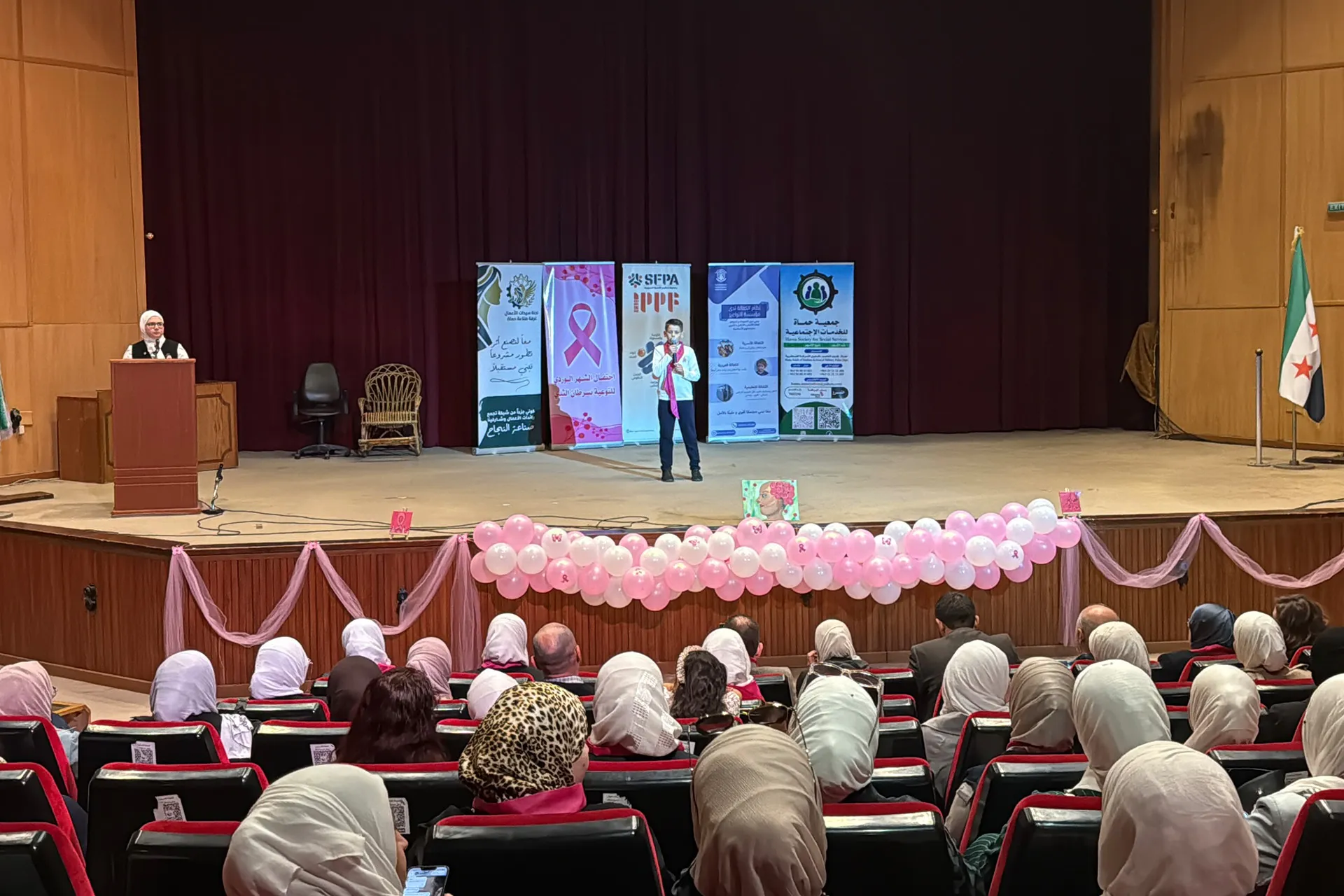
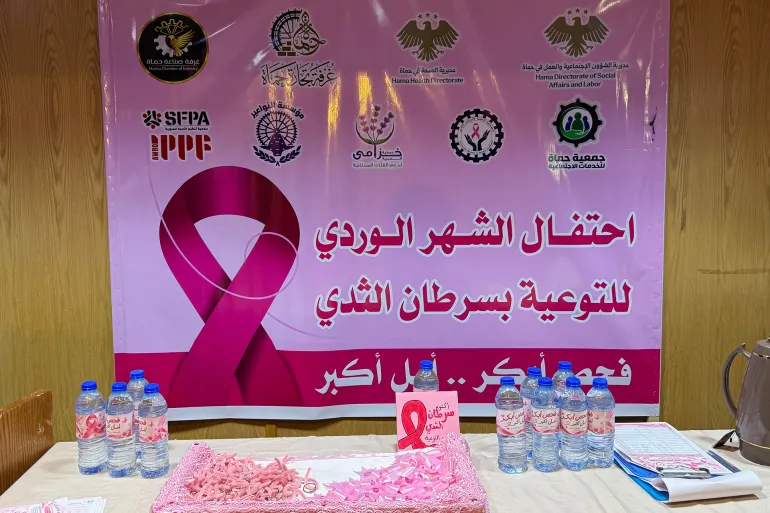
Silvana’s story came as part of the activities concluding the “Pink Month” in Hama, which was held under the slogan “Earlier screening… greater hope,” to raise awareness of the importance of early detection of breast cancer, after activities that extended throughout the month of October.
Regarding the event, Dr. Rawaa Sultan, the event supervisor and chair of the Board of Directors of the Hama Society for Social Services, told “Syria Now” that the event was held in cooperation with the Hama Governorate and the Directorate of Social Affairs and Labor, under the supervision of the Hama Health Directorate, and in cooperation with a number of local associations in Hama.
Sultan explained that the associations’ participation in one event allowed for the exchange of experiences, in addition to the participation of doctors and specialists in oncology and surgery, and specialists in sports and nutrition to talk about their role in preventing the disease.
She added: “We carried out activities in cooperation with the Directorate of Health and Social Affairs with the aim of raising awareness and detecting cases, and there is noticeable community interaction due to the lack of awareness about this disease in our communities.”
Awareness events
For her part, the head of the Waterwheels Charitable Foundation, Nisreen Al-Amin, said: “In the pink month, we held a large number of activities to raise awareness of the danger of breast cancer, and to raise awareness of the importance of detecting it early.”
She added to “Syria Now”: “Our participation with a large number of associations was at the end of the pink month, to communicate our voice and our campaign to all women in Hama, especially with our observation during the campaigns of the possibility of the presence of an infected woman compared to 8 healthy cases.”
Dr. Qaddour Al-Bazo, who is the coordinator of the community health program in the Hama Health Directorate, spoke to “Syria Now” about the importance of campaigns in helping women know the symptoms of the disease and ways to recover from it when it is detected early.
He pointed to the efforts of the Hama Health Directorate during the pink month, including sending volunteer teams to a number of homes and centers to conduct examinations in the governorate.
The importance of early detection
Reem, a young woman in her twenties, in the audience, spoke about the benefit of these campaigns towards the women of society, especially with the lack of awareness of this disease in Syria, and the widespread rumor that women under forty are not infected with this disease, and “herein lies the disaster,” as she described it.
She continued to “Syria Now”: “I learned from the campaign that early detection is important, and that the examination should not be postponed due to young age. I will pay attention to any lump, change in breast shape, or unusual secretion, and I will see a doctor when I notice it.”
Umm Alaa, a woman in her thirties, spoke about how she benefited from the information that doctors and specialists indicated, especially the symptoms that require urgent examination.
She concluded her interview with “Syria Now”: “It is important not to be ashamed or afraid to ask, and to seek medical advice when a lump or change appears in the breast.”