

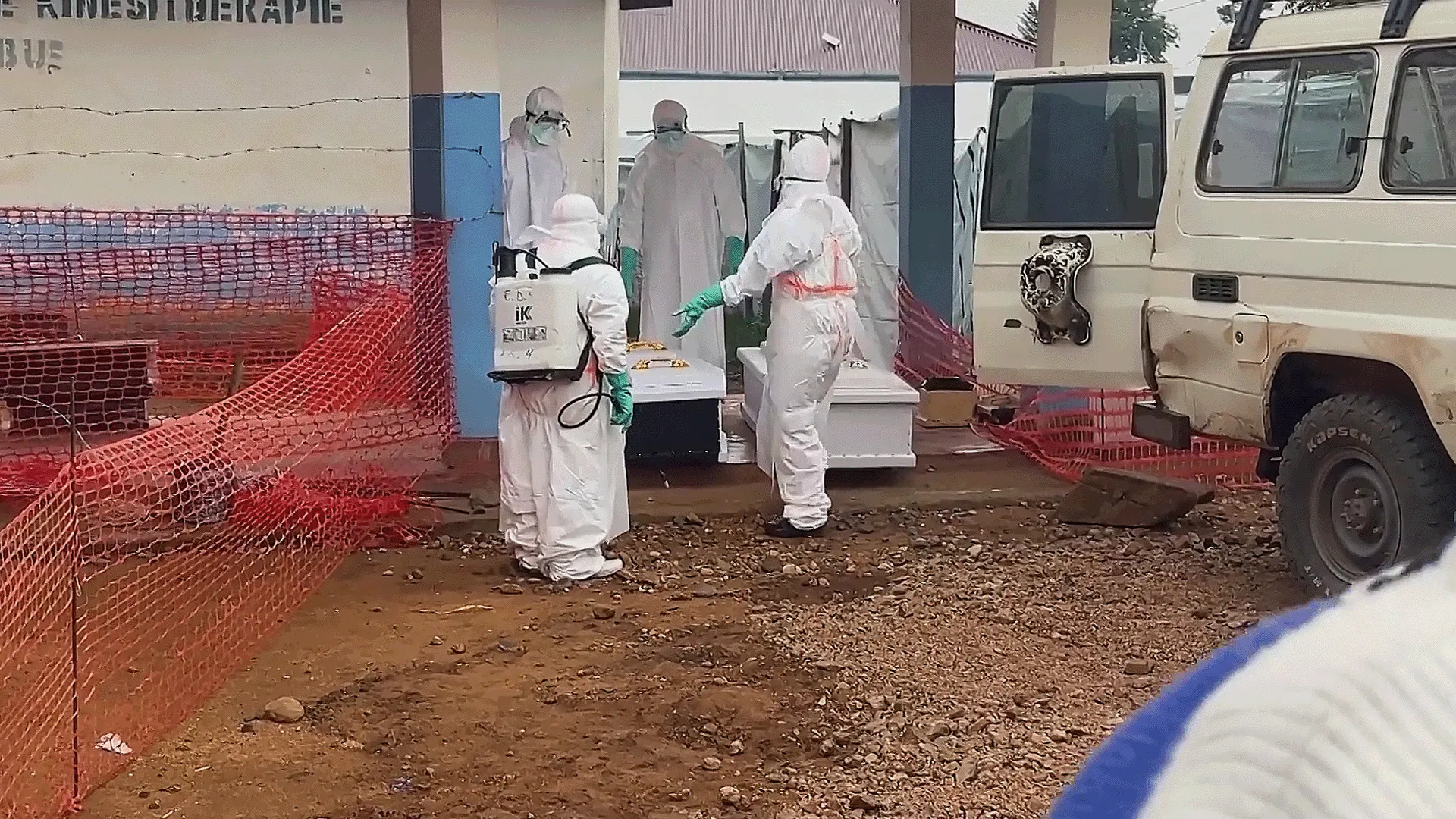
The Ebola virus has re-emerged in the Ituri region, eastern Democratic Congo, leaving many victims among the affected families. Health teams are taking strict measures, preventing families from approaching the bodies of the dead, in an attempt to contain the spread of the epidemic and prevent transmission of infection to the population, while the authorities confirm that they have intensified their measures, calling on the population for greater cooperation.
A report by Al Jazeera, prepared by its correspondent Fadel Abdel Razzaq, said that the battle against Ebola in Ituri continues, and its success depends on the speed of reporting cases and the residents’ trust in health teams.
However, Abdel Razzaq points out that doctors are facing great difficulties, especially with cases of infection among medical staff, which further complicates containment efforts.
Suffering of a female doctor
A health official confirms that field teams are working to activate the response to control the situation as quickly as possible, calling on citizens to report all cases showing symptoms, and to take them to health centers immediately, and acknowledges that the cooperation of the population is the most important element helping to stop the spread of the epidemic.
The surviving doctor, Kahindo Meri, reveals her personal suffering after she was infected with the virus following her child’s infection. She describes how she suffered from social isolation when she returned to her home, where the neighbors kept their family members away from her, and no one approached her. She points out that what frightened her most during treatment was severe diarrhea, but psychological support from doctors helped her overcome the ordeal.
For his part, a member of the medical team points out that treatment depends on support with antibiotics and fluid replacement, after a careful evaluation of the case, and announces that the first injured child has left the center after he has recovered.
In a related context, Dr. Ayham Abu Leila, a professor of virology, warns, in his interview with Al Jazeera, that the current Ebola outbreak is the largest among all its counterpart epidemics, and he attributes this to several reasons:
- Conflicts in the region.
- Local customs such as touching the bodies of the dead.
- The spread of the new “Bundebugyo” strain, which has milder symptoms, delaying diagnosis and increasing the chances of transmission.
Symptoms of the disease
Abu Laila points out that the “Zaire” strain began with strong symptoms that led to rapid diagnosis, while the new strain begins with fever, sore throat, and general pain in the body, which makes it mixed with symptoms of other diseases. He adds that the absence of a vaccine for this strain increases the difficulty of controlling the epidemic, even though its death rates are 35% lower compared to the Zaire strain, which has a death rate of 70%.
The expert explains that the Ebola virus is not transmitted through the air like the Covid-19 coronavirus, but rather requires direct contact with bodily fluids such as blood, vomiting, or diarrhea, which reduces the speed of its spread.
Travelers to areas where the epidemic is spreading are advised to wear protective clothing that covers the entire body, and to undergo quarantine for at least 21 days upon return, noting that some countries, including America, have imposed restrictions on travel to affected areas.
Dangerous virus
The medical expert concludes that Ebola remains a “deadly hemorrhagic fever” virus, and that the high death rates make it a danger that cannot be underestimated, pointing out the need to intensify awareness and prevention efforts, especially in the affected areas, to ensure that this epidemic does not turn into a large-scale humanitarian disaster.
The World Health Organization said on Tuesday that the Ebola outbreak in the Democratic Republic of the Congo continues to outpace response efforts, adding that 80% of new Ebola infections are outside the organization’s contact lists.
Ebola first appeared in 1976. It is a deadly viral disease that spreads through direct contact with bodily fluids. It is believed to have been transmitted to humans from bats. The virus can cause severe bleeding and organ failure.