

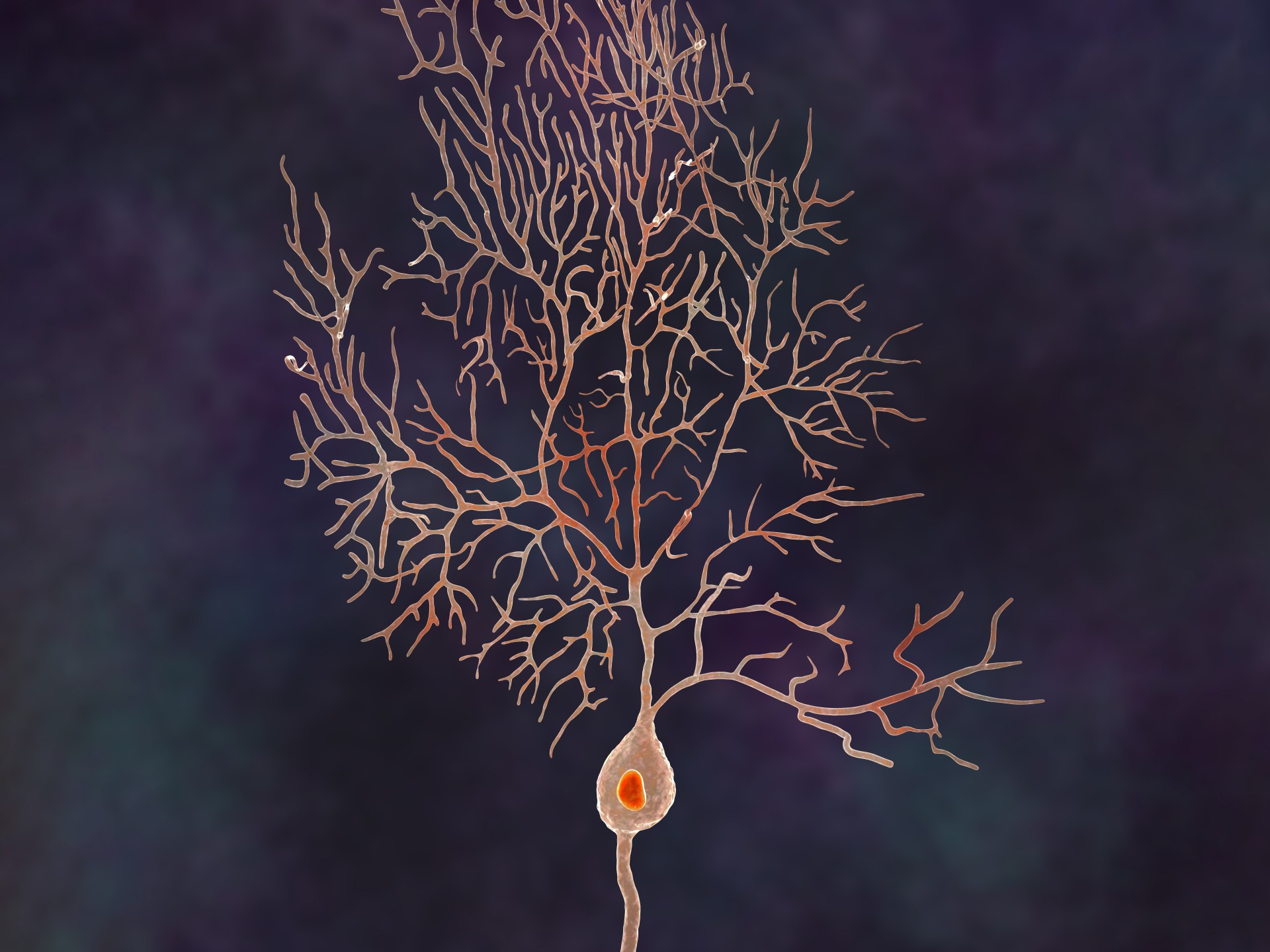
A new study highlighted the mechanisms behind the cerebellum of the cerebellum in multiple sclerosis, and the cerebellum is the part of the brain that helps control movement and balance, and the cerebellum degeneration may lead to tremors and weakness in motor coordination and difficulty in controlling movement. This research aims to a deeper understanding of these mechanisms, which paves the way for developing new treatments that target the causes of the disease and improve the quality of the life of the injured.
The study indicated that the mitochondria defect (cell generation plants in the cell) may play a major role in the gradual loss of neurons called Burkanji cells, and the exacerbation of motor disabilities.
Burkanji cells represent a unique type of neurons that specialize in the cerebral cortex. These cells are characterized by their large, complex and flat cross -brackets, which give them the ability to integrate large quantities of information and learning through the reshaping of their gospels. As an important part of the cerebellum circles, the Burkanji cells are well for the well -coordinated movement, as well as their role in other functions such as perception and emotion.
The study was conducted by researchers from the University of California Riveradide in the United States, and published in the Journal of the National Academy of Sciences, on June 16, and wrote the Yorik Allet website.
Multiple sclerosis is characterized by chronic inflammation and removal of miles in the central nervous system, as it is damaged or loses the sheath of miles surrounding the nerve fibers in the brain and spinal cord.
This disorder interferes with the natural transmission of electrical signals along the nerves, which leads to various neurological problems.
For her part, Sima Tiwari-Woodov, a professor of biomedical science at the University of California Medical College, said, which led the research team, that “our study indicates that inflammation and removal of miles in the cerebellum disrupts the function of mitochondria, which contributes to nerve damage and the loss of Burkanji cells.”
She added: “We have noticed a great loss of the” COXIV “(COXIV) of the mitochondria in democratic cells, which indicates that the weakness of the mitochondria contributes directly to the death of the cells and the cerebellum of the cerebellum.”
A pivotal role is missing
When we walk or move, many parts of our brain and body work together, our muscles, our spine, our eyes, our ears, especially our brain. The cerebellum is a major brain region of movement and balance.
Dr. Sima said: “Inside the cerebellum there are special cells called Burkanji neurons. These large and active cells help to coordinate smooth and precise movements such as dance, throw the ball, or even just walk. They are necessary for balance and microscopic skills.”
She explained that in diseases such as multiple sclerosis, the cerebellum can be damaged, and Burkanji cells often begin to die. This leads to coordination and movement problems, a condition known as ataxia.
She added: “Our research studied the brain tissue in multiple sclerosis patients and found major problems in these neurons: she had fewer branches, and she was losing miles, and she was suffering from problems with mitochondria, which means that her energy supplies were weakened.”
Given the pivotal role that Burkanji cells play in movement, their loss may cause serious kinetic problems, and understanding the reason for their damage to multiple sclerosis may help find better treatments to protect movement and balance in people with this disease.
The team also used a model of laboratory mice showing symptoms similar to the symptoms of multiple sclerosis to study changes in mitochondria during the development of the disease. The researchers found that the affected mice lost the Burkanji cells over time, just as it happened with multiple sclerosis patients.
Dr. Sima said: “The remaining nerve cells do not work efficiently because the mitochondria, which are energy -producing parts, begin to damage.” The researchers also noted that miles decomposed at an early stage of the disease.
These problems begin – the lack of energy, the loss of miles, and the damage of the neurons – early, but the actual death of the brain cells often occurs later, with the exacerbation of the disease, and it appears that the loss of energy in the brain cells is a major factor in the causes of damage to neurons in multiple sclerosis.