

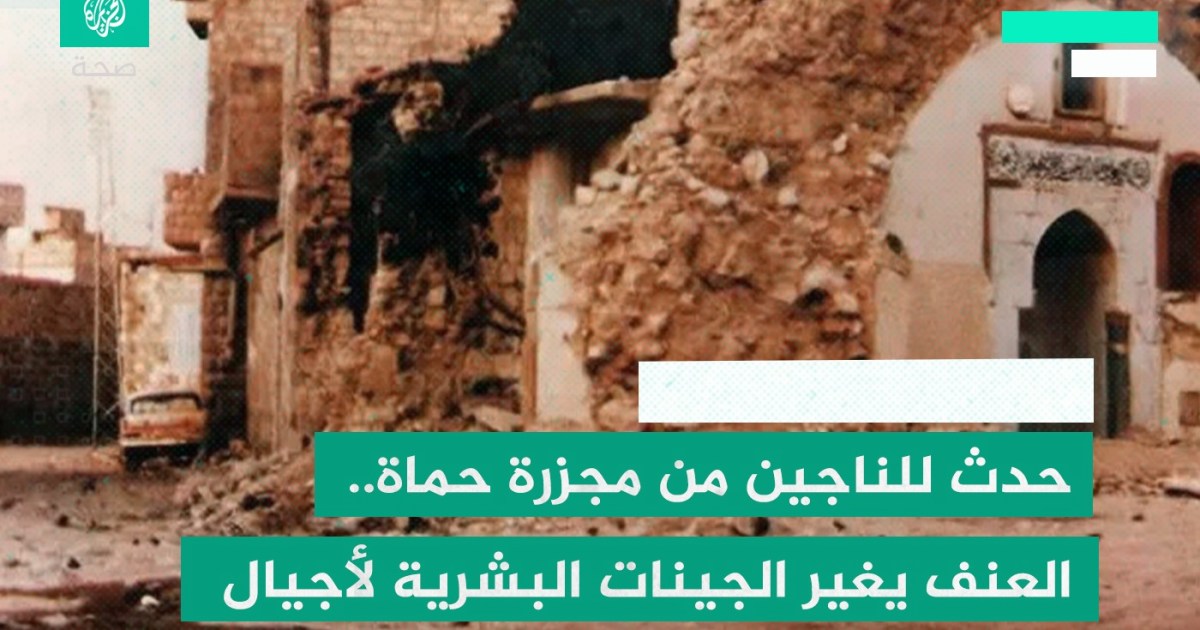
In 1982, the regime of the late Syrian President Hafez al -Assad launched a military operation targeting the Syrian city of Hama, and lasted 27 days, and killed about 40 thousand people and more than 17 thousand missing, while it became known as the “Hama massacre”.
Today, after more than 40 years of the massacre, a new study – the genes of generations of Syrian families examined the Hama massacre before fleeing to Jordan, and other families who lived in the Syrian revolution against the regime of Bashar al -Assad – that the massacre left deep hidden effects in the genes of Syrian families.
It turned out that the descendants of women who were pregnant during the siege of Hama – the grandchildren who have never experienced such violence – carry his signs in their gene. This genetic footprint, which is transmitted through their mothers, provides the first evidence of this phenomenon in humans.
To talk about this study and its results, we hosted at Al -Jazeera clinic, Professor Dr. Rana Al -Dajani, a researcher in genetics at the Hashemite University in Jordan, and the leader who participated in the study.
-
How did the idea of this study come?
The truth is that my mother is from the city of Hama and Aleppo from Syria and my father from Jerusalem from Palestine, and I now live in Jordan and the events that took place in the Hama massacre.
This made me think about the impact of this violence that individuals were exposed to in the city of Hama, and how it affects genes and is it possible for these effects to inherit for future generations and from here the idea of research began, and my question was whether the violence that women were exposed to, especially pregnant women in 1982 in the city of Hama, left traces in their bodies and did they leave traces inheriting for future generations.
Of course, the real research needs a team and one person cannot do it, so I started looking for scholars from different fields in order to cooperate with each other to achieve this matter. And the first thing I called Dr. Catherine Benk Brick from Yale University in the United States, because she specializes in anthropology and in measuring violence, so that we know the extent of violence that women were exposed to. Then I called Dr. Kony Moligan from the University of Florida, who specializes in genetics in order to help us analyze the samples that we take to know the changes that get genes, and the most important thing is that we called Dima Dhatmida, a Syrian researcher from the community itself, and its people in the city of Hama have been subjected to the massacre.
We worked together to find the families that we can take samples from them over 3 generations and we can verify the hypothesis, and thus the team that began to work for 7 or 8 years was completed.
-
What is the importance of study?
The importance of the study lies in several axes, the first of which is the design of the study.
The first group was the families who were subjected to the massacre in Hama and fled outside Syria. The second group was one of those who were part of the revolution and subjected to violence from the Assad government and also fled from Syria. And the third group of those who left Syria in the beginning of the last century and did not suffer any violence and cotton in Jordan.
These were the three groups, and we took samples from the grandmothers who were pregnant at the time of the massacre in 1982, and from the sons and grandchildren, and this formed a system through which we can answer the question.
The second importance of this study is that we know through genetics that if a person is exposed to violence, his genes can be affected, the gene itself does not change, but its control is affected: is it used or not used, and this is called an alpology above genes.
Now we answer the question: Is the pregnant mother affected by violence and changed her genes? Did he inherit it to its grandchildren? The answer to this question is yes in other living creatures. But we could not answer this question in humans. Therefore, the importance of this study arises here, as we were able to answer this question in humans.
We found that the mothers who were pregnant and subjected to violence were affected or changed 21 gina, and changed above the genetic caused by exposure to this violence. This is the first time that is proven in the human race.
The third important thing is that we found that the embryos that were inside the wombs of mothers who were subjected to violence accelerated with them biological aging, and this has to do with the future of these children and their exposure to various diseases such as diabetes or heart disease and others and this was also the first study that proves this acceleration in the aging in the fetuses, and this is evidence of the impact of the fetus in the environment in which the pregnant mother lives.
-
What challenges did you face?
There is no research without challenges.
Second: Earn confidence from these families, because they ask who you are? How do we trust you? Why do you do this work? Why do you take samples from us? The sample is the DNA sample we take from the cheek cells to analyze it. Building confidence and communicating with them was very important.
Another challenge is to find a laboratory that can analyze these samples. Unfortunately in our Arab region, we do not have the laboratories and sufficient financing to do these accurate analyzes. We have not searched for one gene, but we have seen all the genome and all the changes that occurred on this genome in 850 thousand sites.
And we needed a laboratory that could do so and had sufficient financing, and here was the very important partnership to solve this challenge, so the partnership with the University of Florida with Dr. Kony who had the laboratory and she and Dr. Catherine were able to bring funding to pay the price of analyzing these samples properly and obtaining results.
Syrian families who participated in the research are the real heroes of this study
Dr. Rana indicated that social communication, which is part of our customs in our Arab society, made this study possible. She talked about her gratitude to the families who participated in the study. She expressed her hope that the results of the study will reach the participants through the Al -Jazeera platform. She added that, on their part, they prepared a small summary of the participation of all families of the results, and they will be visited to communicate it to them, as they are the heroes of this story.
-
What does this study mean for future generations?
The importance of studying for future generations is that we discovered 14 sites on the genome in which changes occurred, and we do not know what its function is. She indicated that the grandchildren who were not subjected to violence inherited genes that may help them deal with the new environments facing them, and give them options and flexibility to deal with unknown things. This is important because it affects the future policies designed by officials of how to deal with future generations of peoples who have been violent.
-
In light of the Israeli extermination war launched by the occupation on the Gaza Strip, which resulted in more than 50 thousand martyrs and tens of thousands of wounded and missing, do we expect these genetic changes to the residents of Gaza and their children and their grandchildren in the future?
There is a great responsibility for all individuals in the world who witness what is happening now in Palestine, as a scientist must be very accurate, we have discovered these changes among those who have been violent in Syria, and expectations indicate that we may find these changes among the descendants of the Palestinians who were subjected to violence, but unless we drag the experience we cannot be certain.
And they can have new sites (in genes) and the reason is that the violence that people in Palestine were exposed to is not a single event but rather a series of events since 1948. What does it mean to be exposed to continuous violence? This question is now on what is on the genome for the individuals who lived it? And the fetuses in the wombs of their mothers today and the grandchildren who will come in the future?
The truth is that the concern is increasing that the effects will be greater and greater for the descendants of the Palestinians who are now exposed to violence and genocide in Gaza and in the West Bank now.
Our study is very important, and the reason is that we have given the first time an proof that we can measure this effect on genes and if we can measure it, we are documenting it, and if we trust it, we will be able to use it in the future to hold those responsible for this violence accountable.
Here, I would like to note that our people in Syria and in Palestine – who were subjected to violence – have a belief in their cause and a belief against them because they are right and land owners and this is what we call steadfastness, this steadfastness stems from this right, which is what no one has studied, what does this steadfastness mean biologically? Can we measure it? Is it part of the changes that get the genetic material? These are other questions that raise my curiosity, and if we discover the answer, how to employ it in the service of humanity.