

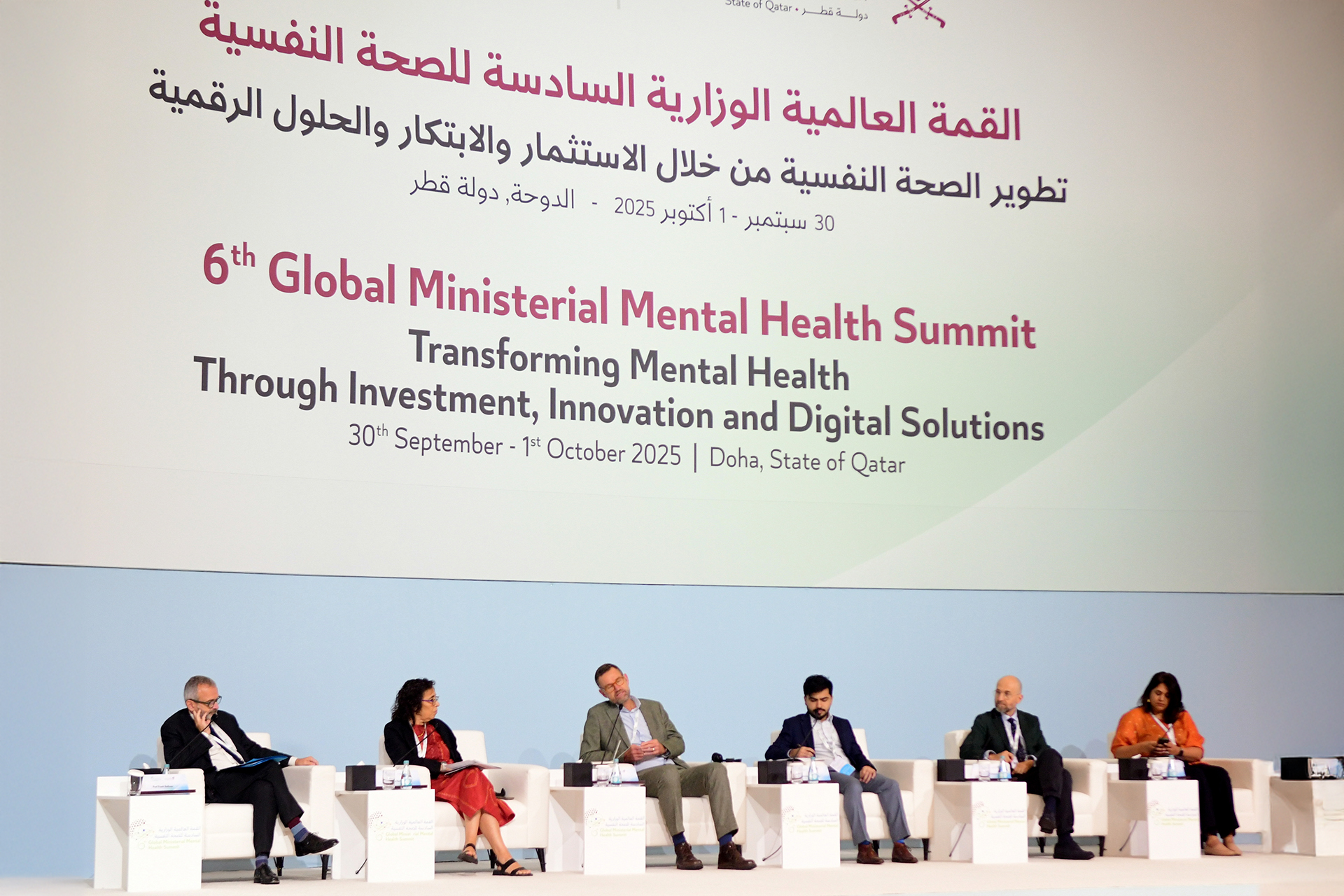
Doha – The Qatari capital, Doha, is hosting an unprecedented global event in the Middle East and Asia, represented by the sixth ministerial global mental health summit, whose work was launched today, Tuesday, under the slogan “promoting mental health sponsorship through investment, innovation and digital solutions.”
This summit, which lasts for two days under the patronage of the Qatari Prime Minister and Minister of Foreign Affairs Sheikh Mohammed bin Abdul Rahman bin Jassim Al Thani, represents a unique platform for exchanging experiences and developing implemented strategies to enhance mental health at the local and international levels.
It also comes at a very important time, as the rates of mental disorders are increasing globally due to the complex overlap between the genetic, social, economic and environmental factors, in addition to the effects of humanitarian crises and conflicts.
From this standpoint, the summit focuses on mental health as an integral part of public health, social justice, and human rights, in line with the United Nations resolutions and international agreements, including the Convention on the Rights of Persons with Disabilities and Decisions of the Human Rights Council on mental health.
The summit also confirms the pivotal role of digital solutions and innovation in developing effective societal psychological care models, and enhancing investment in research and innovation, allowing the exchange of best practices and the development of global strategies that can be implemented.
Increased mental disorders
In his opening speech at the summit, Qatari Minister of Health, Mansour bin Ibrahim Al Mahmoud, stressed that the summit represents an opportunity to work to work to advance mental health all over the world, through a common vision of a more healthy and comprehensive future.
He stressed that psychological disorders are increasing due to the overlapping of genetic, social, economic and environmental factors, and extended humanitarian crises, which requires the development of comprehensive and effective services for mental health as a basic human rights.
He explained that Qatar pays great attention to public health, and puts the welfare of the psychological and physical population at the heart of its policies, in a manner consistent with the Qatar National Vision 2030, which enhances the integration between health, social and development aspects.
The Minister reviewed a set of practical steps taken by Qatar, including the launch of national strategies and frameworks dedicated to enhancing psychological wellness, pointing to Qatar’s adoption of the health approach in all policies, so that mental health is merged in all sectors and society as a whole, while aligning these efforts with the United Nations goals for sustainable development, especially the third goal related to good health and well -being.
The Qatari official’s talk was not limited to the national dimension, but rather linked him to the international dimension, as he stressed that Qatar, by virtue of its active role in bringing in global security and stability, is keen to cooperate with international partners to address crises and mitigate their effects, while giving special priority to the most care categories.
From pledges to implementation
For his part, the Director -General of the World Health Organization, Tedros Adhanum Guerbrisus, stressed that the issues raised at the top table embodying the major challenges facing mental health globally, foremost of which is the investment of digital technology to serve the human being, reduce its negative effects, as well as financing and expanding effective interventions, especially in times of humanitarian crises and disasters.
He pointed out, in a registered speech to the summit, that these issues were also the focus of the high -level meeting of the United Nations on non -transitional diseases and mental health last week, as the countries committed to expanding the scope of mental health care to reach 150 million additional people by 2030, in addition to adopting new measures to combat suicide and protecting mental health for young people.
But the UN official stressed that the biggest challenge now lies in converting these pledges into concrete policies and programs at the national level, stressing that there is no health without psychological health.
Confronting the stigma
In a statement to Al -Jazeera, the Egyptian Minister of Health Khaled Abdel Ghaffar said that the holding of the summit for the first time in the Arab region is a historical event that reflects the increasing awareness of the importance of mental health as an integral part of public health.
He explained that nearly a billion people in the world suffer from psychological disorders, and that the levels of infection ranged between a person from every 5 to a person in 10 according to research, with a wide spread of depression and anxiety as the most common, pointing out that the social stigma is still one of the most prominent obstacles that prevent the request for treatment, which exacerbates individual and societal suffering.
The Egyptian official stressed the importance of introducing mental health within the priorities of national legislation, such as its inclusion in comprehensive health insurance systems, free guarantee of psychotherapy and not making it hostage to financial ability.
He explained that the international community has already begun to adopt these policies, calling for more cooperation in the areas of awareness, education and expansion in therapeutic places to cover different age groups.

Investment and artificial intelligence
At the same time, the Director of the Department of Protective Diseases Programs at the Ministry of Public Health in Qatar, Dr. Muhammad bin Hamad Al Thani, stated that mental disorders represent the first reason for disability from work, and may lead in some cases to addiction or suicide, which makes investment in mental health a strategic priority.
He pointed out, in a statement to Al -Jazeera Net, that most of the ministries of health in the world do not spend more than 2% of their budget on mental health, while the percentage should not be less than 5% at least.
He pointed out that Qatar is moving effectively in this direction, as it aspires to accelerate the pace of investment of modern innovations and technologies, especially artificial intelligence, to develop an advanced psychological care system.
He revealed a project to link the entire state with a unified electronic system that allows early warning mechanisms to reach the patient before his exacerbation, which enhances the opportunities for prevention and early intervention.
Driving services
The head of mental health and a consultant mental illness at the Hamad Medical Corporation, Majid Al -Abdullah, said that the summit discusses the reasons for the social stigma attached to those with mental disorders, and to discuss solutions through possible means, the most important of which is the use of technologies to raise the awareness of societies.
He explained, in a statement to Al -Jazeera, that the summit also discusses how to benefit from what technology provides in facilitating and facilitating access to mental health services, especially since the outbreak of the stigma contributes to keeping a number of those in need of psychological support in the shadow for fear of social stigma.
He explained that the digitization of mental health services will facilitate access, and reduce social stigma and use virtual programs, noting at the same time that mental health services in Qatar have a high privacy and complete confidentiality that gives the patient the freedom not to be named, this is for services provided through the hot lines designated for that unless it requires a prescription.