

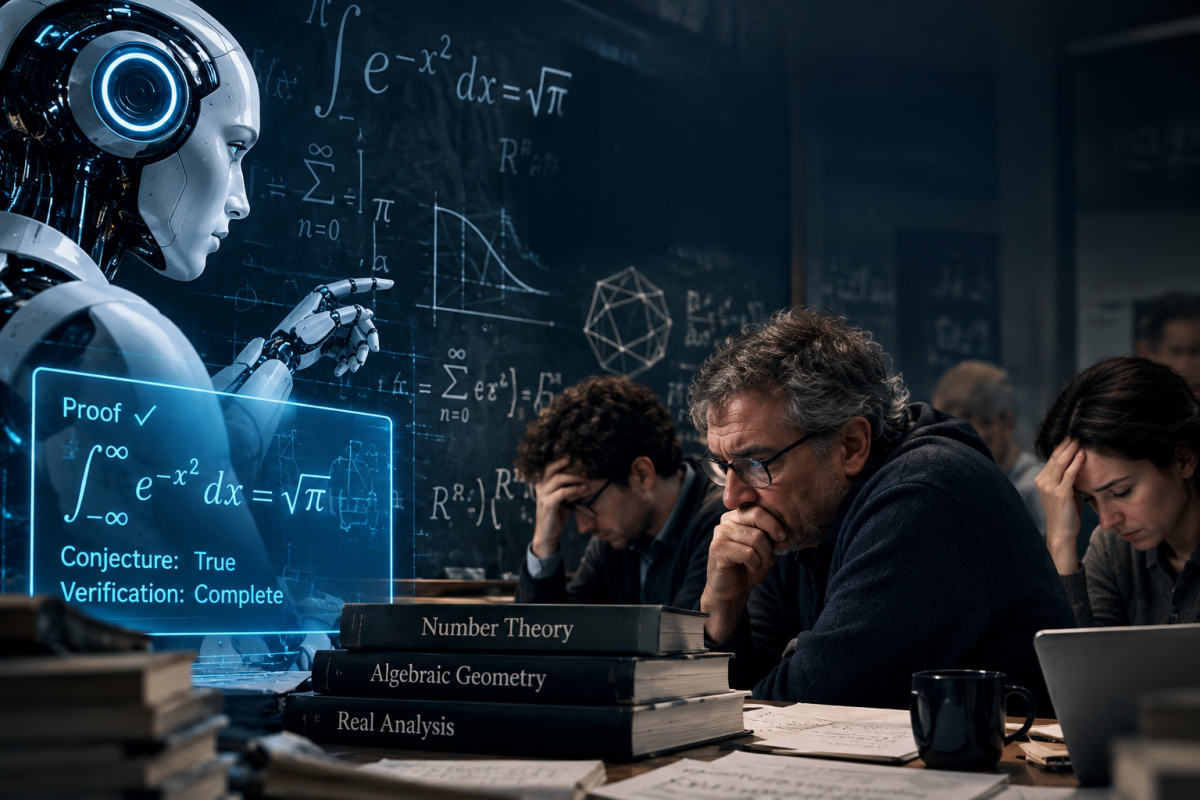
OpenAI caused a sensation in the world of mathematics after its artificial intelligence program succeeded in solving a major mathematical problem that had remained insoluble for a century, in a resounding achievement that raises questions about the role of mathematicians in scientific research.
Terence Tao, winner of the Fields Medal, which is equivalent to the Nobel Prize in Mathematics in 2006, and one of the most influential figures in this field, described this problem by saying, “I was severely disturbed by an existential crisis in my field.”
At the beginning of this September, in just 4 days, an advanced artificial intelligence system from OpenAI succeeded in solving the Navier-Stokes equation, which was finalized in 1845, a problem that generations of mathematicians have grappled with.
Northwestern University mathematics professor Antonio Ovinger recalls that just one year ago, there were “constant hallucinations” in the reasoning processes carried out by artificial intelligence models, even the most advanced ones, adding, “Today, artificial intelligence can formulate long chains of logical arguments” without going off track or launching theories that resemble delirium.
Although researchers have been relying on this technology for a long time, OpenAI’s approach differs in that it gives artificial intelligence the initiative and full control of the process.
Last January, Elon Musk, CEO of Space
Despite his “shock and astonishment,” Northwestern University mathematics professor Benjamin Antioh stresses that OpenAI’s AI system did not start from scratch, but rather “followed in the footsteps of other mathematicians who have been developing this approach to the problem for years.”
What is meant here is mainly two Spanish researchers who also inspired him, Tristan Buckmaster and Levante Albugi. The latter two confirm that they were close to reaching the solution before OpenAI, and wonder whether their work had been subjected to intellectual theft, which the California-based startup denies.
Stanford University professor Muhammad Abu Zaid believes that “this expands the scope of what we can prove, but it does not increase the scope of ideas that we can explore,” adding, “We do not see an innovative leap that would add something new to the science of mathematics.”
Last Friday, 25 recipients of the Fields Medal (the most prestigious award in mathematics) warned of the potential “devastating impact” of artificial intelligence on mathematical research.